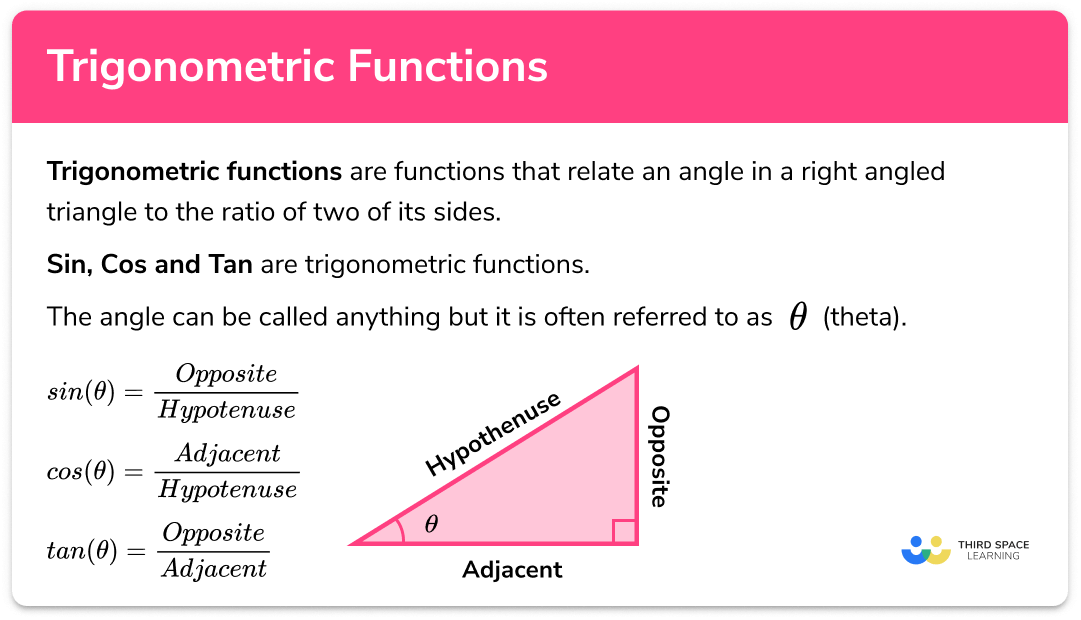
When you're staring down a complicated calculus problem or an engineering equation, trying to remember every single trigonometric formula slows you down. A solid reference sheet cuts through the confusion, letting you substitute, simplify, and solve without second-guessing your algebra.
We'll break down the core relationships you actually need—from fundamental Pythagorean rules to angle sum expansions and double-angle shortcuts—so you can speed up your workflow and avoid common calculation traps.
Core Pythagorean Identities
Every major relationship in trigonometry traces back to the unit circle and right-triangle geometry. The Pythagorean theorem gives us the foundational building blocks that show up in almost every simplification task.
- The Primary Identity: $\sin^2(\theta) + \cos^2(\theta) = 1$
- Tangent-Secant Version: $1 + \tan^2(\theta) = \sec^2(\theta)$
- Cotangent-Cosecant Version: $1 + \cot^2(\theta) = \csc^2(\theta)$
You don't just memorize these to pass a test; you use them to swap out squared terms when integration or factoring gets stuck. For example, if you spot $1 - \cos^2(x)$ inside an integral, you can immediately replace it with $\sin^2(x)$ to make the next step straightforward.
Angle Sum and Difference Formulas
When dealing with non-standard angles or breaking down compound waves, you need formulas that split apart or combine interior angles.
- Sine Sum/Difference: $\sin(A \pm B) = \sin(A)\cos(B) \pm \cos(A)\sin(B)$
- Cosine Sum/Difference: $\cos(A \pm B) = \cos(A)\cos(B) \mp \sin(A)\sin(B)$
- Tangent Sum/Difference: $\tan(A \pm B) = \frac{\tan(A) \pm \tan(B)}{1 \mp \tan(A)\tan(B)}$
Watch out for the sign flips in the cosine formulas—it's one of the easiest places to drop a negative sign. These expressions are widely relied upon in physics when analyzing wave interference patterns or breaking vector forces into horizontal and vertical components. For more details on mathematical standards and curriculum contexts, check out resources from the National Council of Teachers of Mathematics.
Double-Angle and Half-Angle Shortcuts
When an equation or integral features $2\theta$ or $\theta/2$, standard identities won't cut it. Double-angle and half-angle formulas let you scale arguments up or down to match the rest of your expression.
- Double-Angle for Sine: $\sin(2\theta) = 2\sin(\theta)\cos(\theta)$
- Double-Angle for Cosine: $\cos(2\theta) = \cos^2(\theta) - \sin^2(\theta) = 2\cos^2(\theta) - 1 = 1 - 2\sin^2(\theta)$
- Half-Angle Identities:
- $\sin^2(\theta/2) = \frac{1 - \cos(\theta)}{2}$
- $\cos^2(\theta/2) = \frac{1 + \cos(\theta)}{2}$
Half-angle formulas are crucial in calculus when you need to integrate powers of sine or cosine without direct antiderivatives. Lowering the exponent makes the integration step possible.
Symmetry, Even-Odd, and Cofunction Rules
Before diving into complex manipulations, check the symmetry of your functions. Recognizing even and odd properties saves you from messy algebraic expansions.
- Even Functions: $\cos(-\theta) = \cos(\theta)$ and $\sec(-\theta) = \sec(\theta)$
- Odd Functions: $\sin(-\theta) = -\sin(\theta)$, $\tan(-\theta) = -\tan(\theta)$, and $\csc(-\theta) = -\csc(\theta)$
Cofunction identities link complementary angles, which helps when shifting between sine and cosine representations in geometry problems:
- $\sin\left(\frac{\pi}{2} - \theta\right) = \cos(\theta)$
- $\cos\left(\frac{\pi}{2} - \theta\right) = \sin(\theta)$
- $\tan\left(\frac{\pi}{2} - \theta\right) = \cot(\theta)$
Common Mistakes to Avoid
Even experienced students hit roadblocks because of careless algebraic habits. Keep these pitfalls in mind:
- Distributing exponents incorrectly: Remember that $(\sin(\theta) + \cos(\theta))^2$ expands to $\sin^2(\theta) + 2\sin(\theta)\cos(\theta) + \cos^2(\theta)$, which simplifies to $1 + 2\sin(\theta)\cos(\theta)$. It does not equal $\sin^2(\theta) + \cos^2(\theta)$.
- Ignoring domain restrictions: When dividing by $\cos(\theta)$ or $\tan(\theta)$, always note where those functions are undefined (e.g., where the denominator hits zero).
- Forgetting the plus-or-minus sign: When applying half-angle formulas, the correct sign depends entirely on the quadrant where the resulting angle $\theta/2$ lands.
Frequently Asked Questions
How do I know which Pythagorean identity to use?
Look at the powers and terms in your expression. If you see squared trig functions paired with constants like $1$, look to replace them. For instance, seeing $\sec^2(x) - 1$ should instantly trigger thoughts of $\tan^2(x)$.
Why do half-angle formulas have a plus-or-minus sign?
Because taking the square root introduces both positive and negative possibilities. You must check the original quadrant of the angle to determine the correct sign for your specific problem.
Should I memorize every single identity?
Focus heavily on the Pythagorean identities, the sum/difference formulas for sine and cosine, and the double-angle rules. Most other formulas—like product-to-sum or half-angle identities—can be derived quickly from these core foundations if you forget them.


