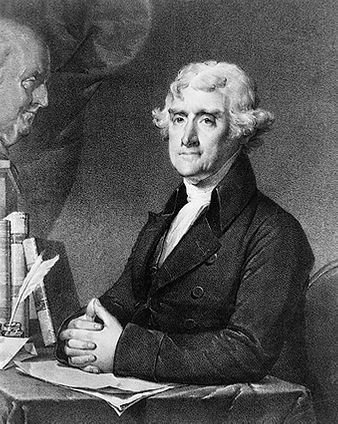
Thomas Jefferson shaped the foundation of the United States as the primary author of the Declaration of Independence, the third president, and a prominent architect of early American political philosophy. His career spanned decades of intense political transformation, bridging the gap between colonial resistance and the establishment of a sovereign republic.
Yet, his historical footprint remains deeply complex. He championed natural rights while simultaneously holding hundreds of human beings in bondage. Understanding his life requires examining both his towering political achievements and the profound contradictions that defined his era.
Early Life and Intellectual Formation
Born in 1743 in Albemarle County, Virginia, Jefferson inherited land and slaves from his father, giving him an elite standing in colonial society. He entered the College of William & Mary at age seventeen, where he immersed himself in mathematics, classical languages, and philosophy.
Following college, he read law under George Wythe, one of the preeminent legal scholars in the American colonies. This rigorous legal training honed his prose style and his analytical approach to governance. In 1769, he won election to the Virginia House of Burgesses, stepping directly into the brewing resistance against British imperial policies. His 1774 publication, A Summary View of the Rights of British America, established his reputation as a formidable intellectual voice for colonial autonomy.
The Declaration and Revolutionary Leadership
When the Second Continental Congress convened in Philadelphia in 1776, delegates appointed Jefferson to draft a formal declaration of independence. Working in a rented room in Philadelphia, he composed a text that argued governments derive their legitimacy from the consent of the governed and protect unalienable rights like life, liberty, and the pursuit of happiness.
During the Revolutionary War itself, Jefferson served two terms as the governor of Virginia. This period proved difficult; British forces invaded the state, forcing the government to flee and exposing vulnerabilities in Virginia's wartime defense infrastructure. Critics later scrutinized his handling of the invasion, prompting Jefferson to retreat temporarily from public office to focus on writing and local reform.
During the 1780s, he served as an American diplomat in France, witnessing the opening stages of the French Revolution. While abroad, he corresponded extensively with James Madison, offering vital feedback on the drafting of the United States Constitution and insisting on the inclusion of a Bill of Rights.
Presidency and the Louisiana Purchase
Jefferson returned to public service as the nation's first secretary of state under George Washington. Disagreements with Alexander Hamilton over fiscal policy and federal power led to the formation of opposing political factions: Jefferson's Democratic-Republicans and Hamilton's Federalists.
After serving as vice president under John Adams, Jefferson won the contentious presidential election of 1800. His administration prioritized agrarian interests, reduced federal spending, and repealed unpopular internal taxes.
His defining executive achievement came in 1803 with the Louisiana Purchase. Desiring secure access to the port of New Orleans, Jefferson authorized negotiators to buy the city from France. Napoleon instead offered the entire territory. The transaction doubled the landmass of the United States for fifteen million dollars, adding roughly 828,000 square miles. Though it contradicted his strict constructionist view of the Constitution—which granted no explicit power to acquire foreign territory—he recognized the strategic necessity of the deal.
To explore the newly acquired western lands, Jefferson dispatched Meriwether Lewis and William Clark on their iconic transcontinental expedition, which mapped routes, recorded indigenous flora and fauna, and established American claims to the Pacific Northwest.
The Contradictions of Slavery
Jefferson's public rhetoric championed universal liberty, but his personal life was anchored in the institution of chattel slavery. He owned Monticello, his plantation estate in Virginia, along with hundreds of enslaved individuals who labored across his properties.
Historical evidence confirms that after the death of his wife Martha, Jefferson fathered multiple children with Sally Hemings, an enslaved woman at Monticello. Despite drafting early legislative proposals to restrict the expansion of slavery in the territories, he freed very few individuals during his lifetime or in his will. This stark gap between his philosophical ideals and his personal actions remains a central focus of modern historical evaluation. Learn more about historical preservation and documentation at the Thomas Jefferson Foundation.
Retirement and Death on the Fourth of July
Jefferson retired from public office in 1809, returning permanently to Monticello. He spent his final decades managing his farms, corresponding with old rivals like John Adams, and pursuing intellectual projects. When the British burned the Library of Congress during the War of 1812, Jefferson sold his personal library of over 6,400 volumes to replenish the national collection. He also founded the University of Virginia, designing its academic curriculum and its iconic neoclassical campus architecture.
Jefferson died on July 4, 1826, exactly fifty years after the adoption of the Declaration of Independence. In a coincidence of history, his former political rival and friend John Adams died hours later. Jefferson left behind explicit instructions for his gravestone, requesting an epitaph that commemorated his intellectual and legislative contributions rather than his presidency: author of the Declaration of American Independence, of the Statute of Virginia for religious freedom, and father of the University of Virginia.
Frequently Asked Questions
What were Thomas Jefferson's primary political beliefs?
Jefferson favored a decentralized government, a strict interpretation of the Constitution, and an agrarian economy composed of independent yeoman farmers. He feared concentrated federal power and believed that public education was essential for preserving a free republic.
How did the Louisiana Purchase impact the United States?
The 1803 purchase doubled the geographical size of the country, secured control of the Mississippi River trade route, and removed French imperial presence from North America, paving the way for westward expansion.
What is Thomas Jefferson's connection to the University of Virginia?
Jefferson conceptualized, designed, and founded the University of Virginia, which opened in 1825. He broke with traditional collegiate models by centering the curriculum on secular learning, modern languages, and sciences rather than theology.
Did Thomas Jefferson free his slaves?
No. Jefferson freed only a small number of enslaved individuals during his lifetime and five in his final will. The vast majority of the enslaved population at Monticello was sold or distributed among heirs after his death to settle his mounting debts.