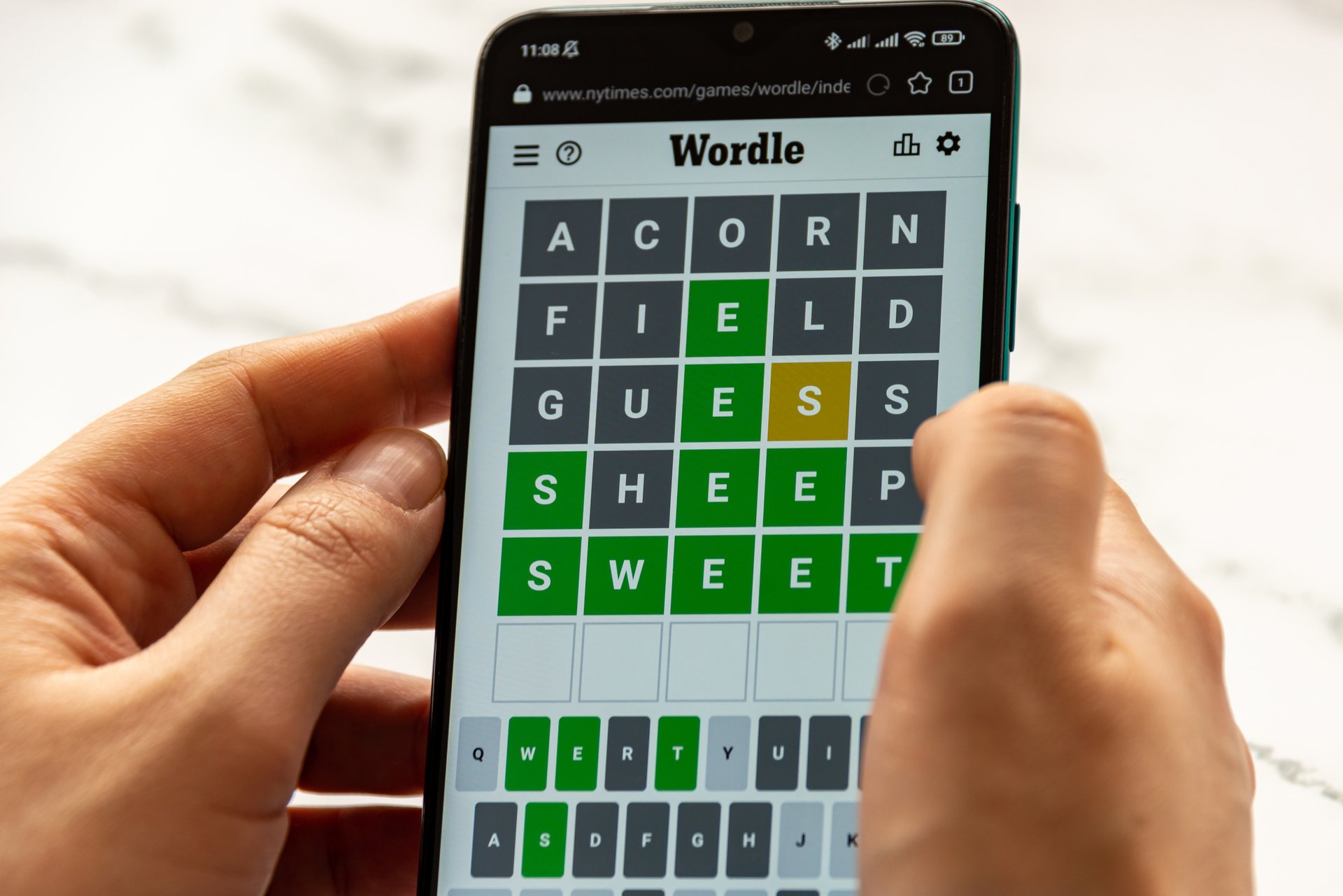
A single green, yellow, and gray square grid took over group chats, timelines, and office Slack channels almost overnight. Wordle didn't rely on flashy graphics, microtransactions, or notifications begging you to return. Instead, it offered a single daily puzzle shared by everyone on Earth at the same time. Created by software engineer Josh Wardle as a quiet gift for his partner, the game quickly exploded beyond its humble origins. When the New York Times acquired it in early 2022, it cemented its place as a defining piece of modern digital culture.
The mechanics were deceptively simple. You had six guesses to find a single five-letter word. Every guess returned color-coded tiles showing which letters were correct, misplaced, or entirely absent. This design avoided the exhausting burnout loops typical of mobile apps. By limiting players to one puzzle per day, Wordle manufactured a rare commodity online: digital scarcity. People couldn't binge the game even if they wanted to. That constraint turned a private brain teaser into a synchronized public ritual, creating an internet phenomenon that media outlets like Mashable tracked closely as it reshaped online habits.
The Architecture of Viral Design
Most modern web products fight aggressively for attention. They use endless feeds, push notifications, and variable reward schedules modeled on slot machines. Wordle did the exact opposite. It stripped away accounts, tracking cookies, and flashing banners. You opened a clean web page, typed your letters, and closed it.
This minimalism created trust. Users didn't feel exploited. Furthermore, the game engineered social sharing brilliantly. When you finished a puzzle, the site generated a grid of colored emoji boxes that hid the actual letters while broadcasting your score. Posting these grids on social media became a subtle form of digital signaling. It said: I woke up, used my brain, and solved today's puzzle.
- Daily limitation: One puzzle per day kept demand high and prevented fatigue.
- Equal footing: Every player globally solved the exact same word on any given day.
- Spoiler-free sharing: Abstract emoji matrices let users brag without ruining the answer for others.
The New York Times Acquisition and Strategy
As millions flooded the original website, media companies noticed. In January 2022, the New York Times bought the game for an undisclosed low-seven-figure sum. Purists panicked, fearing paywalls, tracking software, and ads. While the newspaper eventually integrated the game into its growing digital subscription ecosystem, the core experience remained free for a long time.
The acquisition wasn't just about a word puzzle. It was a masterclass in user acquisition. Millions of players who never read the paper's news articles suddenly visited the domain daily. Many of those visitors stayed to sample Spelling Bee, Connections, or the Mini Crossword. Wordle became the anchor tenant for an entire casual gaming vertical that now drives substantial subscriber retention for the publisher.
Psychological Triggers Behind the Craze
Why did millions care about guessing a five-letter word before breakfast? Psychologists pointed to several overlapping hooks. First, the Zeigarnik effect kept unfinished or active challenges lingering in the back of players' minds. Second, the shared global experience forged artificial community during a time when many people still felt isolated.
When your coworker in London and your cousin in Seattle solved the same difficult word in four tries, you shared an instant conversational anchor. It mirrored watercooler talk from the golden age of broadcast television, but adapted for a fractured, multi-platform internet. People didn't just want to solve the puzzle; they wanted to participate in the conversation surrounding it.
Fan-Made Spin-Offs and the Ecosystem
The explosion of interest spawned an entire ecosystem of clones and variants. Developers built alternative versions that pushed the core concept in new directions. Some apps forced players to guess four or eight words simultaneously. Others turned the concept into a music trivia challenge or a competitive multiplayer battle royale.
While some clones faded after copyright complaints or shifting platform rules, they proved how modular the core mechanic was. The five-letter grid format proved as adaptable as chess or checkers, serving as a blank canvas for independent creators looking to capture lightning in a bottle.
Common Misconceptions About Wordle's Rise
Many casual observers assumed corporate backing fueled the initial explosion. In reality, the game grew entirely through organic word-of-mouth and Twitter sharing. Josh Wardle didn't spend a dollar on user acquisition or marketing.
Another frequent myth is that the game's dictionary is dynamically generated by an algorithm parsing the entire English language. In truth, Wardle curated the initial list of solution words by hand, separating common words from obscure jargon to keep the game satisfying rather than frustrating. The New York Times later refined this editorial curation process, occasionally swapping out words that felt too obscure or culturally insensitive.
Frequently Asked Questions
Who originally created Wordle?
Josh Wardle, a software engineer, built the game as a personal project for his partner, who loved word games. He released it to the public after friends and family became obsessed with it.
Why did the New York Times buy it?
The acquisition aimed to drive daily digital traffic and convert casual puzzle players into paying subscribers for the publisher's broader digital games and news offerings.
Is Wordle still free to play?
Yes, the core daily puzzle remains accessible on the web and through the official mobile application, though certain historical archives require a subscription.
What makes a good starting word?
Experienced players usually pick words containing common vowels like E and A, alongside frequent consonants like S, T, R, and N, to eliminate major variables quickly.



