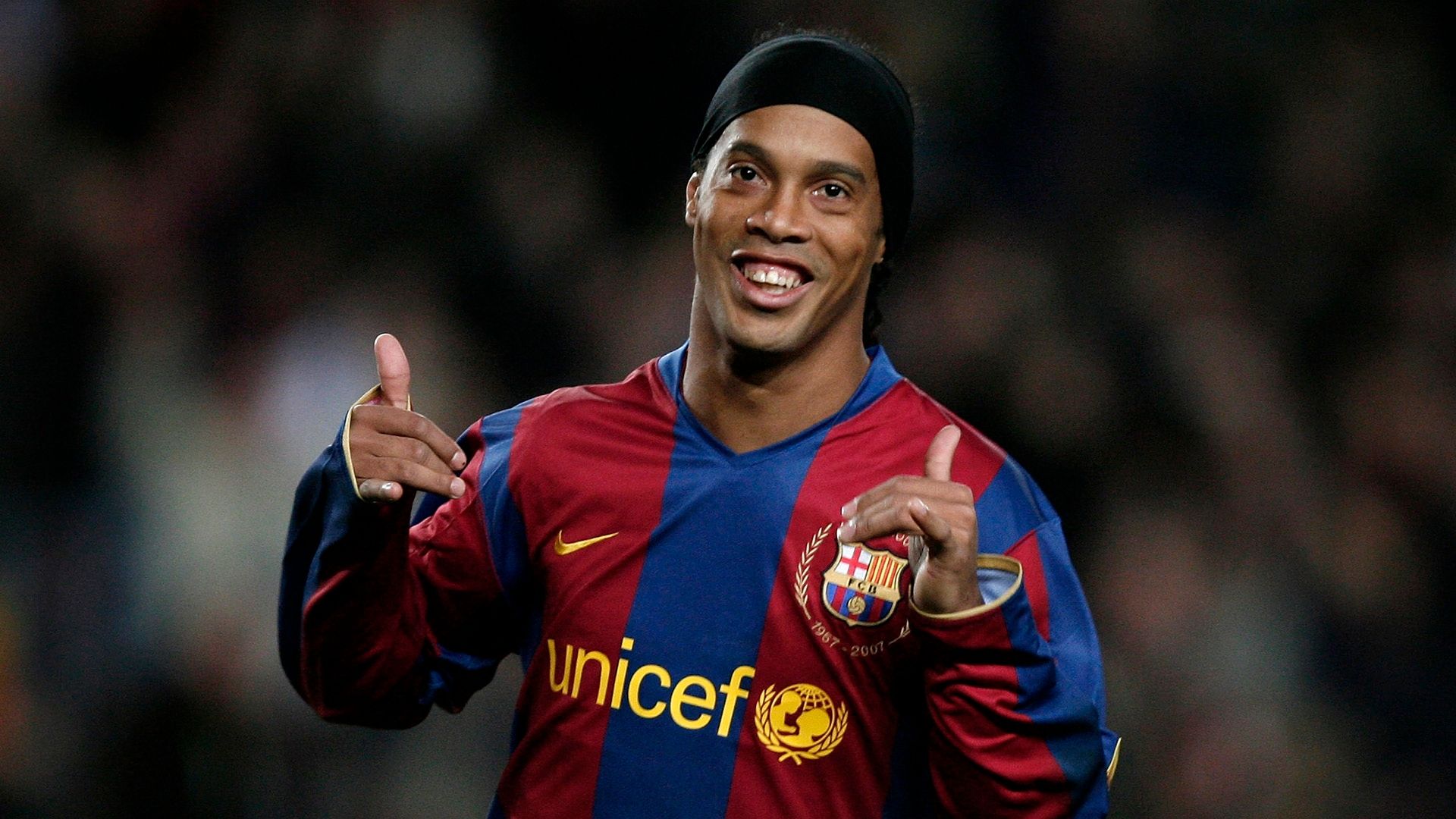
Decoding the Physical Profile of a Legend
When Ronaldinho Gaucho dominated European and international football through the mid-2000s, elite sports science was rapidly pivoting toward hyper-conditioned athletes. The modern game demanded tall, heavily armored frames capable of absorbing high-velocity collisions. Standing at 5 feet 8 inches and weighing roughly 161 pounds, Ronaldinho flatly rejected this template. Instead of relying on raw vertical reach or brute muscular mass, he weaponized a low center of gravity and dense fast-twitch musculature to rewrite the rules of spatial dominance on the pitch.
Understanding his physical makeup requires looking past casual observations about his flair. His physical architecture—short levers, pronounced lower-body stabilization, and exceptional eccentric knee-flexion strength—formed a biological engine built specifically for rapid deceleration and multidirectional acceleration. To outrank surface-level analyses, we must break down the exact biomechanical advantages, training implications, and physiological realities that allowed a compact frame to conquer the sport's most physical eras.
Biomechanics of the Compact Frame
Every movement in elite football boils down to force production, kinetic friction, and spatial control. Ronaldinho's stature gave him inherent mathematical advantages in these areas.
Moment of Inertia and Rotational Speed
In physics, the moment of inertia dictates how difficult it is to rotate an object around an axis. Because Ronaldinho possessed shorter limbs relative to taller players like Peter Crouch or Thierry Henry, his mass was distributed closer to his rotational axis. This reduced his rotational inertia.
When executing rapid cuts, step-overs, or the signature elastico (flip-flap), his body could pivot around his center of mass much faster than a taller player's frame could manage. Less time spent turning meant defenders had zero window to anticipate his change of direction.
Center of Gravity and Ground Reaction Force
A lower center of gravity alters how an athlete interacts with the turf. When planting a foot to push off or shield the ball, Ronaldinho's downward vector of force stayed close to the ground.
- Base of Stability: A compact frame allows for wider relative stance angles during dribbling.
- Force Vectoring: He could apply horizontal force into the grass at sharper angles without losing traction or slipping.
- Contact Resilience: Despite his lighter weight, his low posture meant defenders trying to shoulder-charge him had to hit a target positioned close to the ground, often resulting in the defender over-extending and bouncing off balance.
According to research from Sports Medicine on Agility Performance, athletes with lower stature consistently exhibit superior rapid-change-of-direction performance due to minimized limb repositioning time. Ronaldinho maximized this physiological trait to perfection.
The Myth of the Untrained Athlete
A persistent misconception during Ronaldinho's peak at Barcelona and AC Milan was that his magic was purely innate—that he possessed God-given touch with zero physical discipline. In reality, his movement patterns required extraordinary neuromuscular coordination and specific conditioning.
His training relied heavily on functional agility, short-burst plyometrics, and core stability rather than heavy bodybuilding routines. While modern wingers often look like sprinters, Ronaldinho’s conditioning targeted the phosphagen energy system—the system responsible for maximal-effort bursts lasting between zero and ten seconds.
His explosive acceleration over the first five yards relied on high-threshold motor units firing instantly into his calves, hamstrings, and glutes. He didn't need to run at top speed for forty yards because his entire game was built on destroying opponents within a three-yard box. By stopping dead and exploding into space, he created separation that sustained speed alone could never buy.
Comparing Athletic Blueprints: Power vs. Agility
To understand how Ronaldinho's physique differed from conventional modern athletes, consider two contrasting physical paradigms in professional football:
- The Power-Endurance Model (e.g., Cristiano Ronaldo): Taller (approx. 6'2"), high absolute strength, dominant in the air, optimized for long linear sprints, aerial duels, and sustained athletic output across 90 minutes.
- The Low-Center Agility Model (e.g., Ronaldinho): Compact (approx. 5'8"), high relative strength, optimized for multi-planar movement, instantaneous braking, tight-space manipulation, and low-inertia changes of direction.
While the power-endurance model dominates modern goalscoring charts due to tactical shifts toward high-pressing systems, the agility model remains unmatched in pure creative output and tight-space evasion.
Common Mistakes When Analyzing Player Physiques
Analysts and amateur players often misinterpret what makes a footballer physically elite. Avoiding these analytical traps helps clarify how modern players can apply these lessons:
- Equating Bulk with Strength: Many young players assume adding upper-body mass improves shielding. In football, core and lower-limb relative strength matter infinitely more than bench press numbers.
- Ignoring Deceleration: Fans focus on top speed, but matches are decided by who stops fastest. Braking forces can exceed several times body weight; mastering eccentric leg strength is what actually prevents defenders from tackling you.
- Chasing Generic Workouts: Replicating a bodybuilder's routine ruins a football player's elasticity. Agility requires explosive, reactive plyometrics, not slow, hypertrophic lifts.
Frequently Asked Questions
How tall and heavy was Ronaldinho during his peak?
Ronaldinho stood at approximately 5 feet 8 inches (1.73 meters) and weighed around 161 pounds (73 kilograms) during his peak years with FC Barcelona.
Why does a lower center of gravity help in football dribbling?
A lower center of gravity reduces rotational inertia and keeps the body's mass closer to the supporting foot. This allows for faster weight transfers, quicker changes of direction, and better balance when opponents attempt physical tackles.
Can modern players replicate Ronaldinho's style with a taller frame?
Taller players like Neymar or Jamal Musiala incorporate elements of low-center agility by utilizing low-knee-bend running styles, but extreme height naturally increases rotational inertia, making identical micro-movements more mechanically difficult.
What kind of physical conditioning did Ronaldinho use?
His conditioning favored short-burst acceleration, multidirectional plyometrics, and core stability over heavy linear weight training, preserving his natural flexibility and fast-twitch responsiveness.
For further reading on how athletic profiles influence match performance, consult the FIFA Training Centre Insights.


.jpg)
