Understanding the Fibonacci Problem and Sequence
The Fibonacci sequence starts with zero and one, followed by one, and continues by adding the two preceding numbers together. This yields 0, 1, 1, 2, 3, 5, 8, 13, 21, and so on, stretching infinitely. The Fibonacci problem centers on whether these numbers represent a fundamental blueprint of the universe or simply a human tendency to find order in random data.
While mathematicians study these numbers for their elegant recursive properties, popular culture often wraps the sequence in mysticism. You'll hear claims that every flower petal, spiral galaxy, and historic piece of architecture obeys this exact numerical progression. Reality is more nuanced. While the sequence appears frequently in botany and growth models, it's not a universal law that governs every natural phenomenon. Recognizing where the math actually holds up helps separate genuine scientific observation from romanticized exaggeration.
History of the Sequence and Leonardo of Pisa
Leonardo of Pisa, known historically as Fibonacci, introduced the sequence to Western European mathematics in his 1202 book Liber Abaci. Born around 1170, Fibonacci worked alongside his diplomat father in North Africa, where he learned Hindu-Arabic numerals. He realized these numerals—using digits zero through nine and a place value system—far outperformed cumbersome Roman numerals for trade and calculation.
The sequence itself appears as a mathematical puzzle within Liber Abaci. Fibonacci posed a practical problem about rabbit breeding: how many pairs of rabbits will be born in a year, starting from a single pair, under specific growth rules.
- Month zero: One newborn pair.
- Month one: Still one pair, which matures.
- Month two: The first pair gives birth to a second pair, leaving two pairs.
- Month three: The original pair produces another pair, totaling three pairs.
Fibonacci didn't claim he discovered a hidden code of nature. He presented a neat arithmetic exercise designed to show merchants the power of Hindu-Arabic calculation. Centuries later, mathematicians like Johannes Kepler and Édouard Lucas studied the sequence further, eventually naming it after Fibonacci in the nineteenth century.
The Mathematical Mechanics Behind the Sequence
At its core, the sequence relies on a simple linear recurrence relation. Each term, denoted as $F_n$, depends directly on the two terms that come before it.
$$F_n = F_{n-1} + F_{n-2}$$
Starting with initial conditions $F_0 = 0$ and $F_1 = 1$, the values grow rapidly. By the time you reach the twentieth term, the number climbs to 6,765.
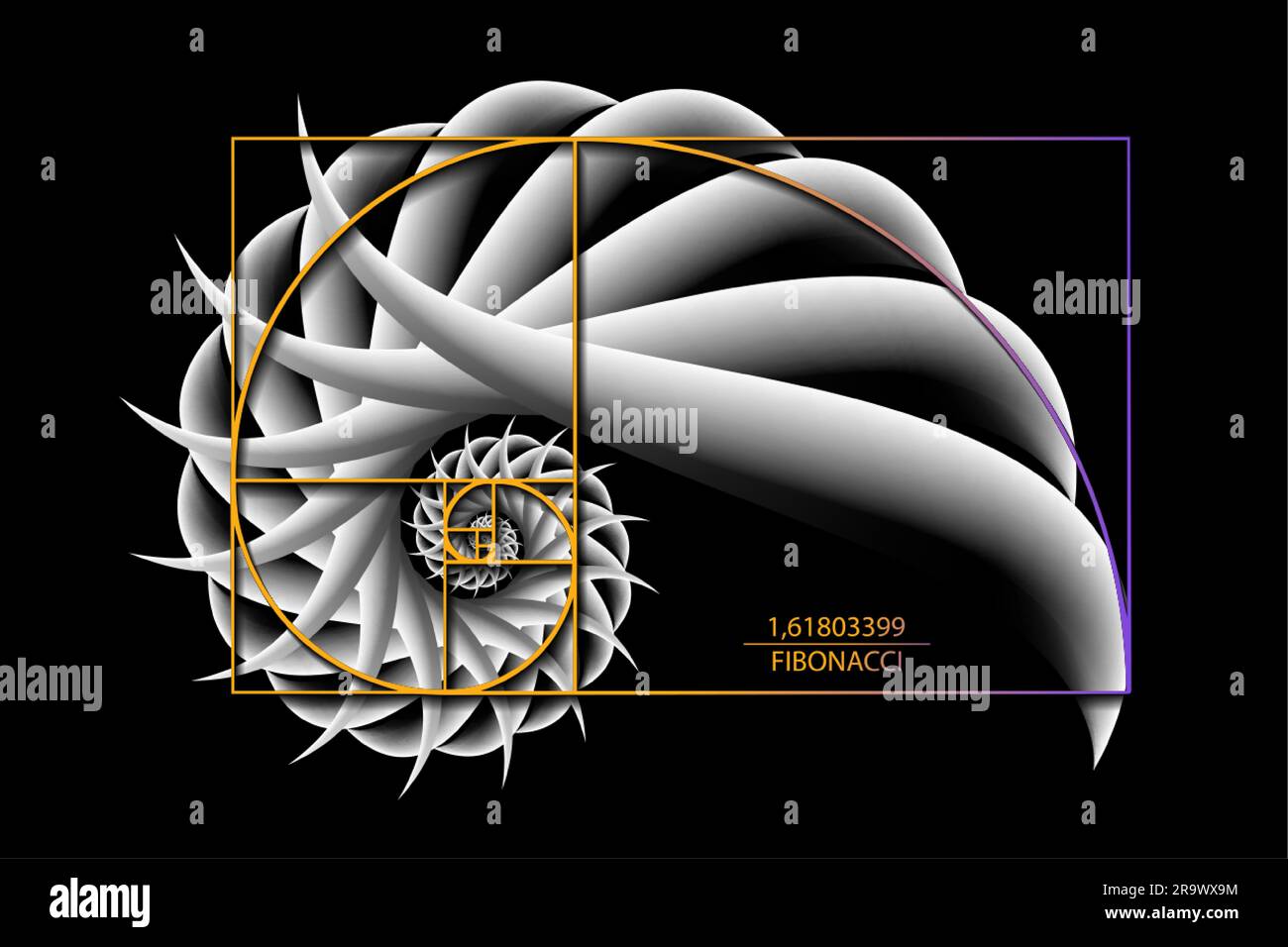
A fascinating property emerges when you divide any Fibonacci number by the one immediately preceding it. As you move further down the sequence, this ratio approaches a constant value known as the golden ratio, approximately 1.61803398875. This constant, often represented by the Greek letter phi, appears in geometry, art theory, and plant growth mechanics.
You don't need advanced calculus to test this. Take 8 and 13. Divide 13 by 8, and you get 1.625. Move higher to 55 and 89. Divide 89 by 55, and you get 1.61818. The larger the numbers get, the closer the ratio crawls toward phi. This mathematical bridge connects discrete integer addition with continuous geometric proportions.
Where the Sequence Actually Appears in Nature
Nature showcases mathematical patterns through physical growth constraints rather than magical design. When organisms grow by adding new cells in spiral arrangements, the Fibonacci sequence naturally emerges as an efficient spatial solution.
Phyllotaxis in Botany
Phyllotaxis describes the arrangement of leaves on a plant stem, or the packing of seeds in a flower head. Plants arrange leaves to maximize sunlight exposure and catch falling rain. By rotating each new leaf or floret by a specific angle—often related to the golden ratio—plants avoid shading lower leaves.
Sunflowers, pinecones, and pineapples display intersecting spirals running clockwise and counterclockwise. If you count these spiral rows, you'll frequently find adjacent Fibonacci numbers, such as 34 and 55, or 55 and 89. This packing efficiency maximizes seed density without wasting space.
Animal Shells and Growth Spirals
Many people assume nautilus shells grow according to the Fibonacci sequence. They don't. A nautilus shell forms a logarithmic spiral, which maintains a constant expansion angle as it grows. While some logarithmic spirals approximate the golden ratio, biological growth varies based on nutrition, environment, and genetics.
Similarly, animal horn growth and hurricane cloud formations follow logarithmic physics rather than strict integer sequences. Conflating logarithmic spirals with the Fibonacci sequence is a common oversight in popular science writing.
Common Misconceptions and Human Over-Patterning
Humans possess an evolutionary drive to find patterns. Recognizing shapes and sequences helped our ancestors track predators, predict weather shifts, and navigate terrain. This cognitive bias, known as apophenia, makes us eager to see order even where none exists.
- The Parthenon Myth: Popular guides claim the ancient Greek Parthenon fits the golden ratio perfectly. Architectural historians point out that measurements vary wildly depending on which parts of the ruined structure you measure.
- Financial Markets: Some traders use Fibonacci retracement levels to predict stock market corrections. Financial analysts view this as a form of technical self-fulfilling prophecy rather than a natural law of economics.
- Human Anatomy: While body proportions show approximate ratios, claiming that human joints or facial features align with exact Fibonacci numbers ignores natural biological variation.
When we project the sequence onto every historical painting or musical composition, we often engage in cherry-picking. We highlight measurements that fit the theory and ignore the ones that don't.
Frequently Asked Questions
What is the difference between the Fibonacci sequence and the golden ratio?
The Fibonacci sequence is a discrete list of whole numbers where each term is the sum of the previous two. The golden ratio is an irrational number approximately equal to 1.618. The connection is that ratios of consecutive Fibonacci numbers approach the golden ratio as the sequence progresses.
Do all sunflowers have Fibonacci number spirals?
Most healthy sunflowers exhibit spiral counts that correspond to Fibonacci numbers, as this provides optimal packing efficiency for seeds. However, stressed plants, mutations, or damaged flower heads can produce irregular patterns.
Did Fibonacci discover the sequence independently?
No. Indian mathematicians including Gopala and Hemachandra discussed similar numerical patterns centuries before Fibonacci published Liber Abaci. Fibonacci introduced the sequence to Europe through his rabbit population puzzle.
Why do plants follow these mathematical patterns?
Plants don't consciously calculate math. Instead, evolutionary pressure favors physical growth angles that maximize access to sunlight, air, and space. The mathematics describes the resulting physical efficiency rather than an active blueprint guiding the plant.
Learn more about mathematical sequences and their history at Encyclopædia Britannica. For deeper explorations into plant growth geometry, review resources provided by Kew Gardens.


