Planets don't move in circles. For centuries, astronomers tried to force planetary observations into perfect circular orbits, running into endless geometric dead ends. The breakthrough came when Johannes Kepler proved that planetary paths are ellipses. This mathematical shape doesn't just dictate how worlds travel around stars. It also shapes Earth's climate cycles and governs large-scale geological structures deep beneath the crust.
Understanding the ellipse in Earth science bridges abstract geometry with physical reality. From the Milankovitch cycles driving ice ages to the strain ellipses used by structural geologists to measure rock deformation, this geometric curve is a fundamental building block of planetary science.
The Geometry of an Ellipse in Planetary Motion
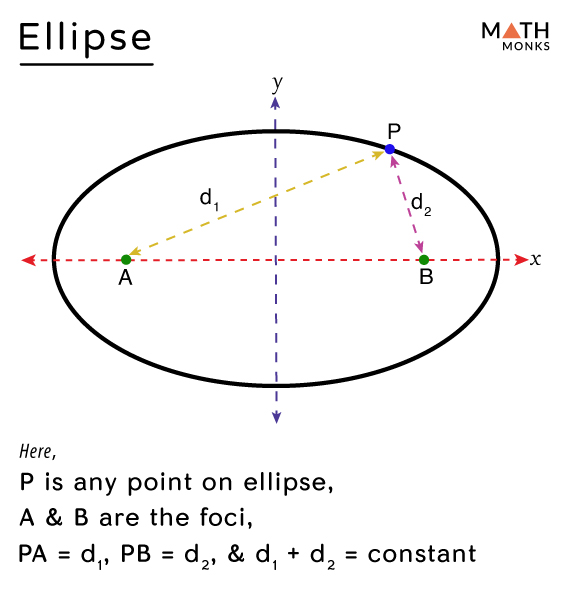
An ellipse is a symmetrical closed curve where the sum of the distances from any point on the curve to two fixed points, called foci, is constant. In orbital mechanics, the Sun sits at one focus of a planet's elliptical path, while the other focus is empty space.
Two critical metrics define any ellipse:
- Eccentricity ($e$): A measure of how stretched out the ellipse is. An eccentricity of zero is a perfect circle. As $e$ approaches one, the ellipse becomes long and narrow. Earth's orbital eccentricity is currently about $0.0167$, meaning it's nearly circular, but it fluctuates over long time spans due to gravitational tugs from Jupiter and Saturn.
- Semi-major axis ($a$): The longest radius of the ellipse, representing the average distance from the orbiting body to the central focus.
Before Kepler's First Law revolutionized astronomy, scientists believed heavenly bodies moved in divine, perfect circles. The mismatch between circular models and actual night-sky observations caused massive headaches. By swapping circles for ellipses, orbital calculations finally matched reality. You can read more about how these principles are applied in orbital dynamics through NASA's Solar System Exploration.
How Orbital Ellipses Drive Earth's Climate Cycles
Earth's orbit isn't fixed. It stretches and relaxes in a predictable rhythm lasting roughly 100,000 years, a core component of the Milankovitch cycles.
When Earth's orbital eccentricity reaches its maximum of about $0.058$, the difference in solar radiation between the closest point to the Sun (perihelion) and the farthest point (aphelion) grows significantly. Right now, Earth is closest to the Sun in January, which makes northern winters slightly milder than they would be otherwise.
Changes in orbital shape don't change total solar energy by much, but they shift the timing and intensity of seasons. When the ellipse is more pronounced, seasonal contrasts sharpen in one hemisphere while muting in the other, triggering the feedback loops that build and melt continental ice sheets.
Elliptical Structures in Structural Geology
While astronomy looks at ellipses in the sky, geology looks at them deep in the Earth. Rock layers rarely stay flat. Tectonic forces squeeze, stretch, and shear rock masses over millions of years, turning once-uniform shapes into distorted geometric figures.
Strain Ellipses and Rock Deformation
Geologists use the concept of the strain ellipse to visualize how rocks deform under stress. Imagine an imaginary, perfectly round sphere of rock deep in the crust. When tectonic plates collide, that sphere doesn't stay round. It flattens and stretches into an ellipse.
By measuring deformed fossils, pebbles, or mineral grains within a rock outcrop, structural geologists calculate the principal axes of the strain ellipse. This tells them:
- The direction of maximum compressive stress.
- The amount of crustal shortening or lengthening that occurred.
- The type of ductile shear acting on the region.
Map-View Geological Structures
On a broader scale, geological mapping reveals elliptical outcrop patterns across landscapes. When tectonic forces warp flat sedimentary layers upward into a dome or downward into a basin, erosion wears away the top layers.
If the uplifted dome has a circular base, erosion creates concentric rings. But if the tectonic compression acts unevenly from two sides, the fold axis lengthens, forming an elliptical dome or an elliptical basin. Geologists studying oil reservoirs, groundwater basins, and mineral deposits rely heavily on these surface elliptical patterns to map subsurface geology. Learn more about regional tectonic mapping standards through the USGS National Cooperative Geologic Mapping Program.
Common Misconceptions About Orbital and Geological Ellipses
It's easy to misunderstand how ellipses function in planetary and geological contexts. Here are a few common pitfalls:
- Mistake: Assuming extreme orbital eccentricity causes seasons.
- Reality: Earth's seasons are driven by axial tilt, not its elliptical distance from the Sun. In fact, Earth is closest to the Sun in January during the Northern Hemisphere winter.
- Mistake: Believing geological strain ellipses represent physical objects trapped in rock.
- Reality: The strain ellipse is a mathematical model used by scientists to quantify deformation, not a physical bubble inside the rock.
- Mistake: Treating planetary eccentricity as a constant value.
- Reality: Gravitational interactions with other planets constantly alter Earth's orbital shape over tens of thousands of years.
Frequently Asked Questions
Why did early astronomers struggle with elliptical orbits?
Ancient philosophers and astronomers favored circles because they viewed them as the most "perfect" and divine geometric shape. Because data didn't quite fit circular paths, they added complex mathematical loops called epicycles rather than abandoning the circle.
What happens to Earth's climate when its orbit is most circular?
When orbital eccentricity is near its minimum, seasonal temperature extremes driven by distance variations are minimized, stabilizing ice sheet growth and altering global glacial cycles.
How do geologists measure strain ellipses in the field?
Geologists analyze deformed markers called strain markers—such as distorted conglomerate pebbles, ooids in limestone, or fossil shells—comparing their deformed shapes to their original spherical or symmetrical forms.
Are all planetary orbits equally elliptical?
No. While Earth and Venus have very low eccentricities and follow nearly circular paths, planets like Mercury and many extrasolar planets possess highly eccentric, stretched-out elliptical orbits.


