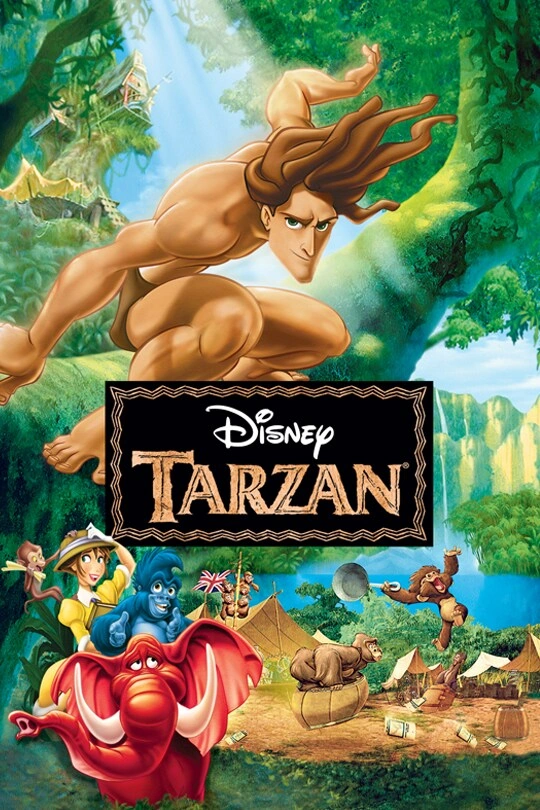
When Disney released its animated adaptation of Edgar Rice Burroughs' classic story in 1999, it marked the grand finale of the Disney Renaissance era. Beyond the groundbreaking Deep Canvas animation technique and Phil Collins' iconic soundtrack, the film's success relied heavily on a stellar cast. The tarzan movie voice actors brought profound emotional weight, comedic timing, and raw intensity to characters navigating the fine line between human civilization and the jungle.
Bringing animals and jungle-raised humans to life requires more than just reading lines into a microphone. The 1999 Disney masterpiece relied on theater veterans, comedic powerhouses, and dramatic actors who grounded fantastical elements in authentic human emotion. Let's examine the primary voice talent behind the characters, the audition processes that shaped them, and the production choices that defined a cinematic classic.
Tony Goldwyn and the Evolution of Adult Tarzan
Securing the voice for the adult protagonist was one of the production's toughest hurdles. Co-director Kevin Lima needed someone who could project both physical vulnerability and commanding strength without relying on excessive dialogue, since the character spends a significant portion of the runtime communicating through body language and vocal grunts.
Tony Goldwyn, known largely for playing intense dramatic roles and antagonists, won the part. Producers noticed an underlying raw intensity in his audition, coupled with surprising animalistic vocalizations that fit a man raised by gorillas. Goldwyn didn't just speak lines; he worked closely with animator Glen Keane to match vocal cadence to physical movement, ensuring the character felt wild yet deeply articulate when discovering his human heritage.
Interestingly, the famous, window-shaking Tarzan yell wasn't entirely Goldwyn's creation. Veteran actor Brian Blessed (who also voiced the villain Clayton) and professional vocal performer Scott Record both contributed to the iconic jungle roar, blending multiple vocal textures to achieve a sound that felt mythic and animalistic.
Minnie Driver as Jane Porter
Jane Porter stands out as one of Disney's most expressive and eccentric heroines. Minnie Driver injected a frantic, brilliant, and comedic energy into the role, transforming Jane from a standard damsel into a passionate anthropologist who matches Tarzan's curiosity.
Driver's performance featured a high degree of improvisation. During the scene where Jane describes her first encounter with Tarzan to her father and Clayton, Driver ad-libbed much of her dialogue and physical descriptions. Animator Ken Duncan took that unscripted vocal track and built one of the longest continuous animated sequences in Disney history around it. It took seven weeks to hand-draw, proving how deeply the voice actor's performance drove the visual art.
Glenn Close and Lance Henriksen: The Gorilla Family Core
The emotional anchor of the film rests on the shoulders of Kala and Kerchak. Glenn Close brought immense warmth and maternal gravity to Kala, the gorilla who adopts the human orphan after losing her own biological infant to the leopard Sabor. Close's delivery balanced fierce protection with gentle vulnerability, making the cross-species bond completely believable.
Opposite her, Lance Henriksen voiced Kerchak, the stoic silverback leader. Henriksen brought a gravelly, authoritative tone that communicated deep-seated trauma and rigid adherence to troop survival rules. Kerchak isn't a simple villain; he's a protective father figure struggling to accept an outsider. Henriksen's performance ensures that when Kerchak finally accepts Tarzan near the end of the film, the emotional payoff hits with maximum impact.
Rosie O'Donnell and Wayne Knight: The Comic Relief
No Disney adventure of this era is complete without a dynamic duo of comedic sidekicks. Rosie O'Donnell voiced Terk, Tarzan's wisecracking gorilla best friend, while Wayne Knight voiced Tantor, the neurotically paranoid elephant.
Terk was originally written as a male gorilla. However, after Rosie O'Donnell delivered an aggressively funny audition, directors shifted Terk into a female cousin dynamic, which added a unique sibling-like bickering to her relationship with Tarzan. Before O'Donnell locked down the part, rock musician Chris Rock was briefly considered for the role.
Wayne Knight brought his signature fast-talking, anxious energy to Tantor. Interestingly, comedy legend Woody Allen was originally cast as the nervous elephant before creative differences led to his departure from the project. Knight stepped in and defined the role with unforgettable comedic timing, especially during the chaotic camp destruction sequence.
Brian Blessed as the Villainous Clayton
Every jungle needs a threat, and William Cecil Clayton remains one of Disney's most grounded and chilling human antagonists. Unlike magical sorcerers or wicked stepmothers, Clayton is an arrogant hunter whose greed exposes the worst traits of human civilization.
Brian Blessed leaned into his theatrical training to give Clayton a booming, charismatic presence that slowly curdles into unhinged malice. Animator Randy Haycock modeled Clayton's physical mannerisms after classic 1930s and 1940s Hollywood stars like Clark Gable, giving the character a vintage adventure-serial flavor that Blessed's thunderous vocal delivery matched note for note.
Alex D. Linz and Supporting Talent
Rounding out the core cast, child actor Alex D. Linz voiced young Tarzan during the formative childhood montage sequences. Linz captured the high-energy curiosity and occasional frustration of a boy trying to fit into a world where he doesn't physically belong.
Meanwhile, veteran British actor Nigel Hawthorne lent his distinguished cadence to Professor Archimedes Q. Porter, Jane's absent-minded, endearing scientist father. It marked one of Hawthorne's final acting roles before his passing, leaving behind a legacy of warmth and intellectual enthusiasm.
For further reading on the history of animation and voice casting, you can explore the Academy of Motion Picture Arts and Sciences or check out comprehensive production records via the Library of Congress.
Frequently Asked Questions
Did Tony Goldwyn do the iconic Tarzan yell?
No. While Tony Goldwyn provided all of the spoken dialogue and emotional acting for adult Tarzan, the famous jungle yell was a cooperative effort featuring actor Brian Blessed and vocal sound designer Scott Record.
Who was originally supposed to voice Tantor the elephant?
Comedian and filmmaker Woody Allen was initially cast to voice Tantor. He left the project early in production, and Wayne Knight took over the role, bringing a drastically different comedic energy to the paranoid elephant.
Why was Terk's gender changed during production?
Terk was initially conceived as a male character. When Rosie O'Donnell auditioned, her energetic and distinct delivery impressed the creative team so much that they rewrote the character as a female gorilla and Tarzan's adoptive cousin.
How did Minnie Driver influence her animation?
Minnie Driver improvised a substantial portion of her dialogue during the scene where Jane describes meeting Tarzan for the first time. Animator Ken Duncan matched her unscripted pauses and gestures verbatim, resulting in a painstakingly detailed sequence that took seven weeks to draw.


