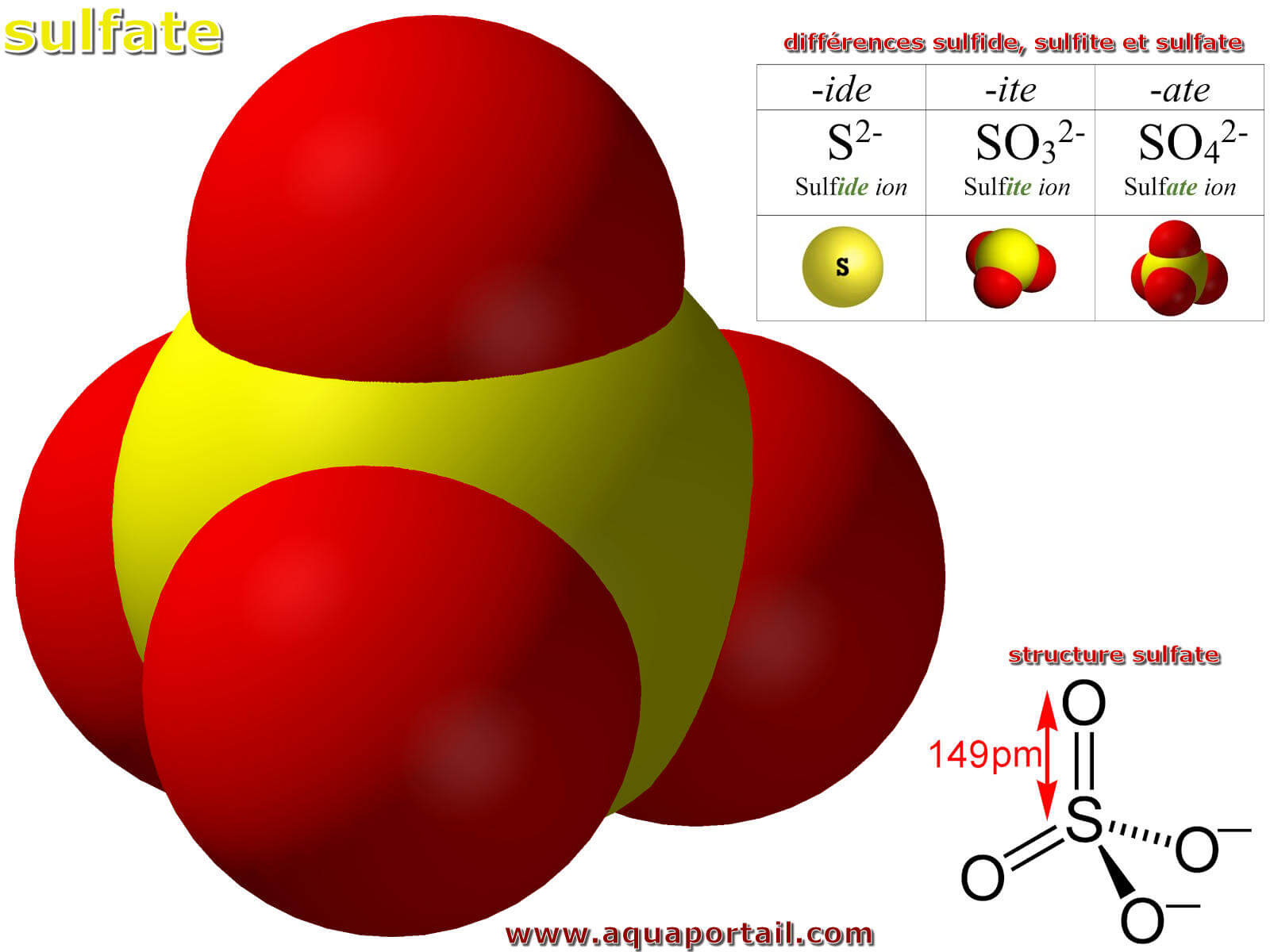
The sulfate ion ($SO_4^{2-}$) forms the backbone of chemical manufacturing and aquatic ecosystems. You'll find it in everything from your morning shampoo to agricultural fertilizers and municipal water treatment plants. Yet its presence in the natural world and industrial supply chains is often misunderstood, swinging between vital nutrient and problematic pollutant.
Understanding this polyatomic anion requires looking past basic high school chemistry definitions. We need to examine how sulfate moves through geological cycles, powers massive manufacturing sectors, and creates specific challenges in wastewater and drinking water systems.
The Molecular Structure and Chemical Properties
At a molecular level, the sulfate ion consists of one central sulfur atom covalently bonded to four equivalent oxygen atoms in a distinct tetrahedral geometry. This structure gives the ion a net negative two charge.
Because of its high electronegativity and stable resonance structures, sulfate is remarkably unreactive in typical organic reduction-oxidation conditions compared to simpler sulfur compounds like sulfides. This stability allows it to persist dissolved in aqueous environments for long periods. As discussed in detailed articles by Reuters, the effects are widespread.
Key properties governing its behavior include:
- High Solubility: Most metal sulfates—such as sodium, potassium, and magnesium sulfate—dissolve readily in water, making aqueous transport the primary vector for sulfate movement in nature.
- Ionic Strength: As a divalent anion, sulfate contributes significantly to the ionic strength of hard water, influencing mineral scaling and electrical conductivity.
- Precipitation Potential: It forms stable, sparingly soluble precipitates with heavy metals and alkaline earth cations like barium, calcium ($CaSO_4$, gypsum), and lead.
Industrial Applications Across Sectors
Modern manufacturing depends heavily on sulfate salts as primary reagents, surfactants, and processing aids. Without them, several multi-billion-dollar industries would need entirely new chemical pathways.
Pulp and Paper Production
The kraft process relies on sodium sulfate (reduced to sodium sulfide in recovery boilers) to break down chemical bonds within wood chips. This cooking liquor strips lignin away from cellulose fibers without degrading the structural integrity of the cellulose itself. The result is high-strength unbleached and bleached paper products.
Surfactants and Detergents
Sodium lauryl sulfate (SLS) and sodium laureth sulfate (SLES) serve as the workhorse anionic surfactants in personal care products and industrial cleaners. Their amphiphilic structure—featuring a nonpolar hydrocarbon tail and a polar sulfate head—lowers the surface tension of water, allowing oils and particulate soils to emulsify and rinse away cleanly.
Agriculture and Fertilizer
Plants cannot assimilate elemental sulfur directly; they rely on soil microbes to oxidize various sulfur forms into plant-available sulfate. Fertilizers like ammonium sulfate and potassium sulfate supply this essential nutrient directly. Sulfur deficiencies stunt protein synthesis, reduce nitrogen-use efficiency, and lower crop yields in sulfur-depleted soils.
The Biogeochemical Sulfur Cycle
In natural systems, sulfate acts as both an electron acceptor and a structural component of organic matter. The global sulfur cycle balances inputs from mineral weathering and volcanic outgassing with biological assimilation and microbial reduction.
[Mineral Weathering / Volcanic Emissions]
                     │
                     ▼
             [Dissolved Sulfate]
            /                   \
           ▼                     ▼
[Plant Assimilation]   [Sulfate-Reducing Bacteria]
           │                     │
           ▼                     ▼
    [Organic Sulfur]     [Hydrogen Sulfide / Sulfides]
Under anaerobic conditions—such as deep lake sediments, wetlands, and waterlogged soils—sulfate-reducing bacteria (SRB) use sulfate as an electron acceptor for respiration instead of oxygen. This metabolic pathway reduces sulfate back into hydrogen sulfide ($H_2S$), a gas characterized by its distinct rotten-egg odor.
Human activities have heavily altered this natural loop. Industrial combustion of fossil fuels releases massive quantities of sulfur dioxide ($SO_2$) into the atmosphere. Atmospheric oxidation converts these emissions into sulfuric acid and sulfate aerosols. While strict environmental regulations have slashed sulfur dioxide emissions across North America and Europe over recent decades, developing industrial economies still face significant air-quality challenges related to sulfur deposition.
Environmental and Infrastructure Challenges
While essential for industry, high concentrations of sulfate create severe operational and ecological hurdles.
Concrete Degradation and Internal Sulfate Attack
When groundwater containing high levels of dissolved sulfate contacts Portland cement concrete, it reacts with calcium aluminate hydrates. This reaction forms expanding crystals of ettringite and gypsum. The volumetric expansion generates internal stress that cracks, spalls, and ultimately destroys foundations, pipes, and bridge pilings. Engineers mitigate this risk by using sulfate-resistant cements with low tricalcium aluminate content.
Drinking Water Aesthetics and Health Effects
The United States Environmental Protection Agency lists sulfate as a secondary drinking water contaminant with a recommended secondary maximum contaminant level of 250 milligrams per liter. Concentrations exceeding this threshold impart a bitter, medicinal taste. Furthermore, drinking water with very high sulfate levels—particularly magnesium or sodium sulfate—acts as a strong laxative, causing acute gastrointestinal distress in unacclimatized consumers.
Microbially Induced Corrosion
In municipal sewer networks, sulfate-reducing bacteria thrive in the slime layers of submerged pipes. When wastewater turbulence releases dissolved hydrogen sulfide gas into the headspace of concrete or metallic pipes, aerobic bacteria on the pipe crown oxidize that gas back into sulfuric acid. This acid attack eats away at concrete infrastructure, causing premature structural failure in urban sewer systems.
Frequently Asked Questions
What is the difference between sulfite and sulfate?
Sulfate ($SO_4^{2-}$ ) contains one sulfur atom and four oxygen atoms, representing a fully oxidized state. Sulfite ($SO_3^{2-}$ ) contains one sulfur atom and three oxygen atoms, representing a less oxidized, more chemically reactive state commonly used as a preservative in food and wine.
How does sulfate get into groundwater naturally?
Natural groundwater acquires sulfate primarily through the dissolution of underground mineral deposits such as gypsum ($CaSO_4 \cdot 2H_2O$) and anhydrite, alongside the weathering of sulfide-bearing ores like pyrite.
Why do high sulfate levels cause laxative effects?
When unabsorbed sulfate salts pass through the intestines, they create osmotic pressure that draws water into the intestinal lumen. This increased fluid volume speeds up digestion and produces a temporary laxative response until the body adjusts.
Can sulfate be removed from industrial wastewater?
Yes. Common removal methods include chemical precipitation using lime or barium salts to form insoluble metal sulfates, biological sulfate reduction in bioreactors, and advanced membrane filtration technologies like reverse osmosis.



