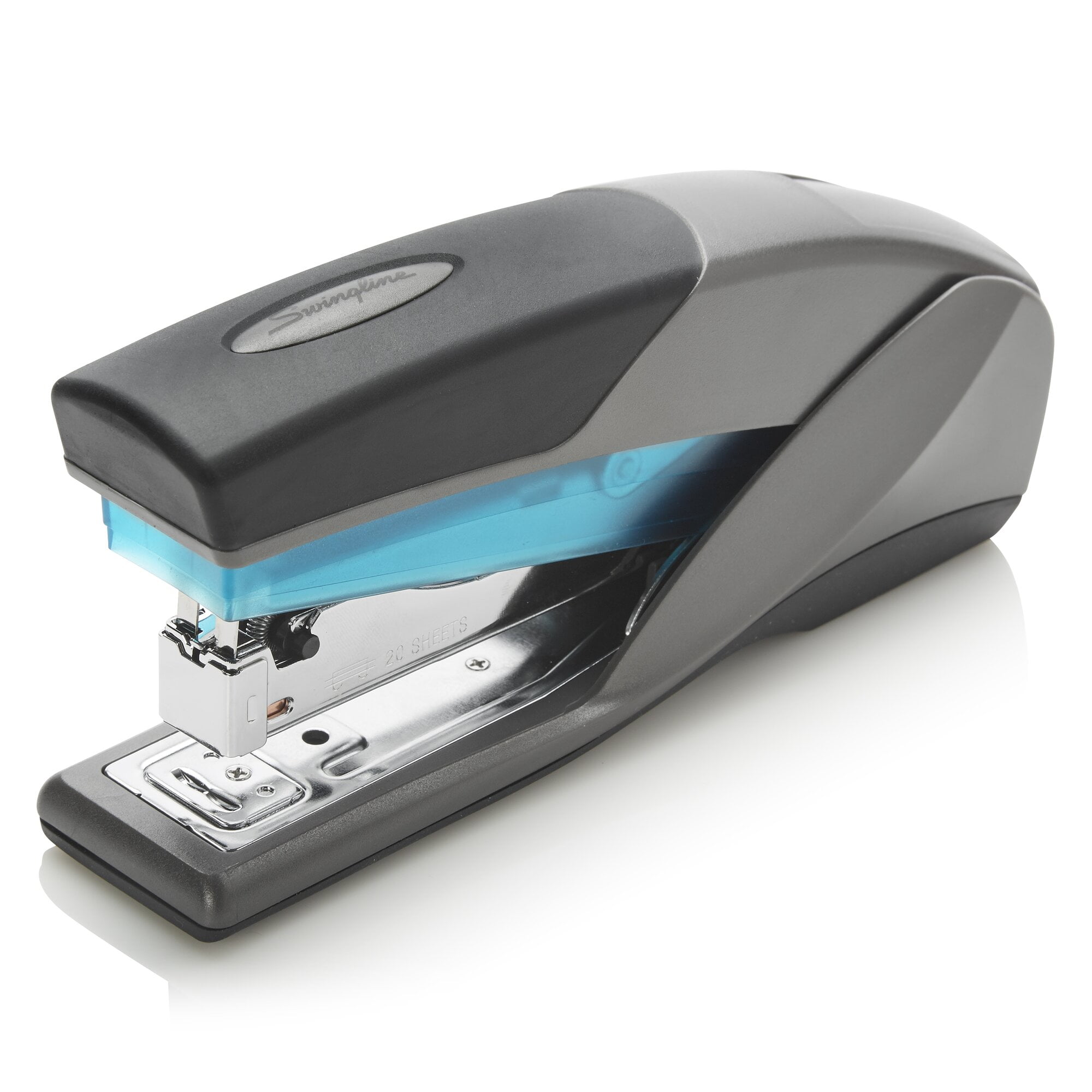
Choosing the right stapler prevents jammed mechanisms, torn paper, and wasted hours of frustration. When you're standing in front of a stack of documents or a stack of corrugated cardboard, a standard office model won't always cut through the material. Understanding the exact mechanical differences between standard and heavy-duty staplers ensures you pick the right tool for the job the first time.
Standard desktop staplers are built for light administrative tasks like binding everyday reports, school assignments, and office memos. Heavy-duty staplers use compound leverage and thicker wire gauges to punch through thick cardboard, leather, thick plastic sleeves, and multi-page bundles exceeding one hundred sheets. Matching your actual daily paper load and material density to the correct stapling mechanism saves money on replacements and eliminates workflow bottlenecks.
The Mechanics of Standard Office Staplers
Standard staplers rely on a simple class-one lever mechanism. When you push down on the top cap, the force transfers through a pivot point, pushing a thin blade (the driver) down onto a single staple. The staple legs strike a small metal plate called an anvil, which curls the wire inward to secure the paper.
These units are engineered for specific operating thresholds:
- Sheet Capacity: Most standard models handle between 10 and 20 sheets of 20lb bond paper. Heavy-duty standard models can push up to 40 or 50 sheets, but forcing them past their limit bends the staple wire inside the housing.
- Wire Gauge: Standard office units use thin wires, typically size 26/6 or 24/6. The first number indicates the wire thickness and tensile strength, while the second number denotes the leg length in millimeters.
- Throat Depth: The shallow reach limits your ability to bind booklets far from the edge of the sheet. Most models offer a throat depth of around two inches.
When you ask a standard model to bind a bulky 60-page manual, the mechanical force required exceeds the yield strength of the thin wire. The staple buckles, folds sideways, and jams the internal track.
The Heavy-Duty Workhorse Architecture
Heavy-duty staplers change the physics of binding altogether. Instead of relying purely on hand pressure, they incorporate compound levers, gear systems, or extended leverage handles that multiply your downward force.
These industrial tools feature distinct structural advantages:
- High-Capacity Driving: Mechanisms are designed to bind anywhere from 50 to 250 sheets in a single strike without requiring excessive physical strength from the user.
- Heavy Wire Gauges: They utilize thick, high-carbon steel staples—such as 3/8-inch, 1/2-inch, or 3/4-inch legs—that can pierce dense substrates like corrugated fiberboard, canvas, and heavy cardstock.
- Adjustable Paper Guides: Built-in margin guides let you align multiple stacks precisely, ensuring professional-grade consistency for binding manuals, booklets, and archive records.
For insights into high-volume office and warehouse equipment standards, check out the U.S. General Services Administration guidelines on office supplies and procurement.
Application Scenarios: Office vs. Workshop
Different environments demand entirely different performance characteristics from a binding tool. Using an office stapler in a workshop or packing room destroys the tool quickly.
Office and Administrative Environments
In a standard office, your main concern is speed and reliability for everyday correspondence. Standard desktop models handle invoices, contracts, and letters efficiently. However, if your accounting department routinely collates monthly tax packets or thick legal briefs, you need a desktop heavy-duty stapler or an electric model. Electric staplers use an internal motor to drive the staple instantly when paper triggers a sensor, reducing repetitive strain injuries during high-volume document preparation.
Workshops and Shipping Operations
In a warehouse or workshop, staplers function more like industrial fasteners. Workers use heavy-duty pliers-style staplers or cart-closing staplers to seal double-walled corrugated shipping boxes, attach tags to lumber, or secure upholstery fabric to wooden frames. These applications require impact resistance, rust-resistant coatings, and durable steel housings that withstand being dropped on concrete floors.
Total Cost of Ownership and Reliability
Purchasing office equipment often comes down to upfront cost versus long-term value. A cheap plastic standard stapler might cost less than ten dollars, but it usually fails within a year due to spring fatigue and plastic housing cracks.
Heavy-duty models require a larger initial investment, but they are built with all-metal construction and replaceable wear parts. When a heavy-duty stapler jams or wears down, you replace the driver blade or anvil rather than throwing away the entire device. For busy workplaces, investing in a robust binding tool eliminates recurring replacement expenses and prevents frustrating workflow delays.
To explore manufacturing and industrial equipment safety standards, you can review resources provided by the Occupational Safety and Health Administration.
Common Mistakes When Choosing a Stapler
Buyers often make predictable errors when selecting binding equipment for their workspace:
- Ignoring Paper Weight: Rating guides assume standard 20lb copy paper. If you print on heavy 28lb or 32lb paper, your actual sheet capacity drops significantly.
- Using Incorrect Staple Sizes: Forcing generic cheap staples into a heavy-duty model causes frequent misfeeds. Always match the exact wire gauge and leg length specified by the manufacturer.
- Overloading the Throat: Trying to staple too close to the center of a large poster or wide format document fails because standard throat depths are too short.
Frequently Asked Questions
Can I use heavy-duty staples in a standard office stapler?
No. Standard staplers have narrow internal tracks and weak driver blades that cannot accommodate thick wire gauges. Trying to load heavy-duty staples will jam the machine immediately and can break the internal spring mechanism.
What causes a stapler to jam repeatedly?
Frequent jamming usually happens for three reasons: using worn-out staples, overloading the sheet capacity, or using bent staples left over from a previous misfeed. Clearing the track completely and using fresh, manufacturer-approved wire solves most jamming issues.
How do I know when I need an electric heavy-duty stapler?
If your team spends more than an hour a week manually binding packets over 40 sheets, or if staff members report wrist fatigue and hand strain, upgrading to an electric heavy-duty model improves both productivity and ergonomic safety.
What is the difference between a desk stapler and a plier stapler?
A traditional desk stapler sits flat on a desk and drives staples downward. A plier stapler operates like a pair of scissors or pliers, allowing you to hold the tool in your hand and squeeze the handles together. Plier staplers are popular in retail stores and shipping rooms for tagging bags and sealing boxes.