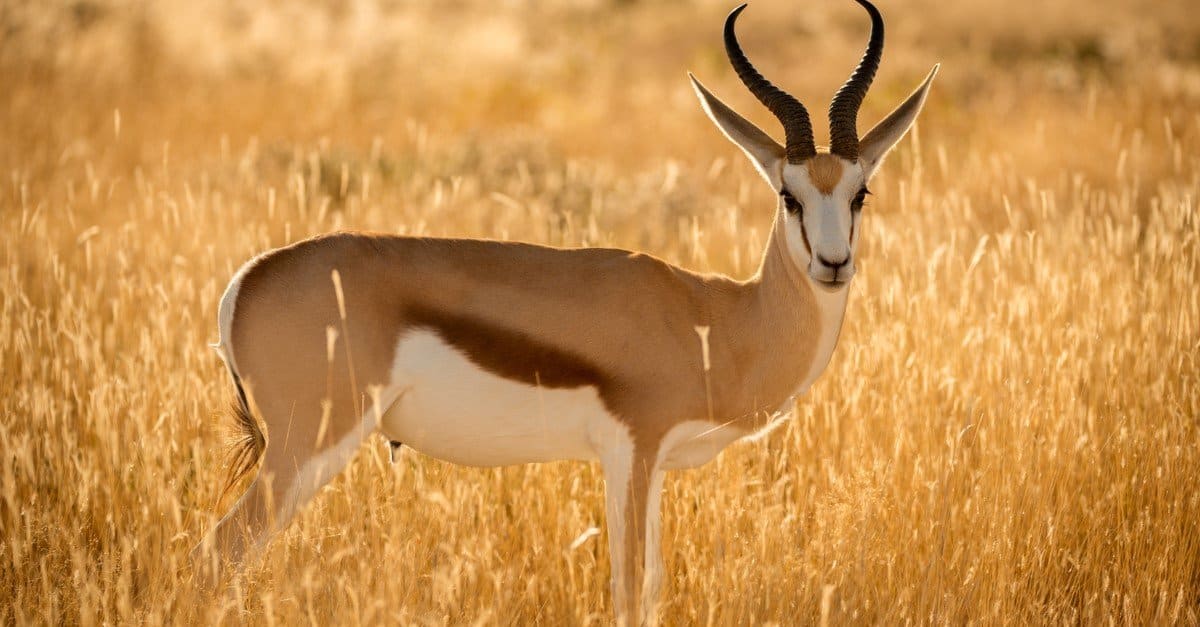
The springbok stands as an iconic medium-sized antelope native to the arid and semi-arid plains of southern Africa. Scientifically classified as Antidorcas marsupialis, this species thrives across open grasslands, scrublands, and the harsh terrains of the Kalahari and Karoo deserts. Renowned for blistering sprint speeds reaching up to 88 kilometers per hour and an acrobatic jumping display known as pronking, the springbok represents a masterclass in mammalian evolutionary adaptation.
Unlike many large herbivores that require daily access to standing water, springboks can survive indefinitely without drinking. They extract all necessary hydration from succulent plants, roots, and morning dew, while specialized nasal passages cool blood flowing to the brain during extreme heat waves. This physiological resilience allows them to inhabit regions where other ungulates simply cannot persist.
Physical Traits and Unique Adaptations
An adult springbok typically weighs between 27 and 42 kilograms, standing roughly 75 centimeters tall at the shoulder. Their distinctive coat features a rich fawn back, white underparts, and a bold dark brown stripe running horizontally along each flank. A fold of skin along the rump conceals a white crest of hair that flares open when the animal is alarmed, serving as a visual warning signal to the rest of the herd.
Both males and females grow slender, ringed, lyre-shaped horns. While female horns are typically thinner and shorter, male horns are robust and heavily ridged, utilized during territorial sparring matches.
The Mystery of Pronking
One of the most fascinating behaviors exhibited by the springbok is pronking (or stotting), where an animal launches itself repeatedly up to two meters into the air. During a pronk, the springbok keeps its legs stiff and straight, arches its back, and opens the white dorsal hair flap.
- Predator Deterrence: Biologists suggest pronking signals to cheetahs and lions that the prey animal is healthy, alert, and too difficult to catch.
- Alarm Signaling: It alerts distant herd members to potential threats lurking in the grass.
- Social Cohesion: Young springboks often pronk out of sheer exuberance during play behavior.
Feeding Ecology and Water Conservation
Springboks are opportunistic mixed feeders, shifting their diet between grazing and browsing depending on seasonal rainfall and plant availability. During wet summer months, they target fresh green grass shoots and high-protein forbs. In dry winter months, they pivot to browsing woody shrubs, succulents, and digging up nutrient-rich roots.
Water conservation is achieved through metabolic efficiency and behavioral adjustments. Springboks frequently feed during the cool early morning and late evening hours, resting in the sparse shade of shrubs during peak afternoon temperatures. When ambient temperatures soar, they can alter their nasal breathing patterns to minimize moisture loss through exhalation.
Social Structure and Herd Dynamics
Springbok society is fluid, operating on a fission-fusion model where herd sizes expand and contract based on food availability and environmental stress. During dry periods, animals gather in large migratory herds numbering in the hundreds or thousands. When food is plentiful during the rainy season, these large groups break down into smaller harems and bachelor groups.
- Territorial Rams: Dominant males establish and defend fixed territories using urine, dung middens, and secretions from preorbital facial glands.
- Bachelor Groups: Young males that haven't secured territory band together in separate non-breeding herds.
- Ewe Herds: Females and their young offspring form maternal herds that move freely across male territories.
For deeper insights into African ungulate migrations and conservation frameworks, explore resources provided by the Sanctuary Wildlife Conservancy and the International Union for Conservation of Nature.
Reproduction and Life Cycle
Breeding is closely tied to environmental conditions, usually peaking immediately after seasonal rains when nutritional quality is highest. Territorial rams actively herd ewes, attempting to restrict movement outside their defended boundaries.
After a gestation period lasting roughly five to six months, a single lamb is born. Mothers hide their newborns in tall grass or shrub cover for the first few weeks, returning only to nurse. Lambs grow rapidly, joining nursery groups within a month, which dramatically increases their chances of evading opportunistic predators like jackals and African wild dogs.
Common Misconceptions
Many casual observers misunderstand the ecological role and historical movements of the springbok.
- Not a True Gazelle: Despite common naming conventions and superficial resemblances, the springbok belongs to the genus Antidorcas and is genetically distinct from true gazelles of the genus Eudorcas or Gazella.
- Historic Treks: Historical accounts describe massive mass movements—known as "trekbokking"—where millions of springboks migrated across the Karoo, though modern fences and agriculture have permanently halted these spectacles.
Frequently Asked Questions
Can springboks really live without drinking water?
Yes. Springboks obtain sufficient moisture from the succulent leaves, roots, and flowers they consume. Under normal environmental conditions, they can go their entire lives without drinking from a standing water source.
How fast can a springbok run?
A healthy adult springbok can reach top sprint speeds of up to 88 kilometers per hour (55 miles per hour) over short distances, making them one of the fastest land mammals on Earth.
Do female springboks have horns?
Yes. Unlike many other antelope species where only males bear horns, both male and female springboks grow distinctive, ringed, lyre-shaped horns, though female horns are generally shorter and narrower.
What is the primary predator of the springbok?
Cheetahs pose the most consistent threat due to their matching speed on open plains, though lions, leopards, spotted hyenas, and African wild dogs also hunt them regularly.



