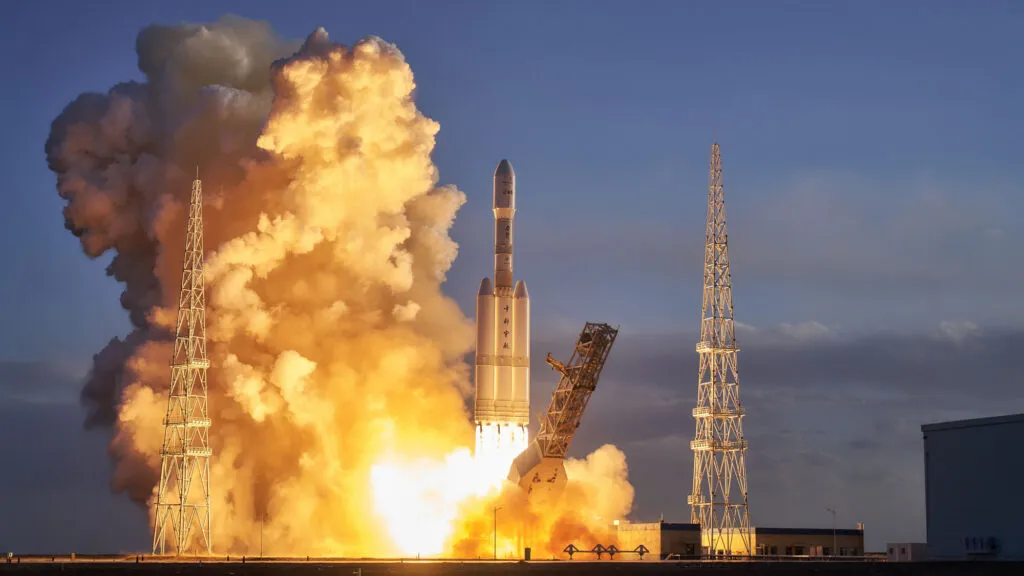
For decades, humanity treated orbital-class rockets like expensive paper cups: build them with immense precision, launch them once, and drop them into the ocean to burn up or rust on the seabed. That single-use economic model kept the cost of getting payload to orbit prohibitively high. Everything changed when aerospace engineers figured out how to land and refly a orbital-class booster.
The primary keyword behind this shift is the SpaceX first reusable rocket, a technological leap that redefined what commercial and scientific access to space costs. Instead of discarding tens of millions of dollars of hardware after a single nine-minute flight, SpaceX engineered the Falcon 9 first stage to fly back, land safely, and launch again. This transition from disposable rocketry to rapid reusability transformed an entire industry, lowering launch economics and enabling a massive surge in global satellite deployment.
The Economic and Engineering Barrier of Disposable Rockets
Before reusability became a reality, traditional space agencies and private contractors operated under a strict throwaway paradigm. Building a rocket requires extreme structural tolerances, exotic metallurgy, turbopumps operating under brutal thermal loads, and thousands of critical components that must function without a single flaw.
When you throw all of that hardware away after one flight, the cost per kilogram to orbit remains sky-high. Launch providers had to amortize the entire manufacturing cost of the vehicle across a single payload. Customers faced multi-year waiting lists and price tags running into the hundreds of millions of dollars.
SpaceX approached this problem with a different philosophy, arguing that commercial aviation wouldn't survive if airlines bought a new Boeing or Airbus for every single passenger flight and junked it upon landing. The core challenge wasn't just physical survival during ascent—it was surviving the brutal atmospheric reentry and executing a controlled, powered vertical touchdown.
Milestone Timeline: From Concept to First Reflight
The path to building the SpaceX first reusable rocket required solving a sequence of intense engineering hurdles over several years.
- Grasshopper and Development Testing (2012–2013): Before trying to land an orbital booster coming back from space at supersonic speeds, SpaceX tested low-altitude vertical takeoff and vertical landing (VTVL) prototypes like Grasshopper in Texas. These tests proved that throttleable Merlin engines and grid fins could stabilize a tall, slender cylinder.
- The First Orbital Landing (December 2015): SpaceX achieved its first historic breakthrough when a Falcon 9 first stage successfully returned from an orbital launch and touched down upright at Landing Zone 1 in Cape Canaveral. It was the first time an orbital-class booster survived the descent and recovery process.
- The First Reflight (March 2017): Landing a booster proved it could survive, but the ultimate economic test was launching it a second time. On March 30, 2017, SpaceX successfully launched the SES-10 communications satellite using a previously flown Falcon 9 first stage, then landed the booster a second time.
You can read more about current vehicle specifications directly on the SpaceX Falcon 9 Overview.
How Falcon 9 Achieves Vertical Landing and Recovery
Recovering an orbital booster involves a complex choreography of flight mechanics, guidance software, and mechanical hardware. When the first stage separates from the second stage at an altitude of roughly 80 kilometers and speeds exceeding Mach 5, the vehicle must execute three distinct engine burns and manage severe aerodynamic forces.
- Boostback Burn: For missions requiring the booster to return to its launch site (RTLS), the engines fire briefly to reverse the rocket's horizontal momentum and steer it back toward land.
- Grid Fin Steering: Four large titanium grid fins deploy from the interstage. These aerodynamic surfaces flip out into the supersonic airflow, steering the rocket through the upper atmosphere where traditional aerodynamic control surfaces are useless.
- Entry Burn: Just before hitting the densest parts of the atmosphere, the center Merlin engines ignite again to slow the vehicle down, protecting the airframe from destructive heating forces.
- Landing Burn: As the booster drops below an altitude of two kilometers, a single Merlin engine ignites for a final suicide burn. The landing legs deploy milliseconds before touchdown, and the flight computer throttles the engine precisely to match zero vertical velocity right at contact.
Common Misconceptions About Rocket Reusability
A lot of casual observers misunderstand how full reusability works in modern aerospace. It helps to clear up a few persistent myths.
Many people assume the entire rocket comes back intact. In reality, the Falcon 9's second stage—which pushes the payload all the way into orbital velocity—still burns up in the atmosphere or deorbits as space debris because it experiences much higher thermal and kinetic loads. True full reusability is the primary goal of newer developmental systems like Starship, but Falcon 9 achieves its massive savings by recovering the expensive first stage, which accounts for the vast majority of the vehicle's manufacturing cost.
Another common belief is that boosters can fly immediately after landing. In practice, a returned booster undergoes rigorous post-flight inspection, data analysis, refurbishment, and static-fire testing before it's cleared for another mission, ensuring safety and structural integrity remain uncompromised.
Frequently Asked Questions
How many times can a single Falcon 9 booster fly?
SpaceX routinely flies individual first-stage boosters more than a dozen times. Several veteran boosters have achieved 20 or more flights, demonstrating exceptional fatigue resistance in the aluminum-lithium airframe and Merlin engines.
Why don't other space agencies reuse their rockets?
Developing propulsive landing technology requires immense software sophistication, flight data, and tolerance for trial-and-error explosions during testing. Many traditional space programs relied on cost-plus contracting models that historically lacked financial incentives to optimize manufacturing costs through reusability.
Does reusability reduce the payload capacity of the rocket?
Yes. Bringing a booster back to Earth requires keeping a portion of the propellant in reserve for the landing burns and carrying heavy hardware like landing legs and grid fins. This propellant penalty reduces the maximum payload weight the rocket can deliver to higher-energy orbits compared to flying it in an expendable configuration.
How does rocket reusability impact global satellite internet?
Without the low launch costs driven by reusable boosters, mega-constellations like Starlink would be economically impossible. Reusability lowered the barrier to frequent flight, allowing operators to launch dozens of satellites at a fraction of historical market rates.