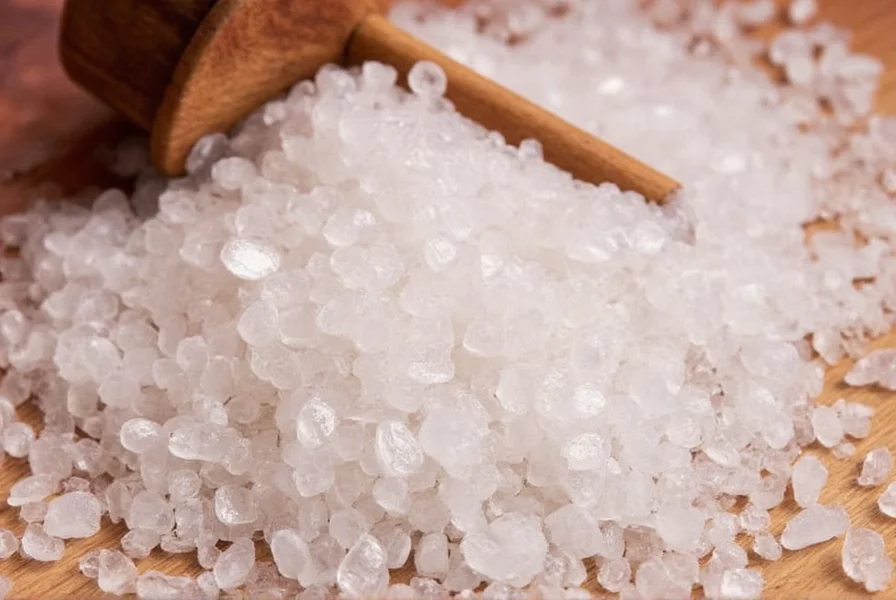
Table salt is the quiet backbone of every kitchen, yet few look past the shaker to understand its atomic blueprint. At its core, table salt is sodium chloride, represented by the chemical formula NaCl. This simple combination of two distinct elements shapes human biology, food preservation, and global industry.
Understanding sodium chloride requires looking past the grocery aisle and examining how individual atoms bond, why they form crystal lattices, and how this common compound impacts daily life.
The Atomic Anatomy of NaCl
The formula NaCl is shorthand for a one-to-one ratio of two elements: sodium (Na) and chlorine (Cl). On their own, neither element belongs anywhere near a kitchen.
Sodium is a soft, highly reactive metal that explodes on contact with moisture. Chlorine is a pale yellow-green, toxic gas used in industrial bleaching and disinfectants. When they react, sodium atoms give up a single valence electron to chlorine atoms.
This electron transfer transforms both dangerous elements into stable ions. Sodium becomes a positively charged cation ($Na^+$), and chlorine becomes a negatively charged anion ($Cl^-$). Opposite charges attract, locking these ions into a rigid, repeating three-dimensional crystal lattice. That ionic bond creates a harmless, life-sustaining white solid.
Crystal Structure and Ionic Bonding
The physical structure of sodium chloride dictates how it behaves in the real world. Under a microscope, salt crystals look like tiny cubes. This cubic habit stems from the way $Na^+$ and $Cl^-$ ions pack together.
Because chloride ions are significantly larger than sodium ions, smaller sodium ions tuck neatly into the octahedral gaps between the larger chloride ions. Each sodium ion is surrounded by six chloride ions, and vice versa, maximizing electrostatic attraction while minimizing repulsion.
This ionic framework explains several familiar physical properties:
- High Melting Point: Breaking those strong ionic bonds requires substantial energy, which is why salt melts only at $801$ degrees Celsius ($1474$ degrees Fahrenheit).
- Brittleness: Striking a salt crystal shifts the aligned ions so that like charges face each other, causing the crystal to cleave cleanly along flat planes rather than bend.
- Electrical Conductivity in Solution: Solid salt doesn't conduct electricity because its ions are locked in place. Dissolve it in water, however, and the polar water molecules pull the ions apart, allowing electrical charges to flow freely.
Beyond the Kitchen: Biological and Industrial Roles
While cooking relies on salt to enhance flavor, human physiology depends on it to survive. The sodium and chloride ions dissolved in bodily fluids regulate blood pressure, transmit nerve impulses, and facilitate muscle contractions.
Cells rely on a delicate balance of sodium across their membranes to transport nutrients and maintain hydration. Without an adequate intake of sodium chloride, nerve signaling fails and cellular osmotic balance collapses.
Industrially, the scope of NaCl expands far beyond food seasoning. Manufacturing sectors use chlorine and sodium hydroxide derived from salt electrolysis to produce plastics, paper, and soap. Municipalities spread millions of tons of road salt each winter because dissolved salt lowers the freezing point of water, melting ice on roadways.
Common Mistakes in Salt Chemistry
Misconceptions about salt often lead to confusion in both the kitchen and the classroom. A frequent error is assuming that "salt" in chemistry refers exclusively to table salt. In scientific terms, a salt is any ionic compound formed by the neutralization reaction between an acid and a base. Sodium chloride is simply the most common example.
Another common mistake involves confusing elemental sodium and chlorine with their ionic forms. Ingesting raw sodium metal or breathing chlorine gas is lethal, but consuming bonded sodium and chloride ions is safe and biologically necessary. The chemical properties of a compound differ entirely from the properties of its constituent elements.
Frequently Asked Questions
Why does salt dissolve so easily in water?
Water molecules are polar, meaning they have a slight positive charge on the hydrogen atoms and a slight negative charge on the oxygen atom. These charges pull on the sodium and chloride ions, overcoming the internal ionic bonds and pulling the crystal apart into a solution.
Is sea salt chemically different from table salt?
Chemically, both are primarily NaCl (usually around $98$ to $99$ percent). Sea salt contains trace amounts of minerals like magnesium, calcium, and potassium depending on its source, but these trace elements change texture and flavor rather than the fundamental chemical formula.
How is salt harvested commercially?
Commercial production relies on three primary methods: underground mining of rock salt deposits, solar evaporation of seawater in shallow ponds, and vacuum evaporation of brine pumped from underground wells.
Can other atoms create table salt?
No. By definition, true table salt requires a one-to-one ionic pairing of sodium and chlorine atoms. Other combinations of alkali metals and halogens form different salts, such as potassium chloride ($KCl$), but they possess distinct tastes and properties.
For more details on chemical bonding mechanics, explore the Royal Society of Chemistry or review foundational principles via PubChem.



