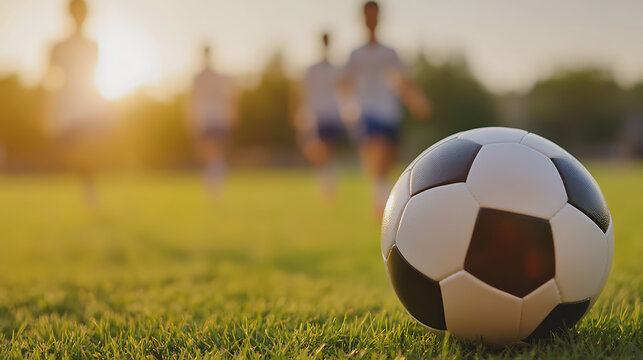
When David Beckham curled a free-kick past the wall, the mechanics of his strike depended on a precise physical formula: a Size 5 ball with an exact circumference of 68 to 70 centimeters and a diameter of roughly 22 centimeters. A tiny shift in diameter alters flight physics, rotational inertia, and striking force. If you hand a young child a regulation adult match ball, their developing joints absorb excessive stress, and their technique breaks down under the heavy weight.
Official FIFA Laws of the Game mandate strict standards for professional play, but backyard matches and youth leagues rely on scaled dimensions. Choosing the right ball isn't just about fitting an age bracket; it's about matching physical leverage and biomechanical control to ensure proper skill development.
The Physics of Diameter: Why Size Matters
A soccer ball's diameter dictates its aerodynamic drag, rotational speed, and impact force. When you kick a sphere, the kinetic energy transferred from your foot depends on the mass distribution and surface area of the ball.
- Surface Area and Air Resistance: A larger diameter increases wind resistance during flight. A Size 5 ball cuts through the air differently than a compact Size 3, altering the curving trajectory famously seen in professional free-kicks.
- Moment of Inertia: A heavier, wider ball requires more torque to spin. Players striking a regulation ball use specific muscle groups in the hips and core that younger players simply haven't developed yet.
- Energy Transfer: If a child kicks an adult ball, the dense inner layers don't compress efficiently against a smaller foot, stinging the ankle and reducing shot velocity.
Standard Soccer Ball Sizes Breakdown
Governing bodies like The FA and US Youth Soccer categorize balls into five distinct tiers based on age, weight, and diameter.
Size 5: The Adult and Professional Standard
- Circumference: 68 to 70 cm (27 to 28 inches)
- Diameter: Approximately 22 cm (8.6 inches)
- Weight: 410 to 450 grams
- Target Audience: Players aged 13 and older, including high school, collegiate, and professional leagues.
This is the definitive match ball used across global competitions. Its weight and diameter provide the momentum needed for long-range passing and powerful shooting on full-sized pitches.
Size 4: The Intermediate Youth Ball
- Circumference: 63 to 66 cm (25 to 26 inches)
- Diameter: Approximately 20 to 21 cm (8 inches)
- Weight: 350 to 390 grams
- Target Audience: Players aged 8 to 12 years old.
Size 4 bridges the gap between junior training and senior play. It allows pre-teens to practice bending the ball and executing driven passes without straining their lower backs or ankles.
Size 3: The Junior Development Ball
- Circumference: 58 to 61 cm (23 to 24 inches)
- Diameter: Approximately 18 to 19 cm (7.3 inches)
- Weight: 300 to 320 grams
- Target Audience: Children aged 5 to 8 years old.
Many youth associations recommend Size 3 balls to help young beginners master close control. The lighter construction ensures kids can lift the ball off the ground naturally when passing or shooting.
Size 2 and Size 1: Mini and Skills Balls
- Size 2 Circumference: 50 to 52 cm (20 to 22 inches)
- Size 1 Circumference: 45 to 48 cm (18 to 20 inches)
- Target Audience: Toddlers and technical skill training for all ages.
Mini balls don't see competitive match play, but elite players use Size 1 balls during warm-ups. Striking a tiny 18-inch sphere forces a player to hit the exact sweet spot with their laces, dramatically sharpening coordination and touch.
Common Mistakes When Choosing a Soccer Ball
Parents and coaches often make critical errors when purchasing training gear. Avoiding these pitfalls protects players from injury and accelerates skill acquisition.
- Buying "grow-into" balls: Giving an eight-year-old a Size 5 ball so they can "grow into it" stifles technique. Kids compensate for the heavy weight by adopting poor mechanics, such as toe-poking instead of striking with the laces.
- Ignoring inflation pressure: A ball pumped above or below the official 0.6 to 1.1 atmosphere range behaves unpredictably. Over-inflating creates a rock-hard surface that hurts to head, while under-inflated balls drag on the turf.
- Using cheap promotional balls outdoors: Promotional balls lacking proper stitching or glued panels warp quickly on abrasive turf surfaces, ruining the spherical geometry needed for true rolling and flight.
Frequently Asked Questions
Can adults use a Size 4 ball for training?
Yes. Many technical trainers and futsal crossover players use Size 4 balls to practice close-quarters dribbling. Because the target is smaller, transitioning back to a Size 5 ball during matches makes trapping and control feel effortless.
What is the difference between a futsal ball and a regular soccer ball?
While both are typically Size 4 in circumference, futsal balls are stuffed with foam or low-rebound filling. This heavy, deadened construction keeps the ball low to the ground on indoor hardwood courts.
How do I check if my soccer ball has correct pressure?
Drop the ball from a height of two meters onto a wooden floor. A properly inflated regulation ball should rebound to a consistent height of roughly 1.2 to 1.4 meters.
Why do professional match balls feel different than replica balls?
Match balls feature thermally bonded panels with textured polyurethane casings that shed water and resist deformation. Cheaper replica balls use hand-stitched or machine-stitched panels that absorb moisture and lose their shape in wet weather.



