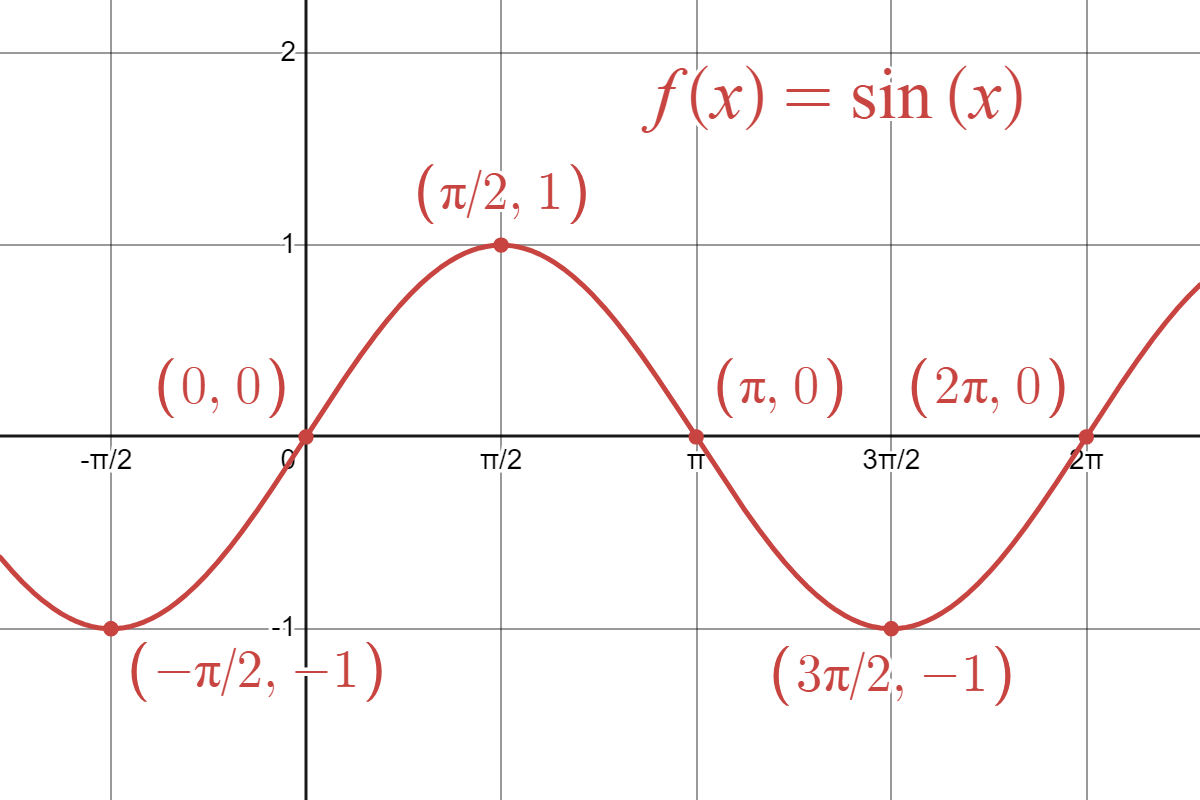
The sine of zero radians is exactly zero, a foundational result that underpins trigonometry, calculus, and physics. When you evaluate the sine function at an input of zero, the output is always zero, whether you measure the angle in degrees or radians.
This core trigonometric value isn't just an arbitrary number memorized in high school algebra classes. It represents the starting point of cyclical motion, the origin of the standard sine wave, and a critical anchor point in complex mathematical analysis. Let's examine why $\sin(0) = 0$, how different mathematical definitions arrive at this exact value, and why it matters in practical calculations.
The Unit Circle Definition of Sine
To understand why the sine of zero is zero, you need to look beyond right-angled triangles. While right triangles define sine as the opposite side divided by the hypotenuse, that geometric model breaks down for an angle of zero degrees because you can't form a triangle with a zero-degree angle.
Instead, mathematicians use the unit circle model. Picture a circle with a radius of exactly one unit centered at the origin $(0, 0)$ of a Cartesian coordinate system.
- Start the ray: Place your initial ray along the positive x-axis pointing to the right. The intersection point with the circle is at coordinates $(1, 0)$.
- Measure the angle: Rotate the ray counterclockwise by an angle $\theta$.
- Locate the point: The ray intersects the circumference of the circle at some coordinate point $(x, y)$.
- Read the value: By definition on the unit circle, the y-coordinate of that intersection point equals the sine of the angle ($\sin(\theta) = y$).
When your angle is zero, you don't rotate the ray at all. It stays resting flat along the positive x-axis. The intersection point remains fixed at $(1, 0)$. Because the y-coordinate of this point is zero, the sine of zero is zero.
Degrees Versus Radians at Zero
A common point of confusion involves angular units. Angles can be measured in degrees or radians, but the numerical output for $\sin(0)$ remains unchanged.
- $\sin(0^\circ) = 0$
- $\sin(0\text{ rad}) = 0$
Even though the number is identical, the mathematical context changes significantly when you enter calculus. Radians are dimensionless ratios of arc length to radius, which makes them the natural unit for calculus operations.
If you attempt to take the derivative of $\sin(x)$ using first principles, you run into a critical limit:
$$\lim_{x \to 0} \frac{\sin(x)}{x} = 1$$
This limit only evaluates correctly to $1$ when $x$ is measured in radians. If you switch your calculator to degree mode, that limit breaks down, yielding an awkward scaling factor of $\frac{\pi}{180}$. Knowing that $\sin(0) = 0$ is the stepping stone that allows this foundational limit to resolve cleanly.
Alternative Mathematical Proofs
Mathematics allows you to verify the value of $\sin(0)$ through multiple independent methods, confirming consistency across different branches of math.
The Taylor Series Expansion
You can express the sine function as an infinite polynomial using its Taylor series (or Maclaurin series):
$$\sin(x) = x - \frac{x^3}{3!} + \frac{x^5}{5!} - \frac{x^7}{7!} + \dots$$
Substitute zero for every $x$ in the series:
$$\sin(0) = 0 - \frac{0^3}{6} + \frac{0^5}{120} - \dots$$
Every single term containing $x$ vanishes immediately, leaving a total sum of zero.
Euler's Formula
Using complex analysis, Euler's formula links trigonometric functions to complex exponentials. The definition of sine using complex numbers is:
$$\sin(x) = \frac{e^{ix} - e^{-ix}}{2i}$$
Plug in $x = 0$:
$$\sin(0) = \frac{e^0 - e^0}{2i} = \frac{1 - 1}{2i} = \frac{0}{2i} = 0$$
Both advanced algebraic methods reinforce the basic geometric truth of the unit circle.
Why Sin(0) Matters in Science and Engineering
Knowing that $\sin(0) = 0$ isn't just an abstract exercise. It dictates how engineers and scientists model real-world phenomena.
Modeling Waves and Oscillations
Sine waves describe simple harmonic motion, sound waves, alternating electrical currents, and light waves. A standard sine wave equation is written as:
$$y(t) = A \sin(\omega t + \phi)$$
When a physical system starts its cycle at equilibrium—such as a pendulum hanging straight down at time $t = 0$ or an alternating voltage crossing zero volts—the phase shift $\phi$ is often zero. Evaluating the equation at the starting moment means calculating $\sin(0)$, which zeroes out that component and correctly establishes the baseline starting position.
Computer Graphics and Transformations
When rendering 3D video games or engineering simulations, objects rotate around coordinate axes using rotation matrices. A standard rotation matrix around the z-axis looks like this:
$$\begin{bmatrix} \cos(\theta) & -\sin(\theta) & 0 \ \sin(\theta) & \cos(\theta) & 0 \ 0 & 0 & 1 \end{bmatrix}$$
Before an object undergoes any rotation ($\theta = 0$), the matrix simplifies because $\sin(0) = 0$ and $\cos(0) = 1$. This turns the matrix into an identity matrix, saving computational cycles by confirming that no transformation occurs on a static object. You can explore more about how matrices govern spatial movement through resources provided by Khan Academy.
Common Mistakes to Avoid
Students and programmers frequently mix up basic trigonometric values at zero. Keep these contrasts clear:
- Sine vs. Cosine: While $\sin(0) = 0$, the cosine of zero is $\cos(0) = 1$. Cosine tracks the x-coordinate on the unit circle, which starts at $1$ when the angle is zero.
- Tangent Value: Tangent is defined as $\frac{\sin(\theta)}{\cos(\theta)}$. Therefore, $\tan(0) = \frac{0}{1} = 0$.
- Radians vs. Degrees in Code: Programming languages like Python or C++ expect trigonometric inputs in radians by default (using
math.sin(0)). Passing degrees without converting them viamath.radians()will return incorrect results for non-zero angles, though $\sin(0)$ happens to return $0$ in both systems.
Frequently Asked Questions
Is sin(0) the same as sin(0 degrees)?
Yes. Zero degrees and zero radians represent the exact same angular displacement of no rotation. Both evaluate to a sine value of zero.
Why is sin(0) zero while cos(0) is one?
Sine measures the vertical y-coordinate on the unit circle, while cosine measures the horizontal x-coordinate. At zero rotation, a point on the unit circle sits directly on the positive x-axis at coordinates $(1, 0)$. The y-coordinate is $0$, making the sine zero, while the x-coordinate is $1$, making the cosine one.
Does the sine function always start at zero?
The standard sine function $y = \sin(x)$ starts at the origin $(0, 0)$. However, if you apply a phase shift or vertical shift—such as $y = \sin(x) + 2$ or $y = \sin(x + \frac{\pi}{2})$—the initial output at $x = 0$ will change.
How do calculators compute sin(0)?
Calculators don't draw unit circles to find answers. Instead, they use programmed approximations based on truncated Taylor series polynomials or CORDIC algorithms to compute the value instantly.


