Trigonometry often feels like an abstract classroom exercise filled with memorization and right triangles. Yet the fundamental ratios of sine, cosine, and tangent govern how we measure distance, navigate across oceans, and render three-dimensional graphics on a flat computer screen. When you understand what these ratios actually measure, geometry transforms from a set of rules into a practical toolkit for describing physical space.
At its core, the study of triangles connects angles to lengths. If you know the angle of an incline, trigonometric ratios let you calculate how high you'll climb without measuring every inch of the slope. This relationship forms the foundation of surveying, navigation, and modern physics.
The Foundation of Right Triangles
Every basic trigonometric function relies on the geometry of a right-angled triangle. A right triangle features one ninety-degree angle and two acute angles. The sides receive specific names based on their position relative to one of those acute angles.
The hypotenuse sits directly opposite the right angle and always serves as the longest side of the triangle. The opposite side lies across from your chosen angle, while the adjacent side sits right next to it, forming the angle alongside the hypotenuse.
These spatial relationships remain constant regardless of the triangle's overall size. If two right triangles share the exact same acute angles, the ratios of their side lengths are identical. This geometric constancy allows us to use ratios to solve for unknown dimensions.
Defining Sine, Cosine, and Tangent
The three primary trigonometric functions are sine, cosine, and tangent. Math students often use the mnemonic SOH-CAH-TOA to remember their definitions:
- Sine (sin) equals the length of the opposite side divided by the hypotenuse.
- Cosine (cos) equals the length of the adjacent side divided by the hypotenuse.
- Tangent (tan) equals the length of the opposite side divided by the adjacent side.
If an angle measures thirty degrees in a right triangle, the sine of that angle will always equal one-half. That means the side opposite a thirty-degree angle is always exactly half as long as the hypotenuse.
Moving Beyond the Triangle: The Unit Circle
Right triangles work well for angles between zero and ninety degrees, but mathematics requires a broader framework. The unit circle extends trigonometric functions to any angle, positive or negative, by placing a circle with a radius of one on a standard Cartesian coordinate system.
Center the circle at the origin where the x and y axes cross. As an angle opens up from the positive x-axis, it intersects the edge of the circle at a specific coordinate point $(x, y)$. In this context:
- The cosine of the angle corresponds directly to the x-coordinate of that point.
- The sine of the angle corresponds to the y-coordinate.
- The tangent represents the slope of the line, calculated as sine divided by cosine, or $y / x$.
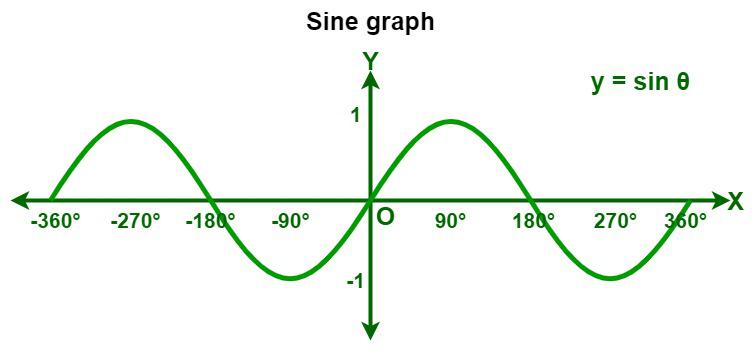
This circular definition allows sine, cosine, and tangent to repeat endlessly. As you rotate past 360 degrees, the coordinates loop through the same values, creating periodic waves that model cyclical phenomena like sound waves and alternating electrical current.
Practical Applications in Navigation and Engineering
Long before computers existed, surveyors used these formulas to map terrain, chart coastlines, and measure the height of mountains without scaling them. By measuring a baseline distance on the ground and sighting the angle to a distant peak, a surveyor can calculate the mountain's height using the tangent ratio.
Civil engineers rely on these same principles to design safe roads and bridges. When a highway climbs a steep grade, engineers calculate the slope using tangent values to ensure trucks can manage the incline without losing traction.
Navigation relies heavily on triangulation. GPS satellites send radio signals that travel at a known speed, allowing receivers to calculate distance. By measuring distances from multiple satellites, your phone uses geometric intersection to pinpoint your exact location on Earth. For deeper reading on how global positioning works, visit the National Geodetic Survey.
Common Mistakes to Avoid
Working with trigonometric formulas often leads to predictable errors, especially when dealing with calculator settings and inverse functions.
- Degree versus radian mode: Calculators can measure angles in degrees or radians. If your answer looks wildly incorrect, check your calculator settings. For example, the sine of ninety degrees is one, but the sine of ninety radians is a completely different value because a full circle equals about 6.28 radians.
- Confusing inverse functions: The notation $\sin^{-1}(x)$ denotes arcsine, which finds the angle that produces a given sine ratio. It does not mean one divided by the sine. To find a reciprocal like one over sine, use the cosecant function instead.
- Misidentifying sides: Always double-check which angle you are referencing before labeling the opposite and adjacent sides. The adjacent side is the one touching your angle of interest, excluding the hypotenuse.
Frequently Asked Questions
What is the difference between sine, cosine, and tangent?
Sine compares the opposite side to the hypotenuse, cosine compares the adjacent side to the hypotenuse, and tangent compares the opposite side to the adjacent side. Each ratio reveals a different aspect of a triangle's proportions.
How do I know when to use sin, cos, or tan?
Choose your function based on the information you have and the information you need. If you know the hypotenuse and want the opposite side, use sine. If you know both legs of the right triangle without the hypotenuse, use tangent.
What are radians and why are they used in math?
A radian is a standard unit of angular measure based on the radius of a circle. While degrees divide a circle into 360 arbitrary parts, radians measure angles based on arc length, which simplifies calculus and advanced physics equations. Learn more about standard units at the National Institute of Standards and Technology.
Can these formulas be used on non-right triangles?
Basic SOH-CAH-TOA formulas only apply to right triangles. However, mathematicians use the Law of Sines and the Law of Cosines to solve problems involving triangles that lack a ninety-degree angle.


