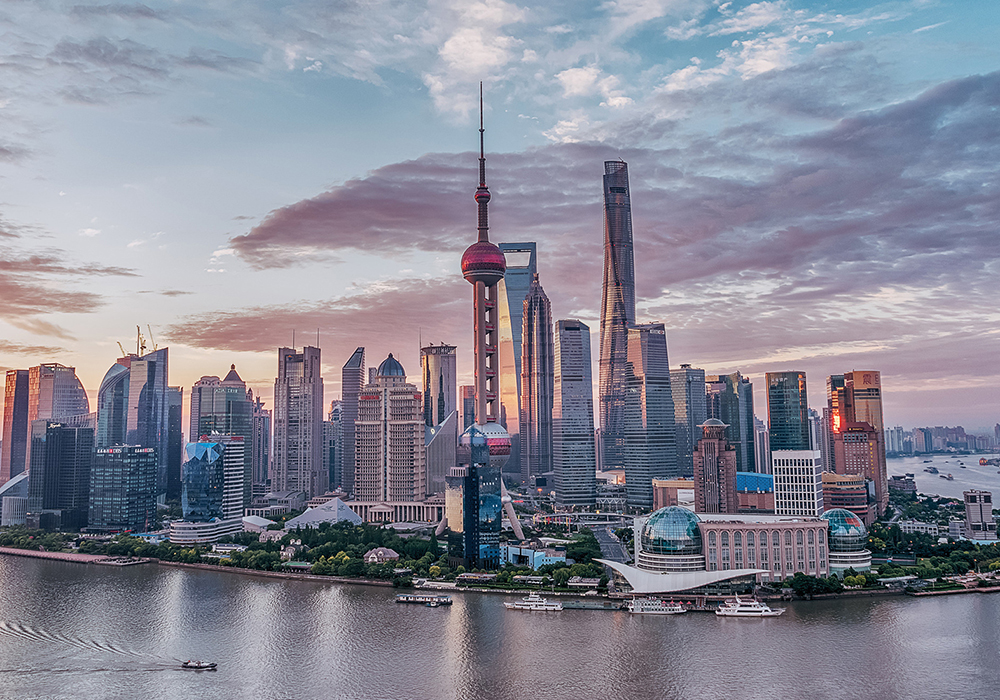
When you look at a modern map, calling China's largest financial hub Shanghai feels a bit ironic. Downtown doesn't sit directly on an open coastline. Instead, it rests along the Huangpu River, miles inland from the East China Sea. Yet, the characters that make up the city's name tell a very different geographical story—one rooted in centuries of shifting riverbeds, tidal flats, and coastal fishing communities.
The name Shanghai translates literally to "Upon the Sea" or "Above the Sea". To understand how a muddy delta village earned this moniker, we have to look past the neon skyscrapers of modern megacity life and examine the linguistic and historical evolution of China's most famous port.
Breaking Down the Characters
The Mandarin pronunciation Shànghǎi comes from two distinct Chinese characters: 上 (shàng) and 海 (hǎi).
- 上 (Shàng): This character carries meanings like "above," "up," "upon," or "going up." In topographical terms, it often indicates a position relative to a water level or an elevated spot.
- 海 (Hǎi): This character simply means "sea" or "ocean".
Put them together, and you get "On the Sea" or "Up into the Sea". For centuries, travelers and locals used this phrase to describe a settlement that sat right at the edge of the tidal waters of the Yangtze River estuary and the open ocean.
Today, that geographic reality has physically shifted. Millions of tons of silt carried down by the Yangtze River over hundreds of years have continuously built up the coastline. Landmasses like Pudong have expanded outward, leaving the historical downtown roughly 40 kilometers (25 miles) away from the direct open ocean. When the name was first coined, however, the water was right at their doorstep.
Historical Origins: From Fishing Village to Town
Long before it became an international treaty port or a gleaming metropolis, the region was a collection of small fishing and salt-producing settlements. During the Song dynasty, roughly around the 11th century, a specific settlement and river confluence in the area began to be formally referred to by this maritime name.
At that time, local people didn't rely on global trade or high finance. They relied on the water. Fishermen used a traditional bamboo and net trap called a hù (沪) to catch fish and crabs in the local creeks. That simple tool left a lasting legacy: Hù remains the official single-character abbreviation for the city today, and you'll see it stamped on local car license plates, shipping containers, and newspapers across the region.
As river trade grew, the settlement transformed. By the Yuan dynasty in the late 13th century, authorities officially elevated the town's administrative status, recognizing its growing importance as a hub for tax collection, cotton shipping, and coastal navigation.
The Ming Dynasty Walls and Economic Rise
The physical layout of the town solidified during the Ming dynasty. In 1553, local officials constructed a massive five-kilometer defensive wall around the old city to protect residents from frequent raids by Japanese pirates (Wokou). That walled area is now known as the Old City or Yu Garden district.
Even though it was technically classified as a lower-tier county seat rather than a provincial capital, the city's economic output caught the attention of the imperial court. In 1602, authorities permitted the construction of a City God Temple—an honor usually reserved for major prefectural capitals. This exception proved that the location's strategic maritime trade position had already made it punch well above its administrative weight.
Evolution Through the Colonial Era and Modern Times
The modern identity of the city was forged in the mid-19th century. Following the First Opium War and the Treaty of Nanking in 1842, the Qing dynasty was forced to open the port to foreign trade. British, French, and American powers established distinct concessions, turning a regional shipping port into a bustling cosmopolitan crossroad often called the "Paris of the East".
Foreign influence reshaped the architecture along the Huangpu River—the famous waterfront known as the Bund—while the Chinese population drove industrial growth behind the scenes. Through wars, revolution, and economic reforms, the city retained its foundational name, serving as a continuous bridge between China's vast inland river networks and the wider Pacific world.
If you want to dive deeper into the region's broader cultural history, you can read more through the Encyclopædia Britannica.
Common Misconceptions About the Name
People often misunderstand Chinese place names because literal translations don't always capture the historical nuance. Here are a few things to clear up:
- It does not mean "Going to Sea." While shàng can mean "to go to" in certain verb contexts (like shàngxué, meaning to go to school), in this ancient topographical compound, it acts as a spatial locator meaning "upper" or "upon" relative to the sea level.
- It wasn't always a mega-city. For most of its recorded history, it was a modest coastal and riverine outpost overshadowed by nearby powerhouses like Suzhou and Hangzhou. The name predates its skyscraper era by nearly a thousand years.
- The coastline didn't vanish by magic. People are often surprised that a city named "Upon the Sea" requires a drive to see actual ocean waves. The natural silt accumulation of the Yangtze River delta means the geography literally migrated eastward over the centuries.
Frequently Asked Questions
What does the single-character abbreviation Hù mean?
The abbreviation Hù (沪) refers to an ancient style of bamboo and net fish trap used by early fishermen in the local tidal creeks. It remains the official shorthand designation for the city in Chinese commerce and transport.
Why is the city so far from the open ocean if the name means "Upon the Sea"?
The name reflects historical geography. Centuries of heavy silt deposits from the Yangtze River have continuously extended the coastline outward, creating vast new tracts of land (such as Pudong) and moving the open sea further away from the historical center.
When was the name first officially recorded?
The name first appeared in historical records during the Song dynasty in the 11th century, identifying a specific town and river confluence located near the river mouth.
Did foreign powers change the city's name during the colonial period?
No. While foreign powers carved out international settlement zones and British, French, and American authorities ran their own municipal councils in the 19th and early 20th centuries, the local Chinese name Shanghai remained unchanged.



