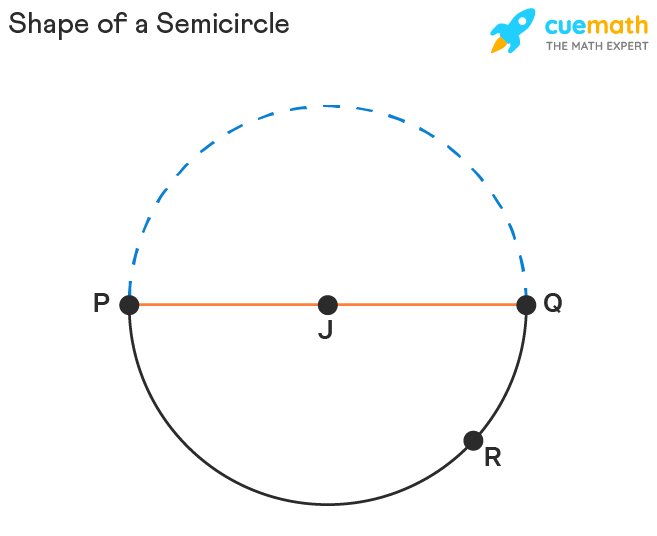
Knowing the semicircle formula helps you quickly calculate the area and perimeter of half-circles used in construction, mechanical parts, and design projects. A semicircle is simply half of a full circle created by cutting it straight across its diameter.
The area of a semicircle is half the area of a full circle, written as $A = \frac{\pi r^2}{2}$. The total perimeter includes both the curved arc and the straight diameter line, expressed as $P = \pi r + 2r$ or $r(\pi + 2)$. Here, $r$ represents the radius, which is half of the diameter.
The Core Math Behind Semicircles
Calculating dimensions accurately requires keeping track of the relationship between radius and diameter. If you have the diameter, divide it by two to find the radius before plugging numbers into the formulas.
Calculating Area
The standard area formula for a full circle is $\pi r^2$. Because you are working with half of that shape, you divide the final product by two.
- Formula: $A = \frac{\pi r^2}{2}$
- Example: For a radius of 6 cm, square the radius to get 36. Multiply by $\pi$ (roughly 3.1416), resulting in approximately 113.1. Divide by two to get an area of 56.55 square centimeters.
Calculating Perimeter
Finding the perimeter trips up many students and professionals because they forget to add the flat bottom edge. The perimeter isn't just the curved arc ($\pi r$); it also includes the straight diameter ($2r$).
- Formula: $P = \pi r + 2r$
- Example: Using that same radius of 6 cm, multiply 6 by 3.1416 for the arc length (18.85), then add the diameter of 12 cm ($2 \times 6$). The total perimeter is 30.85 cm.
Engineering and Design Applications
Engineers and drafters use these formulas daily to plan curved structural elements, drainage channels, and mechanical enclosures.
When building structural arches, knowing the exact surface area and boundary length dictates how much material to order. For instance, half-pipe steel channels or corrugated metal culverts rely on these exact perimeter calculations to determine sheet metal sizing before fabrication.
In manufacturing, pressure vessels often feature hemispherical or semi-circular end caps. Fabricators calculate the internal surface area to ensure the welds and metal thickness can handle internal fluid pressures safely without failing under stress.
Step-by-Step Calculation Example
Let's walk through a complete problem from start to finish. Imagine you're designing a garden path with a semicircular decorative stone patio, and the total span (diameter) against the house wall measures 10 meters.
- Find the radius: Divide the diameter by two. $10 \div 2 = 5$ meters.
- Calculate the surface area: Square the radius ($5^2 = 25$), multiply by pi ($25 \times 3.1416 = 78.54$), and divide by two. The patio covers $39.27$ square meters.
- Calculate the boundary border: Multiply the radius by pi ($5 \times 3.1416 = 15.71$), then add the flat side length (the 10-meter diameter). The total border length is $25.71$ meters.
Common Mistakes to Avoid
Precision errors happen quickly when mixing up linear units with squared units.
- Forgetting the flat edge: Calculating only the curved arc when finding perimeter leaves out the baseline diameter, leading to shortages in fencing or edging materials.
- Confusing diameter and radius: Using the full diameter value directly in place of $r$ inside squared equations quadruples your calculated error. Always double-check your initial measurements.
- Rounding too early: Keep full decimal values through intermediate calculation steps and round only at the final answer.
Frequently Asked Questions
How do you find the radius if you only know the area?
Reverse the area formula. Multiply the known area by two, divide that result by $\pi$, and then take the square root of that value to find the radius.
Is the perimeter of a semicircle the same as its circumference?
No. The circumference refers strictly to the curved outer boundary. The perimeter includes that curved boundary plus the straight diameter edge across the bottom.
Can you use these formulas for ellipses or ovals?
No. Semicircles share a constant radius from a single center point, whereas ellipses have variable radii along major and major axes, requiring entirely different formulas.
Why do some formulas use $r(\pi + 2)$ instead of $\pi r + 2r$?
They are identical algebraic expressions. Factoring out the radius $r$ simplifies manual calculation steps, especially when dealing with multiple recurring measurements.



