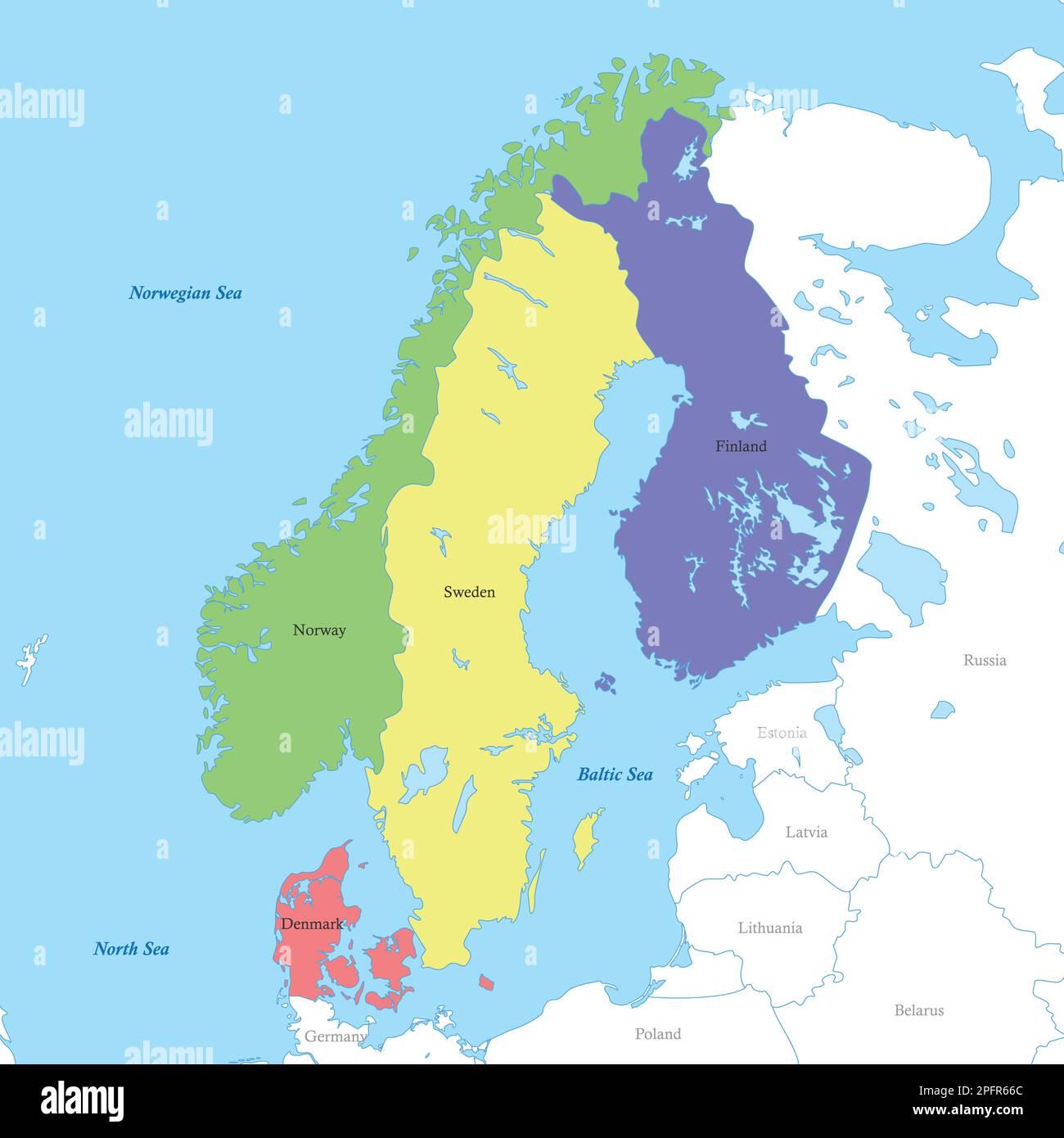
When you look at a map of Europe, Scandinavia occupies a distinct northern position that commands attention. Yet, pinning down what the region actually includes causes constant confusion. Strict geographical and political definitions rarely match, leading travelers and students to mix up Scandinavia with the broader Nordic countries.
Scandinavia strictly includes three nations: Norway, Sweden, and Denmark. However, popular usage frequently drags Finland and Iceland into the mix. Clearing up these boundaries matters because the region operates as a powerhouse of geography, culture, and economic innovation that punches well above its weight class on the global stage.
Defining the Region: Scandinavia Versus the Nordics
To read any map of Northern Europe correctly, you have to separate strict Scandinavia from the broader Nordic region. Scandinavia proper covers Norway, Sweden, and Denmark. Norway and Sweden share the massive Scandinavian Peninsula, while Denmark sits to the south, acting as a bridge toward continental Europe.
When you expand the definition to include Finland and Iceland—along with autonomous territories like Greenland, the Faroe Islands, and the Åland Islands—you are looking at the Nordic countries.
- Scandinavia: Norway, Sweden, Denmark (tied by closely related North Germanic languages and deep history).
- Nordic Region: Scandinavia plus Finland and Iceland (tied by shared political cooperation through the Nordic Council and similar social welfare systems).
- The Peninsula: The physical landmass holding Norway and Sweden, bordered by the Baltic Sea, the Norwegian Sea, and the Arctic Ocean.
Conflating these terms leads to basic geographic errors. For instance, Finnish is a Uralic language unrelated to Swedish, Norwegian, or Danish, even though Finland belongs firmly to the Nordic family.
Physical Geography and Climate Shaping
The physical landscape of Scandinavia was carved by massive ice sheets during the last glacial period, leaving behind dramatic terrain that dictates where people live and how economies function.
The Scandinavian Mountains run down the spine of the peninsula. On the Norwegian side, these mountains drop sharply into the Atlantic Ocean, creating the world-famous fjords—deep, narrow coastal inlets flanked by sheer cliffs. On the Swedish side, the terrain slopes much more gently toward the Gulf of Bothnia and the Baltic Sea, creating rolling hills, vast boreal forests, and thousands of freshwater lakes.
Denmark presents a stark contrast. It features no major mountains, consisting instead of low, flat plains, sandy coasts, and numerous islands. This flat terrain made Denmark historically ideal for agriculture, whereas Norway and Sweden relied far more heavily on maritime trade, forestry, and mineral extraction.
Despite sitting at high latitudes—comparable to Alaska or Siberia—Scandinavia enjoys a surprisingly temperate climate along its coastal regions. This warmth comes courtesy of the North Atlantic Drift, an extension of the Gulf Stream. Winters remain cold and dark in the north, but southern population centers like Copenhagen, Oslo, and Stockholm experience manageable winters and mild summers.
Cultural Foundations and Modern Society
The cultural identity of Scandinavia traces back centuries, forged by Viking Age exploration, shared Germanic root languages, and a persistent adaptation to harsh environments. Modern Scandinavian culture revolves around specific social philosophies that influence everything from workplace design to family law.
Core Cultural Concepts
- Janteloven: A cultural unwritten code emphasizing collective equality over individual boasting, which discourages conspicuous consumption.
- Lagom: A Swedish concept meaning "just the right amount"—neither too little nor too much. It guides design, lifestyle, and environmental sustainability.
- Hygge: A Danish term for creating a cozy, warm atmosphere that fosters well-being and contentment during long winter months.
These values feed directly into the Nordic model of governance. This system combines capitalist market economies with comprehensive welfare states. High tax rates fund universal healthcare, tuition-free higher education, and generous parental leave. Citizens accept high taxation because they see a direct, reliable return in public infrastructure, social security, and low economic inequality.
Economic Powerhouse of Northern Europe
Don't let the relaxed lifestyle fool you. Scandinavia functions as a global economic powerhouse driven by innovation, high productivity, and green technology.
Norway built a massive sovereign wealth fund—fueled by offshore oil and gas production—worth over a trillion dollars, insulating its economy against global shocks. Sweden functions as a hotbed for multinational corporations and tech startups, giving birth to global brands like Spotify, IKEA, Ericsson, and Volvo. Denmark dominates in green energy generation, pharmaceuticals, and advanced shipping logistics through companies like Maersk and Novo Nordisk.
The region consistently ranks near the top of the Ease of Doing Business Index and the Global Innovation Index. High investments in research and development, combined with strong digital infrastructure, allow Scandinavian economies to transition rapidly from traditional manufacturing to knowledge-based and green-tech industries.
To explore the region's official economic policy data and international trade agreements, you can visit the OECD Nordic Policy Reviews or check regional governance frameworks via the Nordic Council.
Common Misunderstandings About the Region
When people study maps or plan business ventures in Northern Europe, they often stumble over a few recurring myths.
- Mistake 1: Assuming all Scandinavian countries use the Euro. Only Finland uses the Euro among the Nordic nations. Sweden, Norway, and Denmark maintain their own currencies (Krona/Krone).
- Mistake 2: Treating the region as culturally uniform. While Sweden, Norway, and Denmark share linguistic roots, their political histories, immigration demographics, and foreign policies differ significantly. For example, Norway and Iceland remain outside the European Union, while Sweden, Denmark, and Finland are member states.
- Mistake 3: Believing the climate is permanently frozen. While Lapland in the far north experiences deep arctic conditions, southern Scandinavia enjoys maritime weather patterns similar to northern Germany or the British Isles.
Frequently Asked Questions
Why is Finland not technically considered part of Scandinavia?
Finland is excluded from strict Scandinavia because its native language belongs to the Uralic family rather than the North Germanic language family shared by Swedish, Norwegian, and Danish. However, Finland is fully part of the Nordic countries.
What is the difference between the Scandinavian Peninsula and Scandinavia?
The Scandinavian Peninsula is a purely geographical landmass shared by Norway, Sweden, and a small northwestern tip of Finland. Scandinavia is a cultural and political region consisting of Norway, Sweden, and Denmark.
Why are Scandinavian economies so successful despite high taxes?
High taxation funds robust public goods, including world-class education, universal healthcare, and active labor market programs. This creates a highly educated, flexible workforce, low corruption, and strong social trust, which fosters stable business innovation.
Do you need to speak a local language to travel or work in Scandinavia?
No. Scandinavia boasts some of the highest rates of English proficiency in the world outside of native English-speaking countries. Most locals speak fluent English, making it seamless to travel or conduct business across the region.



