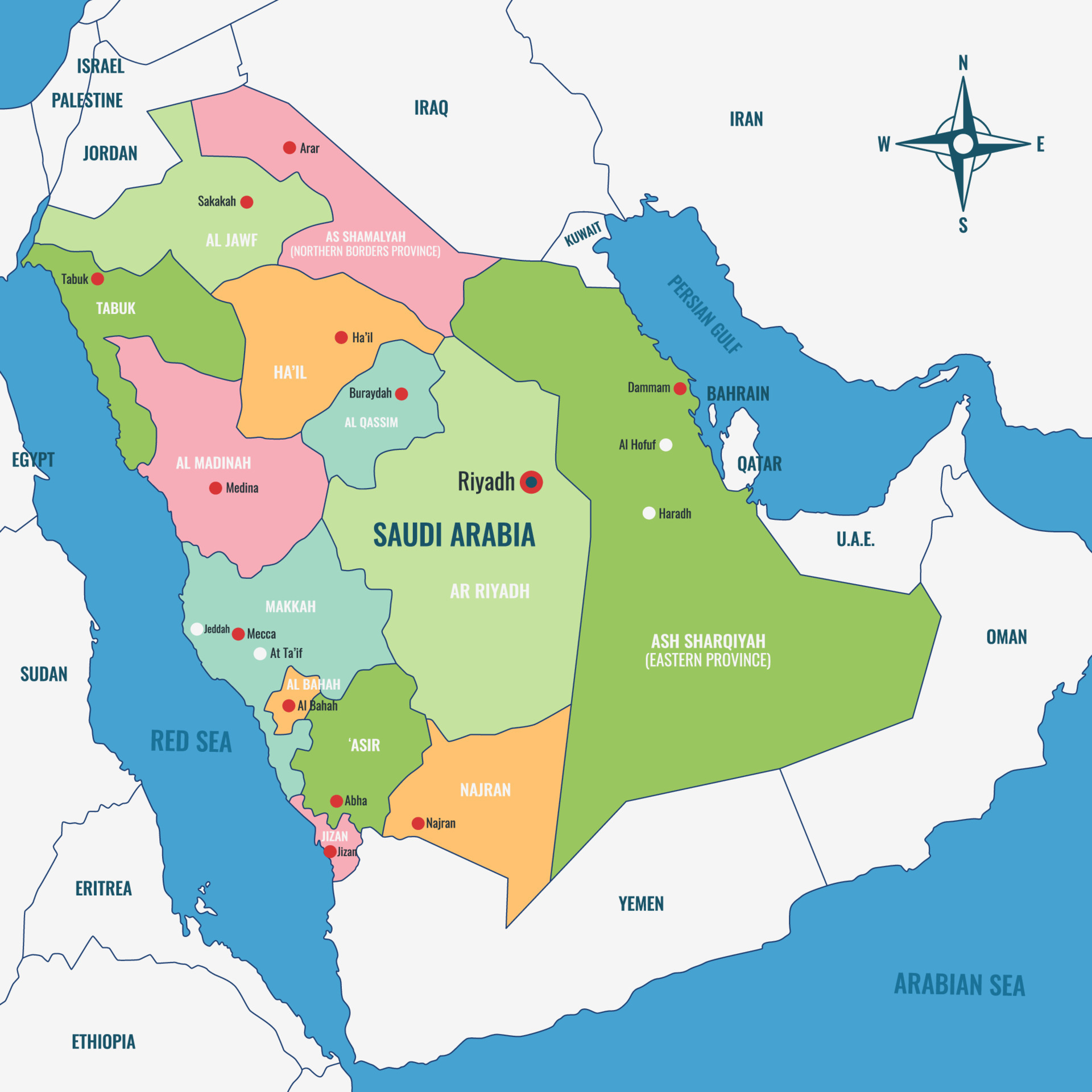
Saudi Arabia occupies a distinct geopolitical space where Asian continental geography converges with Middle Eastern political and cultural influence. While conventional global discourse often segregates the Middle East from the broader Asian landmass, the kingdom sits at the intersection of both, functioning as an anchor for Asian trade routes and the administrative heart of the Gulf Cooperation Council.
Understanding this dual alignment requires examining how Saudi Arabia manages its vast territory, its energy partnerships with eastern economies, and its domestic transformation under Vision 2030. The kingdom isn't just a regional player in West Asia; it's a structural bridge connecting major economic corridors across the Asian continent.
Geographic Realities and Territorial Scale
Spanning approximately 2.15 million square kilometers, Saudi Arabia dominates the Arabian Peninsula. Geologically and geographically, this peninsula forms the southwestern terminus of the Asian continent. The kingdom shares land borders with seven nations—Jordan, Iraq, Kuwait, Qatar, the United Arab Emirates, Oman, and Yemen—while maintaining extensive coastline access to both the Red Sea and the Persian Gulf.
This maritime positioning places Saudi Arabia at a critical global shipping choke point. The Bab-el-Mandeb strait at the southern end of the Red Sea handles a massive share of international trade moving between Asian manufacturing hubs and European markets. By securing these waters and investing in Red Sea port infrastructure, Saudi Arabia ties its economic stability directly to maritime security across South and East Asia.
Economic Integration with Asian Powers
For decades, Saudi petroleum fueled economies across North America and Europe. Today, the economic gravitational pull has shifted decisively toward Asia. China, India, Japan, and South Korea represent the primary destinations for Saudi crude oil exports, anchoring a trade relationship worth tens of billions of dollars annually.
Beyond energy, this economic axis has expanded into infrastructure financing and technological collaboration. Through state-backed entities like Aramco, the kingdom has secured multi-billion-dollar refining and petrochemical joint ventures in China and South Korea. These investments guarantee long-term demand for Saudi hydrocarbons while integrating the kingdom into Asian supply chains.
- China: The leading importer of Saudi oil and a major partner in large-scale infrastructure projects, telecommunications, and industrial manufacturing zones.
- India: A vital demographic and economic partner, absorbing significant energy supplies while sending millions of skilled and semi-skilled workers to support the Saudi labor market.
- Japan and South Korea: Key technology and construction partners, collaborating on advanced manufacturing, nuclear energy development, and smart city planning.
The Workforce and Demographic Exchange
The connection between Saudi Arabia and the rest of Asia extends far beyond trade statistics. Millions of expatriate workers from South and Southeast Asia—predominantly India, Pakistan, Bangladesh, the Philippines, and Indonesia—live and work within the kingdom.
This demographic exchange creates deep cultural and economic feedback loops. Remittances sent home by expatriate workers support millions of families abroad, while the physical presence of diverse Asian communities influences domestic urban life in cities like Riyadh, Jeddah, and Dammam. The kingdom has enacted labor reforms, such as the Labor Reform Initiative, to improve employment conditions, aligning its domestic standards more closely with international expectations while retaining its reliance on a globalized workforce.
Strategic Pivot: Vision 2030 and Asian Development Models
Launched to reduce the national economy's reliance on oil revenues, Vision 2030 borrows heavily from the rapid modernization models seen in East Asian tiger economies. The strategy emphasizes technological innovation, digital infrastructure, renewable energy, and advanced manufacturing.
Mega-projects like NEOM, the Red Sea Project, and Qiddiya showcase an ambition to leapfrog traditional industrial phases. NEOM's linear city design, The Line, relies on cutting-edge engineering partnerships with firms from Asia, Europe, and North America. By positioning itself as a logistics and tech hub, Saudi Arabia aims to become the central node where Asian manufacturing meets Middle Eastern capital and African markets.
You can explore more about regional development goals through official portals like the Saudi Press Agency. For global economic context, the World Bank MENA Overview provides detailed data on regional growth trends and structural reforms.
Balancing Regional Security and Continental Diplomacy
Diplomatically, Saudi Arabia navigates a complex web of regional rivalries and great power competition. Its leadership role within the Arab League and the Organization of the Petroleum Exporting Countries (OPEC) gives it substantial leverage over global energy prices and regional stability.
In recent years, Saudi foreign policy has adopted a pragmatic, diversification-focused approach. Rather than relying exclusively on traditional Western security umbrellas, Riyadh has engaged in diplomatic reconciliations with regional neighbors and strengthened multilateral ties through platforms like the Shanghai Cooperation Organisation (SCO), where it holds dialogue partner status. This diplomacy aims to insulate the region from external shocks and secure stable trade routes across the Asian continent.
Frequently Asked Questions
Is Saudi Arabia considered part of Asia?
Yes. Geographically, Saudi Arabia is located on the Arabian Peninsula, which is the southwestern region of the Asian continent. Politically and culturally, it is frequently grouped with the Middle East, but its landmass and continental shelf are entirely Asian.
What are the primary trade partners for Saudi Arabia today?
While historical ties to Western nations remain important, Asian economies—specifically China, India, Japan, and South Korea—are Saudi Arabia's largest trading partners, primarily driven by energy exports and petrochemical imports.
How does Vision 2030 impact Saudi Arabia's global role?
Vision 2030 shifts the kingdom away from strict oil dependency by developing tourism, technology, manufacturing, and renewable energy sectors, drawing heavy investment and technical expertise from Asian and global markets.
Why is the Red Sea important to Saudi Arabia's strategy?
The Red Sea connects Asian manufacturing to European markets via the Suez Canal. Saudi Arabia's extensive Red Sea coastline allows it to develop logistics hubs, tourism destinations, and secure trade corridors that boost its geopolitical leverage.



