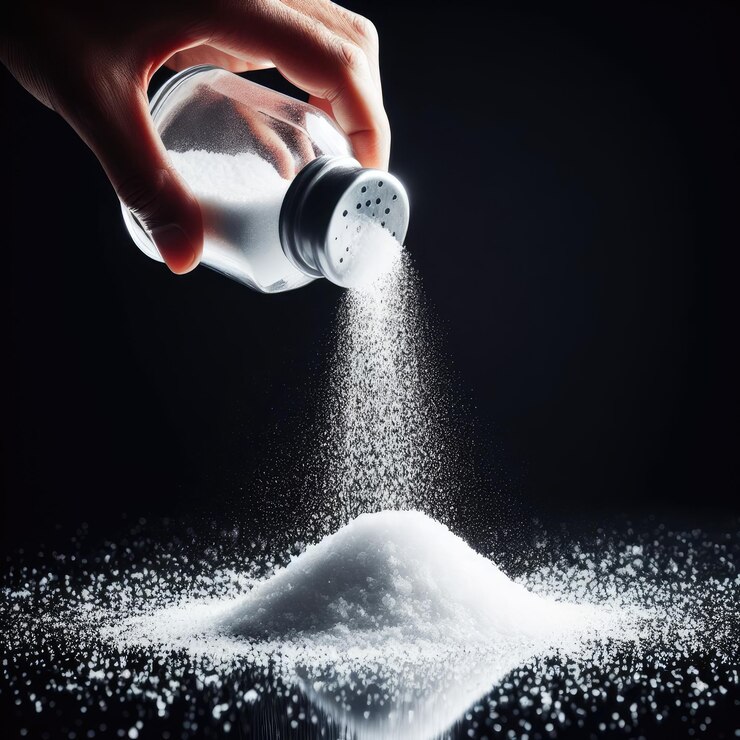
Table salt is one of the most familiar substances on Earth, yet its atomic architecture dictates some of the most robust physical behaviors in chemistry. The chemical formula for standard salt is NaCl, representing sodium chloride in a precise one-to-one ratio of sodium ions to chloride ions. This simple pairing creates an ionic lattice with a high melting point, distinct solubility traits, and crucial electrical conductivity properties when dissolved.
Understanding how this structure holds together requires looking past the shaker on the kitchen table and examining the electrostatic forces operating at the microscopic level. From the transfer of valence electrons to the formation of crystalline cubes, salt offers a textbook example of ionic bonding in action.
The Atomic Blueprint of NaCl
Every grain of table salt consists of sodium ($Na$) and chlorine ($Cl$) atoms bound together. Sodium is a soft, highly reactive alkali metal, while chlorine is a toxic, pungent green gas. When these two elements react, a dramatic chemical transformation occurs.
Sodium has a single valence electron in its outer shell. Chlorine needs one electron to complete its outer octet and achieve a stable electronic configuration. During the reaction, the sodium atom transfers its lone valence electron to the chlorine atom. This transfer turns the neutral sodium atom into a positively charged sodium ion ($Na^+$) and the neutral chlorine atom into a negatively charged chloride ion ($Cl^-$).
Because opposite charges attract, these newly formed ions snap together through electrostatic forces. This attraction doesn't stop at a single pair of ions. Instead, billions of sodium and chloride ions arrange themselves in an alternating, repeating three-dimensional pattern.
The Ionic Crystal Lattice
The geometry of sodium chloride is known as a face-centered cubic lattice. In this structure, each sodium ion is surrounded by six chloride ions, and each chloride ion is surrounded by six sodium ions, forming an octahedral coordination geometry.
This rigid crystalline arrangement explains why solid salt crystals form distinct, perfect cubes when they precipitate out of solution. The macroscopic shape of the crystal mirrors the microscopic geometry of the ionic bonds.
Because the electrostatic attraction holding the lattice together is extremely strong, breaking these bonds takes a significant amount of thermal energy. This is why solid sodium chloride has a very high melting point, sitting at approximately 801 degrees Celsius.
Physical and Chemical Properties
The ionic nature of NaCl gives rise to several predictable physical traits:
- High Melting and Boiling Points: The electrostatic bonds require massive amounts of energy to disrupt, keeping salt solid at room temperature and demanding high heat to liquefy.
- Brittleness: If you strike a salt crystal, you shift the planes of the ions. Like charges are forced next to each other, causing instant repulsion and clean cleavage along crystal planes.
- Electrical Conductivity: In solid form, the ions are locked tightly in the lattice and cannot move, meaning solid salt is an electrical insulator. However, when melted or dissolved in water, the ions break free and can carry an electrical current.
For more details on ionic bonding principles and crystal structures, you can explore resources provided by the Royal Society of Chemistry.
Solubility and Dissolution Mechanics
When you stir table salt into a glass of water, the solid crystals seemingly vanish. This process is driven by the polar nature of water molecules. Water ($H_2O$) has a partial negative charge near the oxygen atom and partial positive charges near the hydrogen atoms.
As water molecules collide with the surface of a salt crystal, their partial charges interact with the surface ions. The oxygen ends of the water molecules pull on the positive sodium ions, while the hydrogen ends pull on the negative chloride ions.
Water molecules surround each liberated ion in a process called hydration. Once hydrated, the ions float freely within the liquid, preventing them from recombining into a solid lattice. This is why saltwater solution conducts electricity so efficiently—the dissolved ions act as charge carriers, a concept detailed further by the American Chemical Society.
Common Mistakes and Misconceptions
People often misunderstand how salt behaves in various contexts. Here are a few errors to avoid when studying NaCl:
- Confusing Ionic and Covalent Bonds: Salt doesn't share electrons the way water or sugar does. It trades them entirely, forming ions rather than molecules.
- Assuming Solutions are Chemical Reactions: Dissolving salt in water is a physical change, not a chemical one. If you evaporate the water, the original sodium chloride crystals reform unchanged.
- Believing Pure Salt Conducts Electricity: Dry table salt sitting in a dry bowl is an insulator. It only conducts current when the ions have freedom of movement.
Frequently Asked Questions
Why is salt written as NaCl instead of Na1Cl1?
Chemical formulas use the lowest whole-number ratio of elements in a compound. Since sodium and chloride combine in a strict one-to-one proportion, the subscript numbers are omitted.
Is sodium chloride a molecule?
Strictly speaking, no. Because NaCl forms an extended continuous crystal lattice rather than discrete, isolated units, chemists refer to it as a formula unit rather than a molecule.
How does road salt melt ice?
When salt is applied to icy roads, it dissolves into the thin film of liquid water on the ice surface. This lowers the freezing point of the water—a phenomenon known as freezing point depression—causing the ice to melt even at sub-zero temperatures.
Can you extract pure sodium and chlorine from salt at home?
No. Doing so requires specialized industrial equipment, such as the molten salt electrolysis process, because separating the elements demands intense electrical currents and high temperatures.



