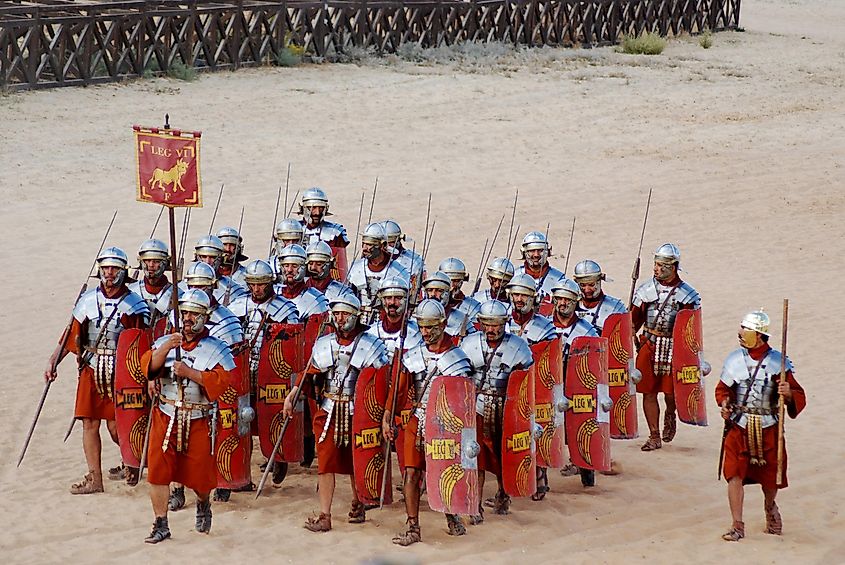
We live inside the architectural bones, legal frameworks, and linguistic structures of an empire that officially fell over fifteen centuries ago. While popular culture often reduces Rome to gladiators, marble busts, and collapsing emperors, its actual legacy is woven into the machinery of daily life today. From the way our cities are zoned to the calendars hanging on our walls, the reach of Roman civilization remains remarkably active.
To understand this persistence, we have to look past the political collapse of 476 CE and examine the functional systems Rome exported across the Mediterranean and Europe. The Romans were supreme synthesizers and engineers. They took ideas from Greece, Etruria, and the Near East, codified them into scalable systems, and built infrastructure designed to last.
Legal Systems and the Rule of Law
Modern legal codes across Europe, the Americas, and parts of Asia owe their foundational architecture to Roman jurisprudence. The concept that laws should be written down, publicly accessible, and subject to rational interpretation rather than the whim of a ruler stems directly from the Twelve Tables and later the Corpus Juris Civilis commissioned by Emperor Justinian.
- Codification: Written statutes protect citizens from arbitrary enforcement by establishing clear, transparent rules.
- Presumption of Innocence: Roman law introduced the principle that the burden of proof rests on the accuser, a cornerstone of modern democratic justice.
- Property Rights: Contracts, wills, and ownership disputes were formalized under Roman civil law, creating predictable commerce across vast geographic distances.
When you look at civil law systems in countries like France or Germany, or even the underlying equity principles in common law, the Roman emphasis on standardized statutes is clearly visible.
Engineering Infrastructure and Urban Planning
Roman engineering prioritized durability, standardization, and public utility. Many modern municipalities still utilize civic layouts and infrastructure concepts pioneered during the Republican and Imperial eras.
Road networks serve as a primary example. The Romans built over 80,000 kilometers of paved roads, using multi-layered foundations of stone, gravel, and packed earth crowned for drainage. These routes connected distant provinces, facilitated rapid military deployment, and boosted trade. Many modern European highways and railway lines follow the exact routes laid down by Roman surveyors.
Urban planning also reflects Roman structural philosophy. Grid systems, public squares acting as civic centers, amphitheaters for entertainment, and centralized water management systems established the template for modern cities. Aqueducts demonstrated a mastery of gravity and concrete, utilizing pozzolana—a volcanic ash mixture that allowed concrete to set even underwater—producing structures that still stand today.
Language and Scientific Nomenclature
Latin didn't disappear; it evolved. The Romance languages—Spanish, Portuguese, French, Italian, and Romanian—are direct descendants of spoken Latin. Furthermore, English absorbed massive vocabulary shifts through the Norman Conquest and the influx of scholarly Latin during the Renaissance.
- Legal and Medical Terminology: Terms like habeas corpus, subpoena, and anatomical descriptors rely entirely on Latin roots.
- Biological Taxonomy: The binomial nomenclature system created by Carl Linnaeus uses Latin and Greek roots to classify every living organism on Earth.
- Technical Writing: Precision in scientific and legal documentation often depends on precise Latin phrasing to avoid ambiguity.
Governance, Citizenship, and the Republic
The structural vocabulary of modern republics comes straight from Rome. The word republic itself derives from res publica, meaning "public affair."
The Roman Republic operated on a system of checks and balances, veto powers, specialized magistracies, and a bicameral legislative framework (the Senate and the assemblies). While Roman democracy was heavily oligarchic and favored the patrician class, the mechanics of representation deeply influenced the Founding Fathers of the United States and the architects of modern European parliaments. Concepts like civic duty, voting rights tied to citizenship status, and military service obligations were heavily debated through a Roman lens during the Enlightenment.
Daily Life and Cultural Habits
Many everyday rituals have direct lineages stretching back to the Tiber River.
The calendar we use today is a direct descendant of the Julian calendar, reformed by Pope Gregory XIII in 1582. The names of our months—January for Janus, the god of beginnings; March for Mars; July for Julius Caesar—perpetuate Roman timekeeping.
Architecture also preserves Roman forms. The use of arches, vaults, and domes dominates government buildings, courthouses, and museums worldwide. The United States Capitol building, courts across Europe, and civic halls from Sydney to London use neoclassical architecture deliberately to evoke the stability, authority, and permanence associated with Rome.
Frequently Asked Questions
Did Rome invent concrete?
No, but the Romans perfected it. While earlier civilizations used mud or lime mortars, Roman builders invented hydraulic concrete by mixing volcanic ash (pulvis puteolanus), lime, and seawater. This chemical reaction created tobermorite crystals that strengthened over time, allowing structures to resist erosion in marine environments.
How did Latin transform into different languages?
As the Roman Empire expanded, soldiers, merchants, and administrators spoke Vulgar Latin (everyday speech) rather than classical literary Latin. Over centuries, as Roman authority fragmented, isolated regional dialects mixed with local Celtic, Germanic, and Iberian languages, gradually fracturing into distinct Romance languages.
Why do modern government buildings look Roman?
Neoclassical architecture was adopted during the 18th and 19th centuries by emerging democracies—particularly in the United States and France—to visually associate their new governments with the ideals of the Roman Republic, emphasizing civic virtue, law, and enduring strength.
What caused the fall of the Roman Empire?
Historians agree that the collapse was not a single event in 476 CE, but a gradual process driven by economic inflation, political instability, overextended borders, continuous civil wars, and external migrations by Germanic tribes. Furthermore, the Western Empire fractured, while the Eastern half (the Byzantine Empire) continued for another thousand years.



