The reciprocal of a number is its multiplicative inverse. When you multiply any non-zero number by its reciprocal, the product equals exactly one. This core principle governs fractional division, algebraic equation solving, and matrix transformations across engineering and physics.
Without multiplicative inverses, scaling numbers up and down or reversing mathematical operations would require complex workarounds. Understanding how these inverses function gives you a reliable tool for simplifying calculations and solving rational expressions efficiently.
The Definition and Core Rules of Reciprocals
In mathematics, the reciprocal of a real number $x$ (where $x \neq 0$) is expressed as $\frac{1}{x}$ or $x^{-1}$. The fundamental equation defining this relationship is:
$$x \times \frac{1}{x} = 1$$
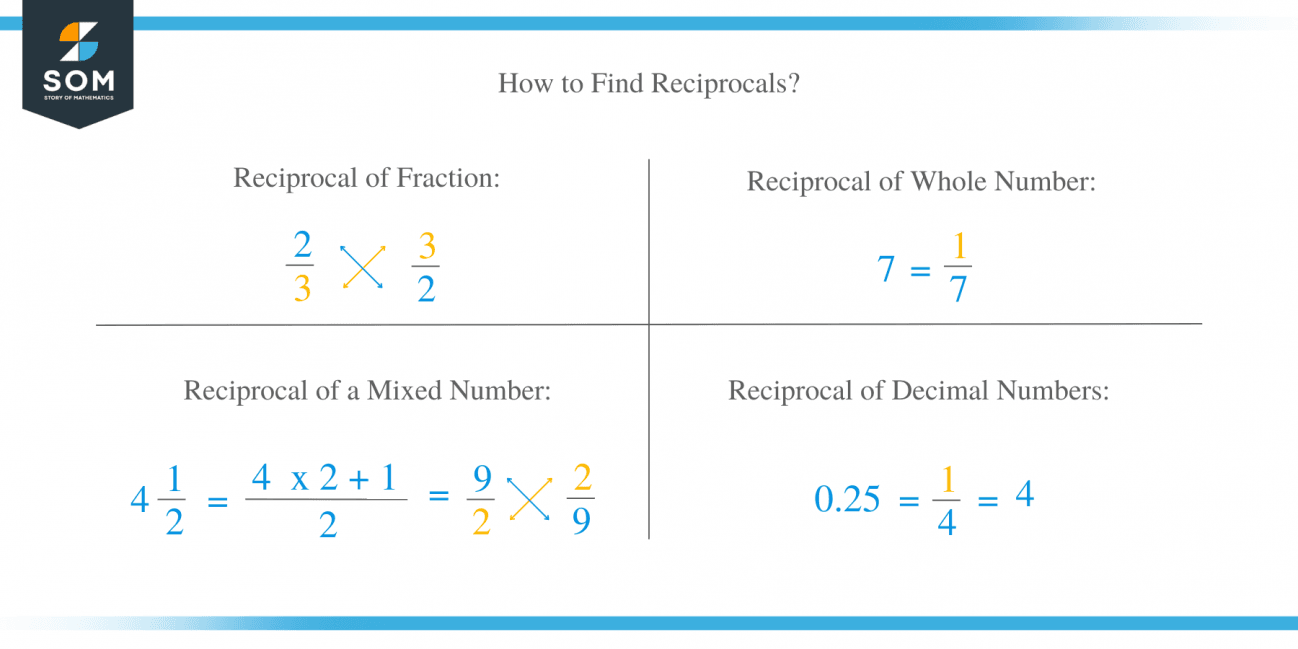
To find the reciprocal of any standard fraction, you simply swap the numerator and the denominator. For example, the reciprocal of $\frac{3}{4}$ is $\frac{4}{3}$.
Whole numbers and integers follow the exact same rule when viewed as fractions with a denominator of one. The integer $7$ can be written as $\frac{7}{1}$, making its reciprocal $\frac{1}{7}$. Decimals convert easily too: $0.25$ equals $\frac{1}{4}$, so its reciprocal is $4$.
- Integers: The reciprocal of $-5$ is $-\frac{1}{5}$. The sign remains unchanged because a negative multiplied by a negative yields a positive one.
- Fractions: The reciprocal of $\frac{a}{b}$ is $\frac{b}{a}$, provided neither $a$ nor $b$ equals zero.
- Mixed Numbers: Convert mixed numbers to improper fractions before swapping. The reciprocal of $2\frac{1}{3}$ (which is $\frac{7}{3}$) becomes $\frac{3}{7}$.
Why Division by Fractions Requires Reciprocals
Division and multiplication are inverse operations. In standard arithmetic, dividing a value by a number yields the exact same result as multiplying that value by its multiplicative inverse.
Consider the expression $12 \div \frac{3}{4}$. Instead of trying to share twelve into three-quarter-sized portions manually, you multiply twelve by the reciprocal of the divisor:
$$12 \div \frac{3}{4} = 12 \times \frac{4}{3}$$
To solve this, multiply $12$ by $4$ to get $48$, then divide by $3$, resulting in $16$. This "keep-change-flip" method relies entirely on the properties of the multiplicative inverse. It ensures that fractional division remains consistent with standard real-number arithmetic.
For a deeper look into foundational arithmetic rules and operations, you can review the National Center on Education and the Economy math frameworks.
Solving Algebraic Equations Using Inverses
In algebra, reciprocals act as primary tools for isolating variables trapped inside coefficients or fractions. When you encounter an equation where a variable is multiplied by a fractional coefficient, multiplying both sides by the reciprocal clears the fraction instantly.
Take the equation:
$$\frac{2}{3}x = 10$$
To isolate $x$, multiply both sides of the equation by the multiplicative inverse of $\frac{2}{3}$, which is $\frac{3}{2}$:
$$\frac{3}{2} \times \left(\frac{2}{3}x\right) = 10 \times \frac{3}{2}$$
This simplifies to:
$$x = \frac{30}{2} = 15$$
This technique applies to complex rational equations as well. Whenever you need to eliminate a denominator from a numerator variable, multiplying by the inverse keeps the equality balanced.
Common Mistakes and Special Cases
While working with reciprocals is straightforward, a few common pitfalls trip up learners and professionals alike.
- Forgetting the Zero Exception: Zero does not have a reciprocal. Because $\frac{1}{0}$ is undefined, attempting to invert zero breaks the rules of arithmetic.
- Swapping Signs on Negative Numbers: People often mistakenly change the sign when finding a reciprocal. The reciprocal of $-4$ is $-\frac{1}{4}$, not $\frac{1}{4}$. The inverse must preserve the original sign so their product remains positive one.
- Failing to Simplify First: When finding reciprocals of complex expressions, simplifying the base expression first prevents calculation errors.
For additional resources on algebra standards and curriculum guidelines, visit the National Council of Teachers of Mathematics.
Frequently Asked Questions
What is the reciprocal of zero?
Zero has no reciprocal. Because division by zero is undefined, there is no number that can multiply by zero to produce a product of one.
Are negative numbers allowed to have reciprocals?
Yes. Every non-zero negative number has a negative reciprocal. For example, the reciprocal of $-8$ is $-\frac{1}{8}$ because $(-8) \times (-\frac{1}{8}) = 1$.
How do you find the reciprocal of a variable expression?
For any non-zero variable expression like $2x$, the reciprocal is $\frac{1}{2x}$. For an exponent expression like $x^2$, the reciprocal is $\frac{1}{x^2}$ or $x^{-2}$.
Is a reciprocal the same as an opposite?
No. An opposite (additive inverse) changes the sign of a number, such as turning $5$ into $-5$, where their sum equals zero. A reciprocal (multiplicative inverse) flips the number, such as turning $5$ into $\frac{1}{5}$, where their product equals one.



