Standard computers store information as bits, which are strictly zeros or ones. Quantum computers break this binary rule entirely. They harness subatomic mechanics to process complex data streams at speeds classical hardware can't touch.
At its core, quantum computing basics center around manipulating matter at the atomic and subatomic levels. While your laptop uses transistors acting like simple light switches, quantum systems rely on quantum bits, or qubits, to evaluate multiple scenarios simultaneously. This shift in architecture changes how we approach cryptography, drug discovery, and logistics optimization.
Understanding Qubits and Classical Bits
To grasp why quantum systems perform differently, we have to look at how data storage works. A classical bit is a single switch. It's either off, representing a zero, or on, representing a one. Every photo you take, every video you stream, and every line of code you write breaks down into massive strings of these zeros and ones.
Qubits operate under entirely different rules governed by quantum mechanics. Instead of being locked into a definitive state of zero or one, a qubit can exist in a combination of both states until it's measured. This foundational concept changes everything about how calculations run. When you add more qubits to a processor, its processing capacity scales exponentially rather than linearly.
IBM provides a comprehensive overview of how these physical hardware units are constructed and measured on the IBM Quantum Computing site. Researchers build qubits using superconducting circuits, trapped ions, or silicon quantum dots, each approach bringing distinct engineering hurdles.
Superposition: Processing Multiple Realities
Superposition is the principle that allows a quantum system to evaluate vast arrays of possibilities at once. Picture a spinning coin. When the coin is resting on a table, it's clearly heads or tails. When you flick it into the air, it's spinning so fast that it's effectively both heads and tails at the same time.
In a quantum processor, superposition lets qubits represent complex probability waves. If you have three classical bits, you can represent one of eight possible values at any given moment. Three qubits in superposition can represent all eight of those values simultaneously. Scale that up to fifty qubits, and the system can evaluate more states at once than there are grains of sand on Earth.
Don't confuse this with parallel processing on a standard multi-core CPU. A standard computer with eight cores runs eight separate tasks sequentially or concurrently down distinct paths. A quantum computer uses interference to amplify correct answers while canceling out incorrect paths, arriving at a solution through wave mechanics.
Entanglement: Spooky Connections at a Distance
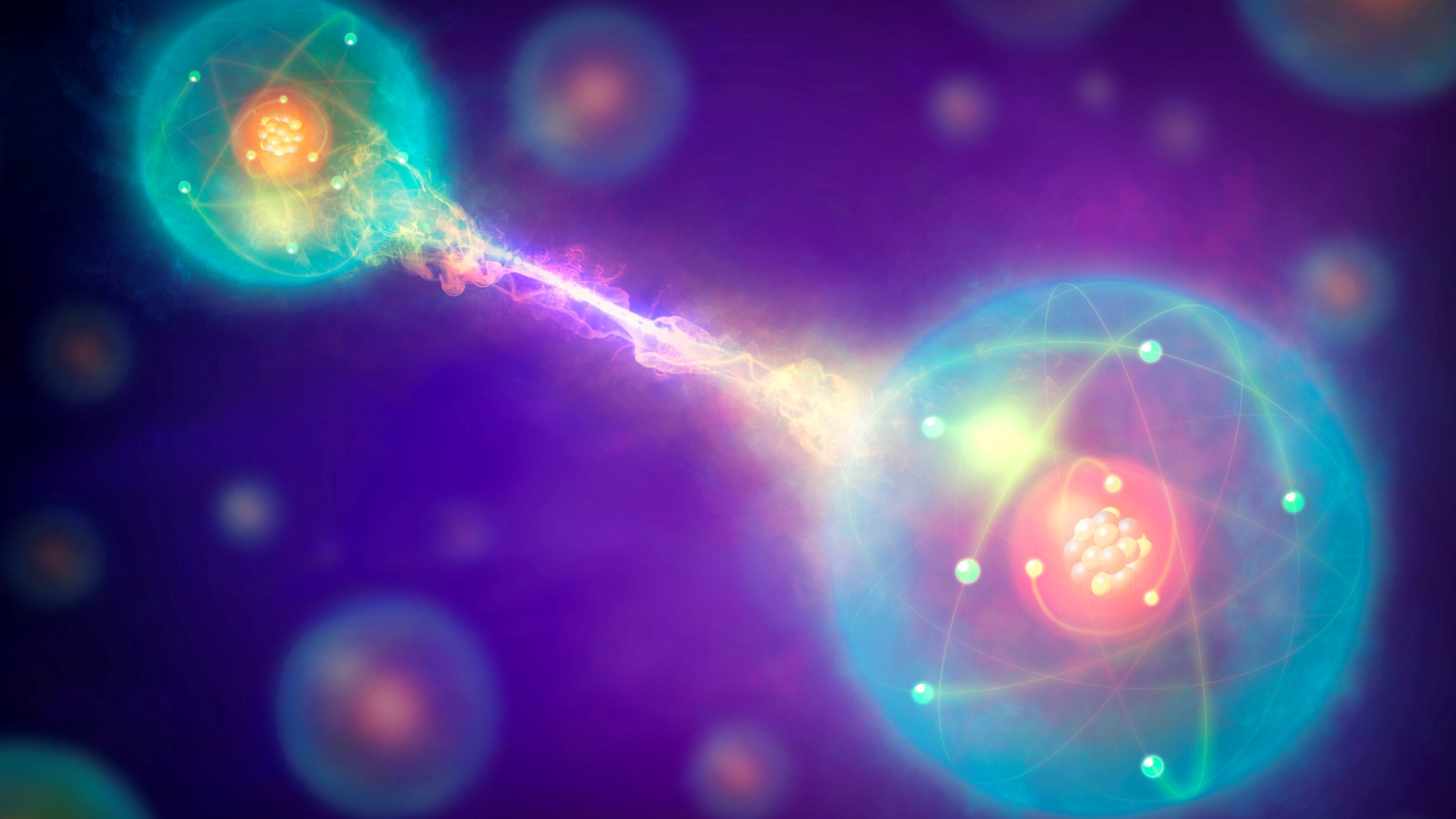
Entanglement is arguably the strangest phenomenon in modern physics. When two qubits become entangled, the physical state of one instantly dictates the state of the other, no matter how far apart they are. Albert Einstein famously called this "spooky action at a distance" because it seemed to violate the rule that nothing travels faster than light.
In a quantum algorithm, entanglement links the fate of multiple qubits together. If you measure one entangled qubit and find it in a state of one, its partner snaps into a correlated state immediately. This linkage allows quantum processors to coordinate vast numbers of calculations with extreme internal consistency.
Physicists measure and verify these states using advanced laboratory equipment. The National Institute of Standards and Technology (NIST) publishes ongoing research regarding how entanglement is stabilized and maintained in laboratory environments despite environmental noise.
Quantum Gates and Circuit Design
Just as classical logic gates like AND, OR, and NOT manipulate standard bits, quantum gates manipulate qubits. However, quantum gates have to obey the laws of quantum mechanics. They must be reversible, meaning you can run the operations backward without losing information.
Building a quantum circuit requires orchestrating laser pulses or microwave signals to tilt qubits into specific angles of superposition. Because qubits are exceptionally fragile, even a stray magnetic field or a microscopic temperature fluctuation causes decoherence, destroying the data before the calculation finishes.
Engineers spend years designing error-correction protocols to protect these fragile circuits. For instance, a logical qubit is often built by grouping dozens of physical qubits together to detect and correct errors on the fly without looking directly at the fragile superposition state.
Real-World Applications and Limitations
You might wonder where quantum computers are actually used today. They aren't meant to replace your smartphone or speed up your web browser. Classical computers remain vastly superior for everyday tasks like word processing, gaming, and basic web browsing.
Instead, quantum computers target intractable problems that would take classical supercomputers thousands of years to solve.
- Molecular Modeling: Simulating complex chemical structures for pharmaceutical development down to the atomic bond.
- Optimization Problems: Finding the absolute most efficient route for global supply chains, financial portfolios, or power grids.
- Cryptography: Breaking legacy RSA encryption while simultaneously creating uncrackable quantum key distribution protocols.
The field is still in its early engineering phase. Maintaining the near-absolute-zero temperatures required for superconducting qubits demands massive, expensive dilution refrigerators. We're still years away from fault-tolerant, utility-scale quantum computers running in commercial data centers.
Common Mistakes in Understanding Quantum Systems
People often misunderstand how quantum computing works due to sensationalized media coverage. Clearing up these misconceptions helps set realistic expectations for the technology.
- Thinking quantum computers try every answer at once like a brute-force search: Quantum algorithms use clever interference patterns to find answers, not just random guessing at high speed.
- Believing quantum computers will replace classical computers: They are specialized co-processors designed for specific mathematical workloads.
- Assuming entanglement allows faster-than-light communication: While the states correlate instantly, you cannot transmit usable data or messages faster than light using entanglement alone.
Frequently Asked Questions
Are quantum computers faster than regular computers?
Not for everyday tasks. For specific mathematical problems involving optimization, factoring, and molecular simulation, they solve problems exponentially faster than classical supercomputers. For browsing the web or editing documents, they are much slower.
What is quantum decoherence?
Decoherence is the loss of quantum information due to interaction with the external environment. Stray heat, electromagnetic radiation, or vibrations cause the delicate superposition of a qubit to collapse into a standard classical state, causing calculation errors.
Can I run quantum code on my own computer?
Yes. Major technology companies offer cloud access to real quantum hardware and simulators. You can write programs using open-source toolkits like Qiskit and execute them remotely on actual superconducting quantum processors.
How do quantum computers affect cybersecurity?
Large-scale quantum computers can run Shor's algorithm, which efficiently factors large prime numbers used in modern public-key cryptography. This capability threatens standard encryption standards, prompting governments and enterprises to transition toward post-quantum cryptography standards.



