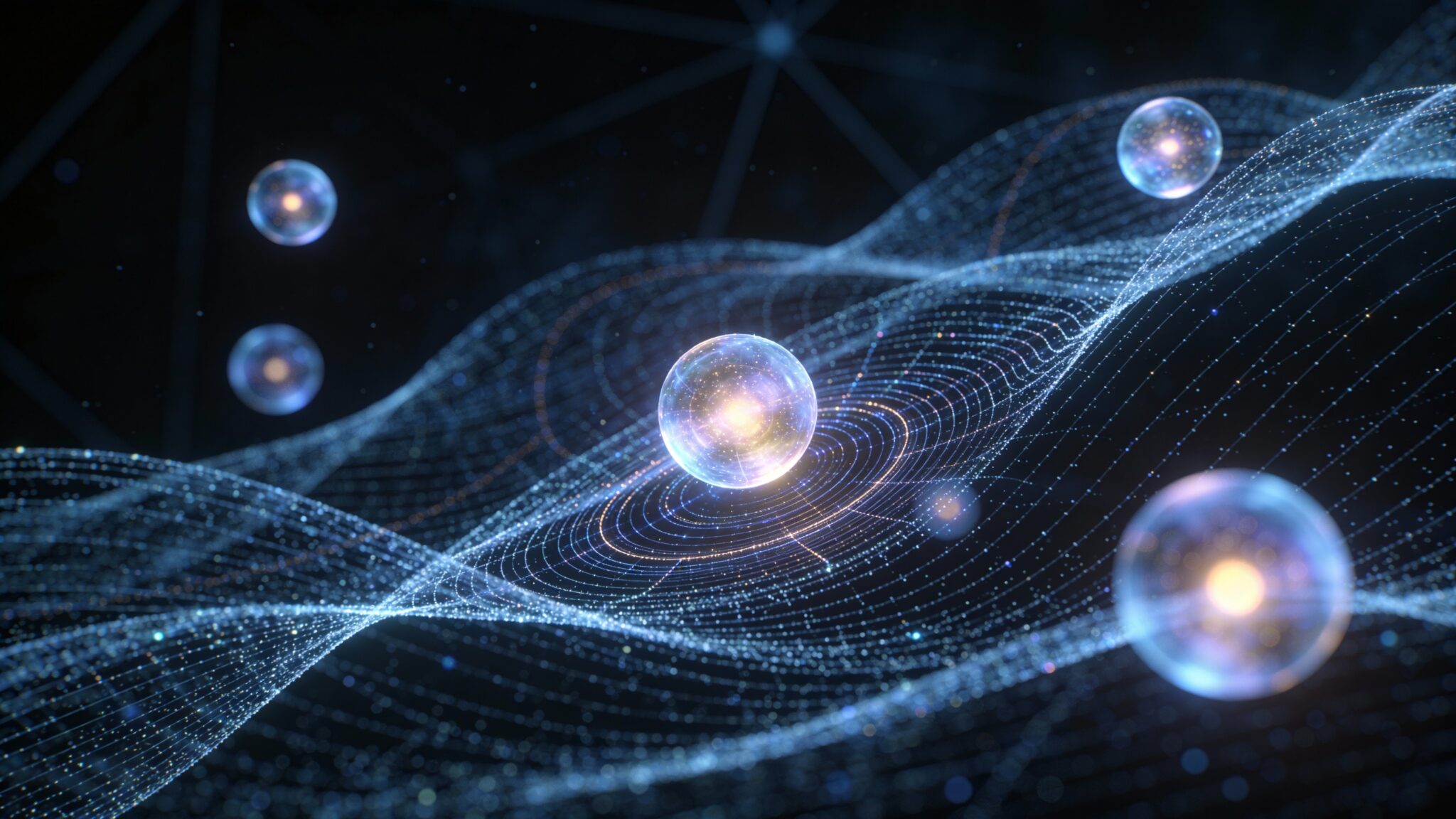
Life appears macroscopic, messy, and warm, operating under the comfortable laws of classical chemistry and Newtonian physics. Yet, beneath cell membranes and protein scaffolding, living systems exploit counterintuitive rules of subatomic physics. Quantum biology investigates how physical phenomena like superposition, entanglement, and tunneling actively drive vital biochemical operations rather than getting lost in biological thermal noise.
Far from being mere theoretical curiosities, these subatomic effects explain biological efficiencies that baffle classical models. From the blistering speed of enzymatic reactions to the precise migration of birds across continents, nature engineers solutions at the quantum edge. Exploring these mechanisms reveals a fundamental shift in how we understand the physics of life.
The Problem of Thermal Noise and Quantum Fragility
For decades, physicists dismissed the idea that quantum mechanics mattered inside living organisms. Quantum states like superposition and entanglement are famously fragile. They require isolated, near-absolute-zero environments to survive without decohering into random thermal motion. A warm, wet, crowded cell seems like the absolute worst place for delicate subatomic wavefunctions to persist.
Yet, evolution doesn't build vacuum chambers; it builds proteins. Recent experimental biophysics shows that biological macromolecules actively shield quantum states. Protein structures act as protective scaffolding, dampening thermal disturbances just long enough for subatomic wizardry to occur. Instead of fighting thermal noise, biological architecture directs it, utilizing quantum rules to achieve thermodynamic feats that classical chemistry alone can't replicate.
Quantum Coherence in Photosynthetic Energy Transfer
Photosynthesis converts sunlight into chemical energy with near-unity efficiency, baffling engineers who try to replicate it. Classical physics predicts that a photon's captured energy—an exciton—should bounce randomly down a pigment molecule ladder until it hits a reaction center, losing significant energy as heat along the way.
Instead, plants and green sulfur bacteria utilize quantum coherence. Ultrafast spectroscopy reveals that excitons don't take one path; they sample multiple energy pathways simultaneously through quantum superposition. This "quantum walk" lets energy find the absolute fastest, most efficient route to the reaction center before thermal decoherence sets in.
- Ultrafast dynamics: Coherent oscillations persist for hundreds of femtoseconds inside light-harvesting complexes.
- Energy conservation: Minimizing thermal dissipation yields conversion efficiencies exceeding 90 percent.
- Biomimetic design: Engineers use these natural quantum blueprints to build advanced solar energy tech.
Quantum Tunneling in Enzyme Catalysis
Enzymes accelerate biochemical reactions by factors of millions or billions, sustaining cellular metabolism. While classical models attribute this speed entirely to lowering activation energy barriers via structural positioning, they miss a crucial subatomic shortcut: quantum tunneling.
Protons and electrons don't always climb over energy barriers; sometimes, they pass straight through them. Because subatomic particles exhibit wave-particle duality, their position is described by a probability wave. If a barrier is thin enough, a non-zero portion of that wave exists on the other side, allowing the particle to materialize past the obstacle without spending the thermal energy required to climb it.
Studies on enzymes like alcohol dehydrogenase demonstrate that proton tunneling accounts for massive reaction rate enhancements. Without this quantum shortcut, metabolic reactions would proceed too slowly to sustain life.
Avian Magnetoreception and Radical Pairs
How migratory species navigate thousands of miles across open oceans without maps or GPS remains one of nature's greatest navigation feats. The answer lies in the avian eye, specifically within light-sensitive proteins called cryptochromes.
When blue light strikes cryptochrome molecules in a bird's retina, it creates a radical pair—two electrons separated across the molecule, each possessing a correlated spin state. These electron spins form a quantum entangled pair whose behavior responds delicately to the weak pull of Earth's magnetic field.
- Spin dynamics: The magnetic field shifts the radical pair between singlet and triplet chemical states.
- Visual cues: This chemical shift alters nerve signals, allowing birds to literally "see" magnetic field lines as patterns of light or shadow.
- Biological persistence: Cryptochromes maintain this spin correlation long enough to provide stable navigational input despite cellular noise.
For broader context on how quantum phenomena intersect with physical chemistry, explore resources from the National Science Foundation.
Implications for Medicine and Synthetic Design
Understanding how biological machinery exploits subatomic mechanics opens entirely new doors across technology and medicine. Drug discovery is moving beyond rigid lock-and-key models toward dynamic quantum-aware frameworks, accounting for how molecular flexibility and tunneling influence drug-target binding.
Furthermore, synthetic biology aims to engineer artificial enzymes and nanomaterials that harness quantum efficiency. By mimicking nature's protective protein scaffolding, engineers hope to build robust quantum computing components that resist environmental decoherence.
Frequently Asked Questions
Does quantum biology mean the brain uses quantum mechanics for consciousness?
While speculative hypotheses suggest quantum processes occur inside neuronal microtubules, mainstream biophysics treats these ideas with extreme caution. Current concrete evidence for quantum biology is strictly limited to well-defined molecular mechanisms like photosynthesis, enzyme catalysis, and magnetoreception.
How do scientists detect quantum effects in warm, wet cells?
Researchers use advanced optical tools like two-dimensional electronic spectroscopy and cryogenic techniques. These methods fire ultrafast laser pulses to track energy transfer and molecular vibrations on femtosecond timescales, capturing fleeting quantum signatures before they decay.
Is quantum biology a newly discovered field?
The foundational theories date back to physicist Erwin Schrödinger's 1944 book What is Life?, where he proposed that life might rely on non-classical physics. However, technological breakthroughs in ultrafast lasers over the past two decades turned these theoretical musings into an empirical science.



