Introduction to Prose
Prose is ordinary language that follows the natural flow of speech and grammatical structure, rather than the rhythmic structure of verse. If you aren't writing poetry or song lyrics, you're writing prose. It's the default mode of communication for novels, journalism, technical manuals, emails, and everyday conversation.
Writers often complicate the concept by treating it as an academic abstraction. At its core, prose is simply communication stripped of metrical constraints. Understanding how it functions, how it differs from poetry, and how to shape it effectively transforms your ability to communicate clearly across any medium.
Defining Prose in Contrast to Verse
The easiest way to understand prose is to look at what it isn't. Poetry relies on meter, rhyme schemes, and intentional line breaks. Prose relies on sentences and paragraphs.
Consider this poetic excerpt:
"The woods are lovely, dark and deep, But I have promises to keep..."
Now, look at a prose version of the same thought:
"The forest looks lovely and dark, but I have obligations to fulfill before I can rest."
The prose version uses standard grammatical rules. It flows horizontally across the page in sentences rather than stacking vertically in poetic stanzas.
Key Structural Differences
- Rhythm: Poetry has a measured, rigid beat. Prose has a natural rhythm dictated by spoken speech patterns and punctuation.
- Layout: Poetry uses line breaks and stanzas. Prose uses sentences grouped into paragraphs.
- Grammar: Poetry often bends syntax, drops punctuation, or twists word order for artistic effect. Prose adheres strictly to standard grammatical rules, unless a specific stylistic choice requires otherwise.
Major Types of Prose
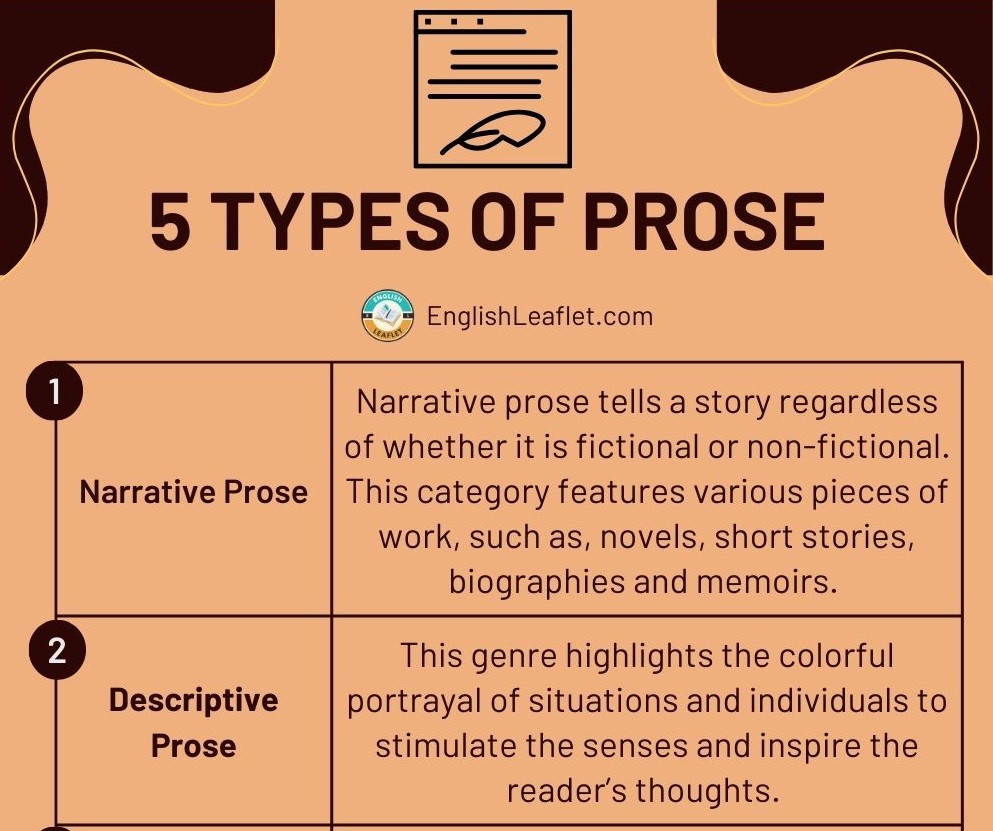
Prose isn't a monolith. Writers categorize it based on purpose, audience, and style. Knowing these categories helps you choose the right approach for your writing goals.
1. Narrative Prose
Narrative prose tells a story. It has characters, a plot, a setting, and a conflict. You find this in novels, short stories, memoirs, and fables.
- Example: Pride and Prejudice by Jane Austen.
- Purpose: To entertain, evoke emotion, or explore human experiences through storytelling.
2. Expository Prose
Expository prose explains, informs, or describes a specific topic. It doesn't tell a story; it delivers facts and analysis. You encounter this in textbooks, news articles, and instruction manuals.
- Example: A guide explaining how photosynthesis works.
- Purpose: To educate the reader clearly and objectively without personal bias.
3. Descriptive Prose
Descriptive prose paints a picture with words. It engages the five senses to help the reader visualize a scene, person, or object. Writers use it heavily in fiction to build immersive worlds.
- Example: "The kitchen smelled of burnt sugar, damp wool, and the sharp tang of cheap bleach."
- Purpose: To create a vivid sensory experience for the reader.
4. Persuasive Prose
Persuasive prose aims to convince the reader to adopt a specific viewpoint or take a specific action. It uses logic, evidence, and rhetorical appeals. You see this in opinion columns, advertising copy, and political speeches.
- Example: An editorial arguing for local park funding.
- Purpose: To sway public opinion or drive behavioral change.
Elements of Effective Prose
Writing good prose requires attention to craft. Even though it lacks the musicality of verse, strong prose has its own distinct music created by pacing, word choice, and sentence variety.
Sentence Variety
Monotony kills engagement. If every sentence in your paragraph has the exact same length and structure, your writing feels robotic. Mix short, punchy sentences with longer, complex thoughts.
Bad: The dog ran down the street. He chased a red ball. He barked at a mailbox. He came home tired. Good: The dog bolted down the street, locking his eyes on a rogue red ball. After barking furiously at an innocent mailbox, he trotted home exhausted.
Active Voice
Passive voice drains the energy out of your writing. Instead of hiding who performs the action, put the subject up front.
- Passive: The cake was eaten by the children.
- Active: The children ate the cake.
Active prose moves faster and keeps the reader anchored in the scene.
Eliminating Clutter
Good prose is concise. Strip away filler words like very, really, just, and that unless they serve a vital purpose. Trust strong nouns and verbs to do the heavy lifting. For more on cutting unnecessary words, read the classic writing advice in The Elements of Style via Project Gutenberg.
Common Mistakes in Prose Writing
Writers often trip over a few predictable hurdles when trying to craft clean prose.
- Overwriting: Using five adjectives when one precise noun will do. Keep your language sharp.
- Ignoring the Ear: Forgetting to read your writing aloud. If your sentences make you stumble, they'll make your reader stumble.
- Melodrama: Overloading non-fiction or casual narrative with flowery, poetic adjectives. Save the flourishes for when the moment actually demands them.
- Neglecting Pacing: Keeping every paragraph the same length. Let your paragraphs breathe by varying their size based on the weight of the idea.
Frequently Asked Questions
Is dialogue considered prose?
Yes. Any written dialogue formatted in standard sentences and paragraphs falls under the umbrella of prose. Play scripts use a specialized format, but novels and short stories integrate dialogue directly into narrative prose.
Can prose include rhythm?
Absolutely. While prose lacks the strict meter of poetry, skilled writers use cadence, alliteration, and sentence length to create a musical reading experience. This is often called lyrical prose.
Is a graphic novel considered prose?
No. Graphic novels combine visual art with text, placing them in a separate multimodal category, though any traditional text captions inside them generally follow prose rules.
How do I improve my prose style?
Read widely outside your comfort zone, study how professional journalists and novelists structure their paragraphs, and practice editing your own drafts by cutting at least ten percent of your word count.



