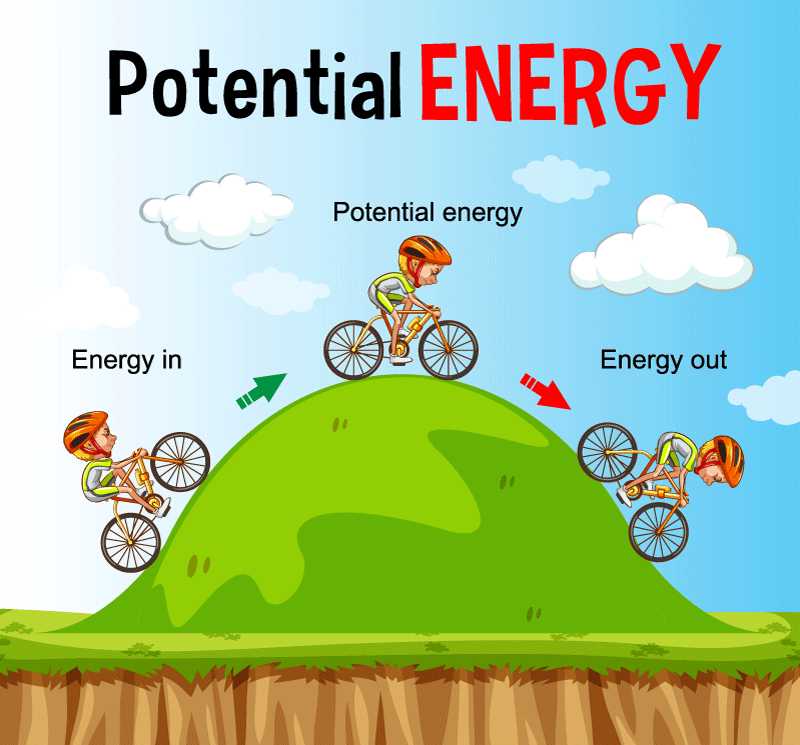
Potential energy is stored energy determined by an object's position, chemical composition, or internal stress. It is the capacity to do work that remains inactive until external forces trigger a transformation into kinetic energy. Without this invisible reservoir, modern power grids, mechanical clocks, and biological systems couldn't function.
We encounter stored energy everywhere, from water held behind a massive concrete dam to chemical bonds inside a lithium-ion battery. Understanding how this energy works requires looking past formulas to examine the physical mechanisms that govern storage and release.
Defining Potential Energy
At its core, potential energy is a state function. It depends entirely on the current configuration of a system rather than how the system got into that state. When you lift a heavy iron weight off the floor, you invest work against gravity. That energy doesn't disappear; it gets stored in the gravitational field surrounding the earth and the object.
Physicists express gravitational potential energy with the standard formula:
$$PE = mgh$$
In this equation, $m$ represents mass, $g$ is the local acceleration due to gravity, and $h$ measures height above a reference point. If you drop the weight, gravity accelerates it downward, turning that stored potential into kinetic energy until impact.
Every form of stored energy follows a similar conservation principle. Energy transforms from one type to another, but the total amount within a closed system remains constant.
Major Categories of Stored Energy
Physical systems store energy in several distinct ways depending on the forces involved.
Gravitational Fields
Masses separated by distance store gravitational energy. On a planetary scale, this principle enables hydroelectric power generation. Engineers build reservoirs high above river valleys to maximize the head height. When water flows down penstocks through turbines, gravity converts massive amounts of potential energy into mechanical rotation and electrical current.
Elastic Structures
Materials that resist deformation store elastic potential energy when stretched, twisted, or compressed. Robert Hooke described this behavior for springs, noting that the force required to deform an elastic object scales linearly with the distance displaced:
$$F = -kx$$
Here, $k$ stands for the spring constant, and $x$ measures displacement from equilibrium. Archery bows, mechanical watch mainsprings, and vehicle suspension systems rely entirely on this mechanical storage mechanism.
Chemical Bonds
At the molecular level, energy is stored in the electrical forces holding atoms together. Chemical potential energy depends on the arrangement of electrons within molecules. When wood burns or gasoline reacts with oxygen in an internal combustion engine, molecular bonds break and reform into more stable configurations like carbon dioxide and water. The difference in bond energy releases thermal and mechanical power.
Electrostatic and Magnetic Fields
Charged particles and magnetic materials store energy based on their relative positions in electromagnetic fields. Capacitors in electronic circuits store electrical potential energy in an electric field between two conductive plates, releasing it rapidly when needed to power camera flashes or stabilize computer power supplies.
Practical Applications in Modern Engineering
Harnessing stored energy allows society to decouple power generation from immediate consumption. Electrical grids rely heavily on pumped-storage hydroelectricity. During periods of low electricity demand, facilities use excess grid power to pump water from a lower reservoir to an upper one. During peak demand, operators release the water backward through the turbines to generate electricity quickly.
In transportation, regenerative braking systems capture kinetic energy that would otherwise turn into waste heat during deceleration. Electric vehicles use their electric motors as generators when slowing down, routing current back into the battery pack as chemical potential energy.
Flywheel energy storage systems use massive rotors spinning at high speeds in a vacuum to store mechanical energy kinetically and potential-wise, offering rapid response times for grid frequency regulation. According to the U.S. Department of Energy, modern storage technologies are critical for stabilizing grids that incorporate intermittent renewable sources like wind and solar.
Common Misconceptions
People often confuse potential energy with static inactivity, assuming that a stationary object possesses zero energy. In reality, an object at rest can hold immense destructive or mechanical capability based on its position or internal stress.
Another frequent error assumes that potential energy is an intrinsic property of a single isolated object. Gravitational potential energy belongs to the Earth-object system, not just the object itself. If you remove the Earth, the concept of gravitational height loses its meaning.
Frequently Asked Questions
Can potential energy be negative?
Yes. Potential energy is always calculated relative to an arbitrary reference point or zero level. If an object sits below your chosen reference point, its potential energy value relative to that point is negative.
How does temperature affect stored energy?
Thermal energy influences internal molecular motion, but potential energy specifically concerns configuration and position. However, extreme heat can alter chemical bonds or crystal structures, changing a material's chemical and elastic potential energy limits.
Why is chemical energy classified as potential energy?
Chemical energy depends on the relative positions and spatial arrangements of electrons and nuclei within atoms and molecules. Because it relies on configuration rather than net macroscopic motion, physicists classify it as a form of potential energy.



