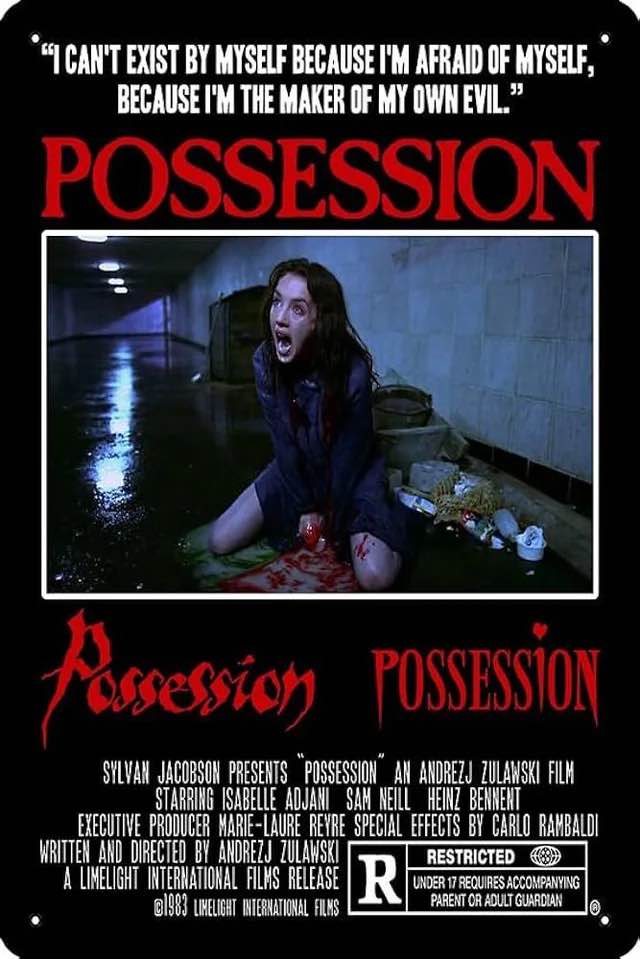
Released in 1981, Andrzej Żuławski’s Possession remains one of the most abrasive and emotionally taxing psychological horror films ever committed to celluloid. The narrative follows Mark, a spy who returns to West Berlin to find his wife, Anna, demanding a divorce while acting increasingly erratic, secretive, and unhinged. What begins as a brutal domestic dispute over infidelity quickly spirals into a surreal, nightmarish descent involving body horror, doppelgangers, and a grotesque creature living in an abandoned apartment.
The primary search intent behind this topic centers on viewers trying to decode the labyrinthine, metaphor-heavy plot, understand the visceral creature elements, and make sense of the devastating emotional wreckage depicted on screen. While surface reviews summarize the breakdown of a marriage, they routinely fail to address why the film uses Berlin's political climate as a mirror, how Carlo Rambaldi’s creature practical effects function as physical manifestations of trauma, or why the character names and mirror imagery lock the film into a closed loop of eternal repetition.
The Breakdown of Marriage as a Battlefield
The central affair between Anna and her lover Heinrich is depicted not as a quiet betrayal, but as a total demolition of human sanity. Mark returns home to discover a household already rotting from the inside. Żuławski shoots these early scenes with aggressive, swirling hand-held camera movements that trap the audience inside the suffocating hallway of their apartment. You aren't just observing a failing marriage; you're trapped in the crossfire of two people weaponizing their own psychological fractures.
Anna's infidelity isn't standard cinematic adultery. She gives herself over to an entity that defies natural law, symbolizing how deeply trauma and emotional withdrawal can distort a person beyond recognition. Mark's reaction is equally destructive. Instead of leaving, he obsessively tracks her movements, subjects himself to physical self-harm, and lets his obsession consume what is left of his professional and personal life.
- The apartment becomes a pressure cooker of unexpressed resentment and repressed violence.
- Conversations escalate instantly from cold silence to shattering physical outbursts, particularly in the infamous subway station sequence where Isabelle Adjani experiences a convulsive, blood-soaked breakdown.
- The physical separation of the couple mirrors the divided geopolitical state of Berlin at the time, positioning personal paranoia as a symptom of a fractured larger world.
Decoding the Creature and Body Horror
The most jarring element of the film is the grotesque tentacled creature that Anna hides in her secondary apartment. Many first-time viewers miss the symbolic weight of this entity, viewing it merely as a bizarre monster-movie trope. In reality, the creature serves as the physical manifestation of Anna's internal void and her desperate, destructive desire for an absolute, primal connection that human relationships fail to satisfy.
The creature evolves across the runtime, growing larger and more demanding as Anna's human ties disintegrate. It requires human sacrifice, feeding on the men who enter her orbit. This dynamic flips traditional horror conventions: Anna isn't a helpless victim trapped by a monster; she is a willing partner in a parasitic symbiosis.
- Carlo Rambaldi, renowned for his work on E.T. and Alien, crafted the creature using practical animatronics that give it a slimy, tactile realism.
- The interactions between Anna and the creature are shot with an intimacy that mimics grotesque romance, emphasizing that her true bond lies with this monstrous abstraction rather than her husband.
- The creature represents the literal embodiment of guilt, obsession, and the heavy burden of secrets kept inside a crumbling relationship.
Doppelgangers and the Cyclical Nature of Trauma
As the plot thickens, the introduction of identical look-alikes—Helen the gentle schoolteacher who looks like Anna, and Bob the doppelganger of Mark—transforms the narrative from a domestic drama into an existential loop. These alternate versions are not sci-fi clones in the traditional sense; they are psychological projections of what the original characters wish their partners could be.
Mark clings to Helen because she offers the peaceful domesticity that Anna has completely abandoned. Yet, this replacement offers no salvation. The doppelgangers carry the same fundamental flaws, doomed to reenact the exact same cycle of suspicion, violence, and self-destruction.
- Helen's Role: She represents the sanitized, harmless ideal of womanhood that Mark desperately craves to quiet his own anxieties.
- Bob's Role: He mirrors Mark's possessive, hyper-vigilant tendencies, proving that changing the face doesn't fix the underlying rot.
- The Final Imagery: The film closes with the terrifying implication that the nightmare is about to start all over again with the next generation, symbolized by the eerie behavior of the young son and the final shot of the new doppelgangers.
According to a Criterion Collection analysis on Possession, Żuławski crafted the film immediately following a painful divorce, which explains the raw, unadulterated venom bleeding through every frame. The actors didn't just portray distress; Isabelle Adjani later noted that the intensity of the shoot required years of psychological recovery, particularly because the grueling emotional demands blurred the line between fiction and genuine breakdown.
Frequently Asked Questions
What does the ending of Possession (1981) actually mean?
The ending features the terrifying appearance of an apocalyptic entity outside the apartment while the doppelgangers prepare to repeat the cycle of violence. It suggests that personal trauma and emotional abuse are contagious, unstoppable forces that eventually spill over to consume the entire world, leaving no one untouched.
Why was Possession banned upon its initial release?
The film was heavily censored or banned in several countries—earning a spot on the UK's infamous "video nasty" list—due to its extreme depiction of visceral body horror, self-mutilation, and the harrowing, unhinged intensity of Isabelle Adjani's performance in the subway scene.
Was the creature in Possession a metaphor for something specific?
Director Andrzej Żuławski intentionally kept allegorical interpretations open, but critics widely view the creature as a physical representation of the absolute ugliness of divorce, emotional isolation, and the monstrous things people create when love turns to absolute hatred.
How did the Cold War setting influence the plot?
Set in West Berlin with the Berlin Wall looming in the background, the film uses the divided city as a direct parallel to the characters' fractured psyches. The constant surveillance, paranoia, and feeling of living on an artificial precipice mirror the political tension of the era.



