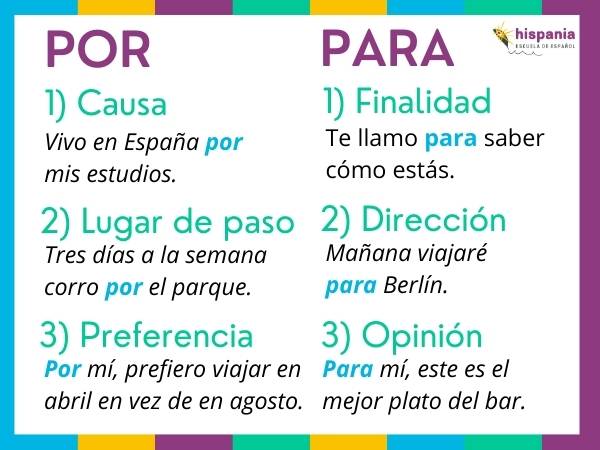
Mastering por vs para is the ultimate milestone for any Spanish learner. These two tiny words both translate to English as "for," "by," or "through," which explains why they cause endless headaches. But they aren't interchangeable. Para targets destinations, endpoints, and recipients, while por tracks causes, means, paths, and exchanges.
If you've ever frozen up trying to decide whether to say gracias por or gracias para, you're not alone. This guide breaks down the exact logic, provides clear formulas, lists common traps, and gives you a practical framework to choose correctly every single time.
The Core Rule: Destination vs. Journey
The easiest way to separate por and para is to think of them as coordinates versus trajectories.
- Para is the destination. It looks forward to a final goal, a hard deadline, an intended recipient, or a specific endpoint. It answers the question: Where is this going, or who is it for?
- Por is the journey. It looks backward at a cause, or sideways at the means, duration, exchange rate, or path traveled. It answers the question: By what means, why, or through where?
Once you anchor this mental model, the specific rules fall naturally into place.
When to Use Para
Think of para using the acronym PROED: Purpose, Recipient, Opinion, Endpoint, Deadline.
1. Purpose (In order to + Verb)
When para is followed immediately by an infinitive verb, it means "in order to." It states the exact goal of an action.
- Estudio mucho para sacar buenas notas. (I study hard in order to get good grades.)
- Compramos ingredientes para cocinar la cena. (We bought ingredients to cook dinner.)
2. Recipient / Beneficiary
If someone is receiving an object, a gift, or the benefit of an action, use para.
- Este regalo es para María. (This gift is for Maria.)
- Hice este café para ti. (I made this coffee for you.)
3. Destination (Physical Direction)
When moving toward a specific physical destination, para marks the final stop.
- Salimos para Madrid mañana. (We leave for Madrid tomorrow.)
- Este tren va para la costa. (This train is headed for the coast.)
4. Deadlines and Future Time
When setting a specific due date, schedule, or time limit, use para.
- El informe está listo para el viernes. (The report is ready by Friday.)
- Tenemos que terminar esto para las tres. (We have to finish this by three o'clock.)
5. Opinions and Perspective
When expressing whose point of view or opinion is being shared, para means "according to" or "for [someone]."
- Para mí, la paella es el mejor plato. (To me / In my opinion, paella is the best dish.)
- Para un principiante, habla muy bien español. (For a beginner, he speaks Spanish very well.)
When to Use Por
Think of por using the acronym CAEED: Cause/Reason, Around/Through a place, Exchange, Duration, Means/Mode.
1. Cause or Reason
Use por to explain why something happened (the motive or root cause), equivalent to "because of" or "due to."
- No fui a la fiesta por la lluvia. (I didn't go to the party because of the rain.)
- Te ayudé por amistad. (I helped you out of [because of] friendship.)
2. Movement Through or Along a Space
If you are passing through an area, traveling along a street, or moving via a general zone rather than heading to a final destination, use por.
- Caminamos por el parque. (We walked through the park.)
- Entró por la ventana. (He entered through the window.)
3. Exchange and Cost
When trading one thing for another—whether buying an item, paying a price, or doing a favor in return—use por.
- Pagé veinte euros por el libro. (I paid twenty euros for the book.)
- Te cambio mi manzana por tu sándwich. (I'll trade you my apple for your sandwich.)
4. Duration of Time
When stating how long an action lasted, use por. Note that in many contexts, you can omit por entirely in casual speech, but it's grammatically correct here.
- Viví en Barcelona por dos años. (I lived in Barcelona for two years.)
- Estudió toda la noche por seis horas. (He studied all night for six hours.)
5. Means of Communication or Transportation
How did you travel, send a message, or communicate? Use por for the medium or channel.
- Hablamos por teléfono. (We talked on the phone.)
- Viajamos por avión. (We traveled by plane.)
- Mandé el documento por correo electrónico. (I sent the document by email.)
Common Contrasts That Clear Up Confusion
The best way to lock in the difference is to look at pairs of sentences where changing the preposition completely changes the meaning.
Example 1: Studying
- Estudio español para hablar con mis amigos. (I am studying Spanish in order to speak with my friends — goal/purpose.)
- Estudio español por mi trabajo. (I am studying Spanish because of my job — cause/reason.)
Example 2: Running Errands
- Voy al supermercado por leche. (I'm going to the supermarket to fetch/get milk — motivation/errand.)
- Compré leche para el pastel. (I bought milk intended for the cake — recipient/purpose.)
Example 3: Travel
- Salgo para Sevilla hoy. (I am leaving destined for Seville today — endpoint.)
- Paso por Sevilla hoy. (I am passing through Seville today — trajectory.)
Essential Fixed Expressions
Many common phrases in Spanish use por or para as fixed idioms. Instead of analyzing the grammar, memorize these high-frequency pairings:
- Por lo general: Generally speaking
- Por supuesto: Of course
- Por fin: Finally
- Por lo tanto: Therefore
- Para siempre: Forever
- Para variar: Just for a change
You can explore more contextual structures through resources like the Real Academia Española or structured practice guides on Instituto Cervantes.
Frequently Asked Questions
Can por and para ever mean the exact same thing?
No. Even when both translate loosely to "for" in English, their underlying perspective differs. One always emphasizes destination or goal (para), while the other highlights cause, path, or exchange (por).
Why do native speakers sometimes mix them up in casual speech?
In certain regional dialects, speakers lean heavily on one preposition over the other in colloquial expressions. However, in formal writing and standard Spanish across Spain and Latin America, the distinction remains strict.
How can I stop translating from English in my head?
Stop thinking of the English word "for." Instead, ask yourself a conceptual question before speaking: Am I talking about a goal/endpoint, or a cause/path? Build your intuition by grouping vocabulary around the acronyms PROED and CAEED.
What is the easiest way to test myself?
Take a simple sentence frame like Lo compré [por/para]... and test the logic. If you bought it in exchange for money, use por. If you bought it as a gift for someone, use para. Context always provides the answer.



