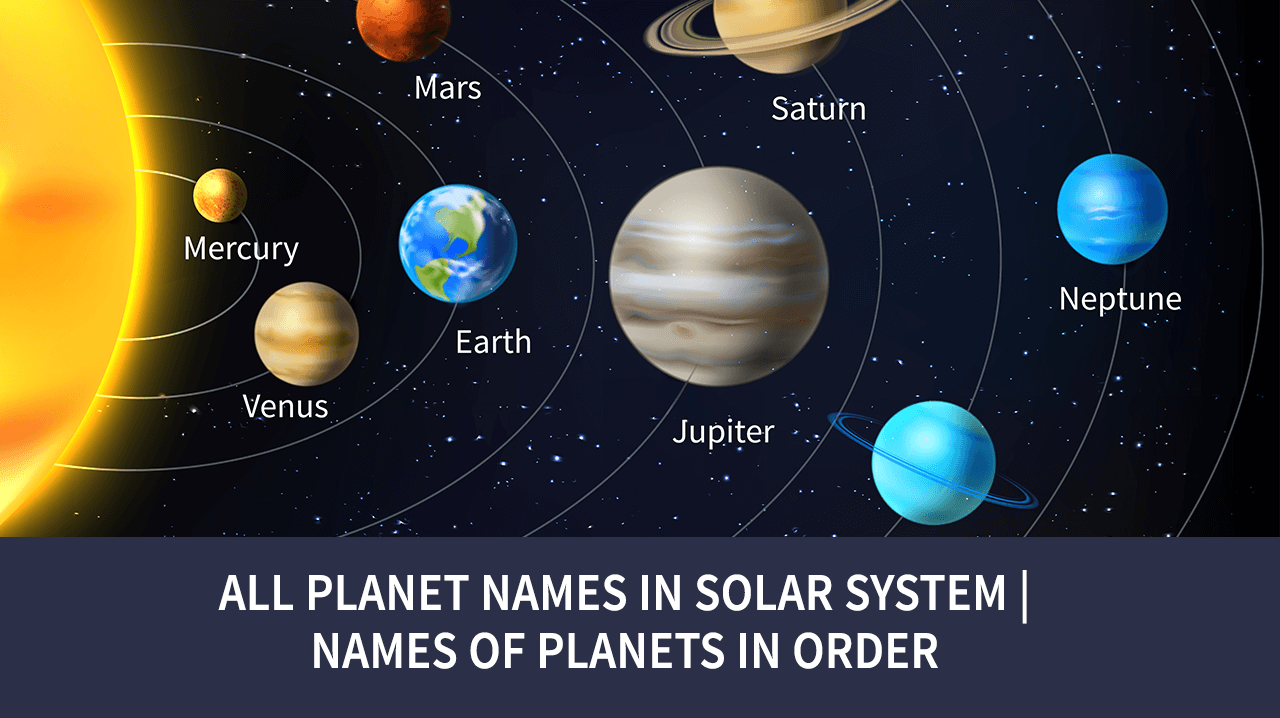
The planets in our solar system arrange themselves in a strict, sun-centered sequence determined by gravitational pull, angular momentum, and the thermal gradients of the early solar nebula. Moving outward from the Sun, the correct order is Mercury, Venus, Earth, Mars, Jupiter, Saturn, Uranus, and Neptune.
This sequence splits cleanly into two distinct categories: the four rocky terrestrial worlds situated near the inner system and the four massive fluid worlds dominating the outer reaches. Understanding this arrangement requires looking past simple memorization mnemonics to examine the physical mechanisms—such as frost lines, accretion rates, and orbital resonances—that dictate why each planet occupies its specific cosmic address.
The Inner Terrestrial Worlds
The inner solar system houses four rocky bodies formed close to the Sun where intense solar radiation and stellar winds swept away lighter hydrogen and helium gases, leaving behind refractory minerals, metals, and silicate rock.
Mercury
Mercury sits closest to the Sun at an average distance of 36 million miles, completing a full orbit in just 88 Earth days. Because it lacks a substantial atmosphere to trap heat or distribute thermal energy, it experiences the most extreme temperature fluctuations in the solar system, ranging from 430 degrees Celsius on its sunlit side to -180 degrees Celsius in its dark craters. According to NASA Solar System Exploration, Mercury's oversized iron core accounts for about 85 percent of its radius, making it denser than any other planet relative to its size.
Venus
Venus orbits second from the Sun at roughly 67 million miles, sharing a similar mass and bulk composition with Earth that earned it the moniker of Earth's twin. However, a runaway greenhouse effect driven by a thick carbon dioxide atmosphere and clouds of sulfuric acid creates surface temperatures around 475 degrees Celsius—hot enough to melt lead. Atmospheric pressure at the surface is 92 times that of Earth, equivalent to the pressure found nearly a kilometer beneath Earth's oceans.
Earth
Earth occupies the third orbital slot at approximately 93 million miles from the Sun, resting squarely within the circumstellar habitable zone where liquid water can pool on the surface. A balanced mix of nitrogen and oxygen in the atmosphere, combined with a protective global magnetic field generated by fluid motion in the core, stabilizes surface conditions. Active plate tectonics recycle carbon and minerals, maintaining the chemical balance necessary for complex carbon-based life to thrive.
Mars
Mars orbits fourth at an average distance of 142 million miles. While it once possessed a thick atmosphere and flowing surface water roughly 3.5 billion years ago, the loss of its magnetic field allowed solar wind to strip away most of its atmospheric envelope. Today, Mars is a cold, arid desert featuring Olympus Mons, a shield volcano nearly three times the height of Mount Everest, and Valles Marineris, a colossal tectonic scar spanning thousands of miles.
The Asteroid Belt Boundary
Separating the inner terrestrial planets from the outer gas giants is the asteroid belt, spanning the orbital gap between Mars and Jupiter at roughly 2.2 to 3.2 astronomical units from the Sun.
Rather than being the remnants of a destroyed planet as once hypothesized, the belt consists of primordial planetesimals that failed to coalesce into a full-sized planet due to the powerful gravitational perturbations of nearby Jupiter. The region contains millions of rocky bodies, ranging from tiny dust particles to dwarf planet Ceres, which holds nearly a third of the belt's total mass.
The Outer Gas and Ice Giants
Beyond the asteroid belt, temperatures drop sharply, allowing volatile compounds like water, ammonia, and methane to condense into solid ices alongside massive reservoirs of hydrogen and helium gas.
Jupiter
Jupiter is the fifth planet from the Sun and the undisputed giant of the system, outweighing all other planets combined by a factor of 2.5. Composed primarily of hydrogen and helium under immense pressure, Jupiter features iconic banded cloud patterns and the Great Red Spot, a persistent anticyclonic storm larger than Earth that has raged for centuries. Its powerful gravitational field shapes the orbits of nearby asteroids and comets, while its Galilean moons—Io, Europa, Ganymede, and Callisto—form a miniature planetary system of their own.
Saturn
Saturn orbits sixth, sitting roughly 900 million miles from the Sun. Famous for its dazzling ring system composed of trillions of ice and rock particles ranging from microscopic dust to house-sized boulders, Saturn boasts the lowest density of any planet; if you could find a body of water large enough, it would float. Its largest moon, Titan, features a dense nitrogen atmosphere and stable surface lakes of liquid methane and ethane, making it a primary target in astrobiology.
Uranus
Uranus orbits seventh at an average distance of 1.8 billion miles, classified alongside Neptune as an ice giant due to its high concentration of heavier volatile elements like water, ammonia, and methane. Uranus stands out for its extreme axial tilt of 98 degrees, meaning it essentially orbits the Sun on its side. This unusual orientation likely stems from a catastrophic collision with a protoplanetary body during its formation phase, resulting in unusual seasonal cycles that last over two decades per pole.
Neptune
Neptune is the eighth and final classical planet in our solar system, sitting nearly 2.8 billion miles from the Sun. A year on Neptune takes 165 Earth years to complete. Despite receiving minimal solar energy, Neptune generates internal heat that drives the fastest planetary winds recorded in the solar system, whipping cloud tops of frozen methane at supersonic speeds exceeding 1,200 miles per hour.
Frequently Asked Questions
Why is Pluto no longer considered a planet?
In 2006, the International Astronomical Union established a precise definition for a planet: it must orbit the Sun, possess sufficient mass to achieve hydrostatic equilibrium into a round shape, and have cleared its orbital neighborhood of competing debris. While Pluto meets the first two criteria, its shared orbit with numerous other icy bodies in the Kuiper Belt means it hasn't cleared its zone, leading to its reclassification as a dwarf planet.
What is the frost line and why does it matter?
The frost line is the theoretical distance from the Sun within which volatile compounds like water vapor remained gaseous during the solar system's formation due to high heat. Inside this line, only rocky and metallic materials could accrete, forming the terrestrial planets. Outside this line, ices remained solid, providing abundant raw material that allowed outer planets to grow massive enough to capture vast envelopes of hydrogen and helium gas.
Are the planets lined up in a straight line?
No. The planets orbit the Sun at different speeds and distances on slightly elliptical paths that don't share the exact same orbital plane. While they occasionally appear roughly grouped on one side of the Sun from an Earth-based perspective—a visual alignment known as conjunction—they never form a rigid straight line in three-dimensional space.
How long does light take to travel from the Sun to Neptune?
Sunlight takes about 8 minutes and 20 seconds to reach Earth, but it travels a much greater distance to the outer edge of the planetary system. Light from the Sun takes approximately 4 hours to reach Neptune.



