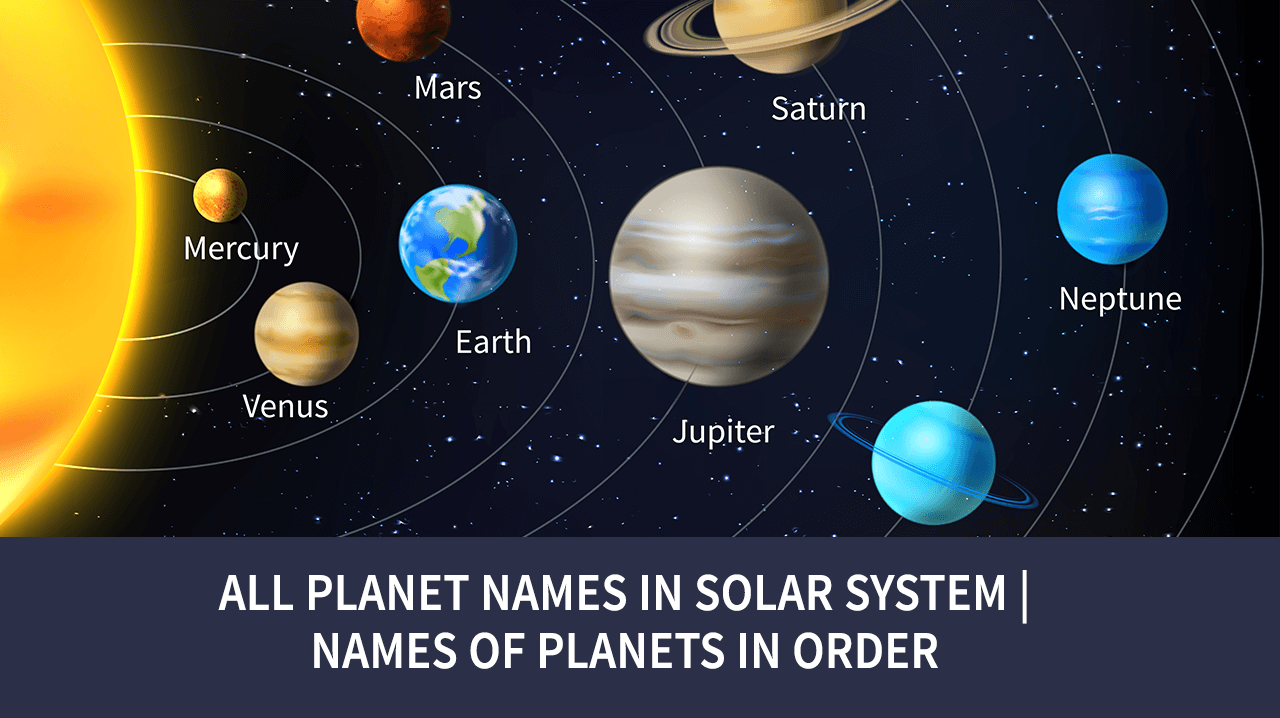
Our solar system features eight distinct worlds orbiting a single central star, spanning nearly five billion kilometers from its inner rocky core to its distant icy boundaries. Understanding the planets in order from the sun gives you a clear map of how gravity, solar wind, and planetary formation shaped our local cosmic neighborhood.
Moving outward from the solar center, you cross two radically different planetary regimes: the terrestrial inner worlds made of rock and metal, followed by the massive fluid giants of the outer solar system. Each body maintains unique orbital dynamics, atmospheric compositions, and surface features that set it apart.
The Inner Terrestrial Planets
The four innermost worlds—Mercury, Venus, Earth, and Mars—sit closest to the sun. These terrestrial planets share solid surfaces, higher densities, and relatively small volumes compared to the worlds beyond the asteroid belt.
Mercury: The Swift Extremist
Mercury orbits closer to the sun than any other planet, completing a full revolution in just 88 Earth days. Because it lacks a substantial atmosphere to trap heat or redistribute thermal energy, its surface experiences wild temperature swings. Daytime temperatures reach up to 430 degrees Celsius, while nighttime readings plunge to -180 degrees Celsius.
Data from missions like NASA's MESSENGER spacecraft revealed a heavily cratered landscape resembling our moon, alongside a massive iron core that makes up about 85 percent of the planet's radius.
Venus: The Toxic Pressure Cooker
Venus ranks as the second planet from the sun and matches Earth closely in size and mass. Despite these similarities, Venus evolved into an extreme environment driven by a runaway greenhouse effect. Its thick atmosphere consists mostly of carbon dioxide wrapped in clouds of sulfuric acid.
Surface pressures reach 92 times Earth's atmospheric pressure, and surface temperatures hover near 465 degrees Celsius, making Venus the hottest planet in the solar system. It also rotates backward compared to most other planets, causing its sun to rise in the west and set in the east.
Earth: Our Water-Rich Home
Earth occupies the third orbit from the sun, positioned comfortably within the habitable zone where liquid water can persist on the surface. Dynamic geological processes, driven by plate tectonics, constantly reshape the crust, while a nitrogen-oxygen atmosphere shields the surface from harmful solar radiation and stabilizes global temperatures.
According to NASA Science, Earth remains the only known world in the universe capable of supporting complex biological life, thanks to its stable magnetic field and protective atmospheric shielding.
Mars: The Rust-Colored Desert
Mars stands as the fourth planet from the sun, presenting a cold, desert landscape tinted red by iron oxide minerals scattered across its dust-covered terrain. A thin atmosphere offers little protection against solar radiation, yet evidence from robotic explorers like NASA's Perseverance rover confirms that ancient rivers, lakes, and volcanic activity once shaped a warmer, wetter Martian surface.
Mars features the largest volcano in the solar system, Olympus Mons, standing nearly three times the height of Mount Everest.
The Asteroid Belt Boundary
Separating the inner and outer solar system lies the asteroid belt, positioned between the orbits of Mars and Jupiter. This vast ring contains millions of rocky and metallic bodies, ranging from tiny dust specks to dwarf planets like Ceres.
Rather than forming a dense, hazardous obstacle course like those depicted in science fiction movies, the objects in the asteroid belt drift millions of kilometers apart. Gravitational tugs from Jupiter prevented these rocky fragments from coalescing into a single planet during the early formation of the solar system.
The Outer Gas and Ice Giants
Beyond the asteroid belt, the nature of the solar system shifts dramatically. The four outer planets possess massive envelopes of gas and ice, lacking well-defined solid ground.
Jupiter: The Colossal Gas Giant
Jupiter is the fifth planet from the sun and the undisputed king of our solar system, holding more mass than all other planets combined. As a gas giant composed primarily of hydrogen and helium, Jupiter displays dramatic cloud bands, intense storms, and the iconic Great Red Spot—a massive anticyclonic storm larger than Earth that has raged for centuries.
Jupiter also commands a vast family of moons, including Europa, which conceals a subsurface liquid water ocean beneath a thick ice crust.
Saturn: The Ringed Masterpiece
Saturn sits in the sixth orbit, famous for its dazzling ring system composed of countless chunks of water ice and rocky debris. Like Jupiter, Saturn is a gas giant with a density so low that the planet would float in water if you could find a tub large enough.
The Cassini-Huygens mission provided revolutionary data on Saturn's ring dynamics and its largest moon, Titan, which features a dense nitrogen atmosphere and rivers of liquid methane running across its surface.
Uranus: The Sideways Ice Giant
Uranus, the seventh planet, is classified as an ice giant due to its interior composition of water, ammonia, and methane fluids surrounding a rocky core. Its most distinctive trait is an extreme axial tilt of nearly 98 degrees, causing the planet to essentially roll along its orbital path on its side.
This unusual orientation leads to extreme 42-year seasons of continuous sunlight or total darkness at the poles. William Herschel discovered Uranus in 1781, marking the first planetary find made with a telescope.
Neptune: The Windy Edge
Neptune marks the eighth and final officially recognized planet in our solar system. Located far from the sun, this deep-blue ice giant experiences extreme weather, driving the fastest wind speeds recorded in the solar system at over 2,000 kilometers per hour. Methane gas in Neptune's upper atmosphere absorbs red light, giving the world its striking azure appearance.
Discovered through mathematical calculations before it was ever spotted in an eyepiece, Neptune anchors the transition into the distant Kuiper Belt.
Common Mistakes When Studying Planetary Order
When people study the arrangement of the planets, a few persistent misconceptions often cause confusion:
- Confusing order with distance spacing: The planetary orbits do not sit at equal intervals. The inner planets crowd relatively close together, while the outer planets occupy vastly wider expanses separated by astronomical units of empty space.
- Mislabeling Pluto: Pluto was reclassified as a dwarf planet by the International Astronomical Union in 2006. While it remains a prominent object in the Kuiper Belt, it is no longer counted among the primary eight planets.
- Assuming outer planets are solid: Gas and ice giants do not have rocky ground to stand on. Their atmospheres simply transition into dense, high-pressure fluid layers surrounding compressed cores.
Frequently Asked Questions
Which planet is closest to the sun?
Mercury is the closest planet to the sun, maintaining an average distance of about 58 million kilometers.
Why is Venus hotter than Mercury despite being farther away?
Venus features a runaway greenhouse effect driven by its dense carbon dioxide atmosphere and thick clouds of sulfuric acid. This atmospheric blanket traps incoming solar heat efficiently, pushing surface temperatures higher than those on Mercury.
Are the planets lined up in a straight line in space?
No. The planets orbit the sun on slightly different orbital planes and at vastly different speeds. They never form a straight line in three-dimensional space, though they occasionally appear clustered on one side of the sun from our perspective.
How long does light from the sun take to reach Earth?
Sunlight travels across space at the speed of light, taking approximately eight minutes and twenty seconds to bridge the 150-million-kilometer distance to Earth.



