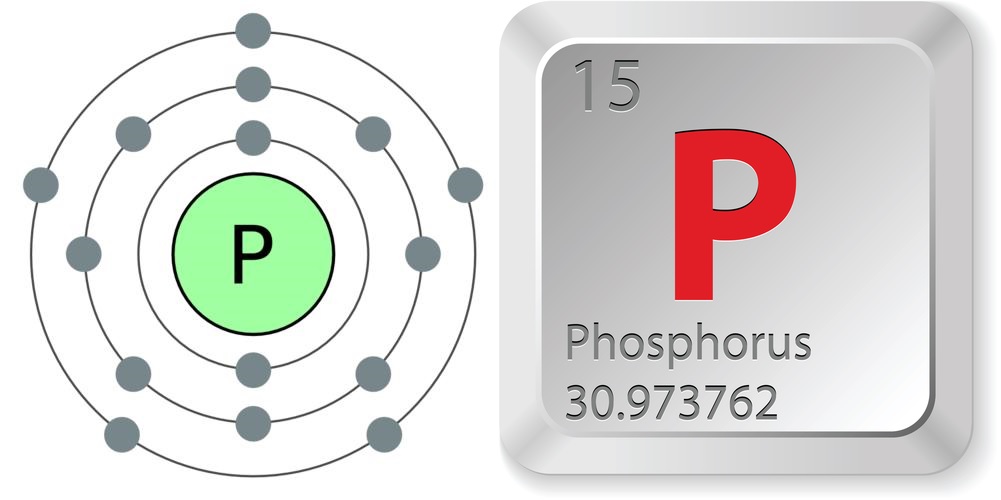
A neutral phosphorus atom has 5 valence electrons located in its outermost third energy level. Knowing this count helps predict how the element behaves in chemical reactions, how it forms covalent bonds, and why it plays a critical role in both biology and industrial chemistry.
Phosphorus sits in group 15 of the periodic table, directly beneath nitrogen. Its atomic number is 15, which means a neutral atom contains 15 total protons and 15 electrons. While inner-shell electrons stay tightly bound to the nucleus, these five outermost electrons dictate how phosphorus interacts with other atoms to achieve stability.
Decoding the Electron Configuration of Phosphorus
To understand where those five outer electrons live, we break down the full electron configuration of phosphorus, which is written as $1s^2 2s^2 2p^6 3s^2 3p^3$.
Each term represents an energy sublevel holding a specific number of electrons:
- The first shell contains 2 electrons in the $1s$ orbital.
- The second shell contains 8 electrons split between the $2s$ and $2p$ orbitals ($2s^2 2p^6$).
- The third shell—the outermost valence shell—contains 5 electrons split between the $3s$ and $3p$ orbitals ($3s^2 3p^3$).
You can also write this using the noble gas shorthand notation as $[Ne] 3s^2 3p^3$, where $[Ne]$ represents the inner core configuration identical to neon ($1s^2 2s^2 2p^6$). When drawing a Bohr model, these shells appear as concentric rings holding 2, 8, and 5 electrons respectively.
How Valence Electrons Drive Chemical Bonding
Atoms seek a stable electron configuration, typically resembling the nearest noble gas (argon, in the case of phosphorus). With five valence electrons, phosphorus needs three more electrons to complete its octet.
Instead of completely ionic transfers, phosphorus usually achieves stability by sharing electrons through covalent bonds.
Single and Multiple Covalent Bonds
In molecules like phosphine ($PH_3$) or phosphorus trichloride ($PCl_3$), phosphorus forms three single covalent bonds. Each bond pairs one of its unpaired $3p$ electrons with an electron from another atom. This satisfies the octet rule for both the phosphorus atom and the bonded partners.
Expanded Octets
Because phosphorus occupies the third period of the periodic table, it has access to vacant $3d$ orbitals. This allows phosphorus to form compounds with five or even six covalent bonds—such as phosphorus pentachloride ($PCl_5$) or the hexafluorophosphate ion ($PF_6^-$). In these cases, phosphorus accommodates more than eight electrons in its valence shell, a behavior not possible for second-period elements like nitrogen.
Oxidation States and Reactivity
The presence of five valence electrons gives phosphorus a flexible range of oxidation states, spanning from $-3$ to $+5$.
- The -3 State: When bonding with less electronegative elements (like hydrogen or active metals), phosphorus can gain or formally accept three electrons to form phosphide ions ($P^{3-}$), achieving an electron configuration identical to argon.
- The +3 and +5 States: When bonding with highly electronegative elements like oxygen or chlorine, phosphorus shares or effectively loses its valence electrons, resulting in common positive oxidation states found in phosphoric acid ($H_3PO_4$) and various phosphate compounds.
Because elemental phosphorus is highly reactive, it never occurs as a free, isolated element in nature. You'll find it locked inside phosphate rock or integrated into biological molecules like DNA, RNA, and adenosine triphosphate (ATP), where energy transfer relies entirely on the behavior of these outer shell electrons.
Frequently Asked Questions
Why doesn't phosphorus follow the octet rule strictly in every compound?
While many main-group elements strictly obey the octet rule, elements in the third period and below possess empty $d$ orbitals. Phosphorus can utilize these orbitals to house extra electron pairs, enabling hypervalency where it shares up to ten valence electrons across five covalent bonds.
How do you find the valence electrons of phosphorus using the periodic table?
Find phosphorus in column 15 of the periodic table. For main-group elements (designated with the $A$ group labeling system or columns 1, 2, and 13 through 18), the units digit of the group number corresponds directly to the number of valence electrons. Group 15 elements possess 5 valence electrons.
What is the difference between core electrons and valence electrons in phosphorus?
Core electrons are inner-shell electrons ($1s^2 2s^2 2p^6$) that do not participate in chemical bonding. Valence electrons are restricted to the outermost energy level ($3s^2 3p^3$), possessing higher energy and driving all chemical reactions and bond formations.
Does white phosphorus have a different number of valence electrons than red phosphorus?
No. All allotropes of phosphorus—including white, red, and black phosphorus—consist of identical phosphorus atoms. They share the same atomic structure of 15 protons and 5 valence electrons, but differ only in how those atoms bond and pack together in solid form. Learn more about elemental structures through the Royal Society of Chemistry Periodic Table.


