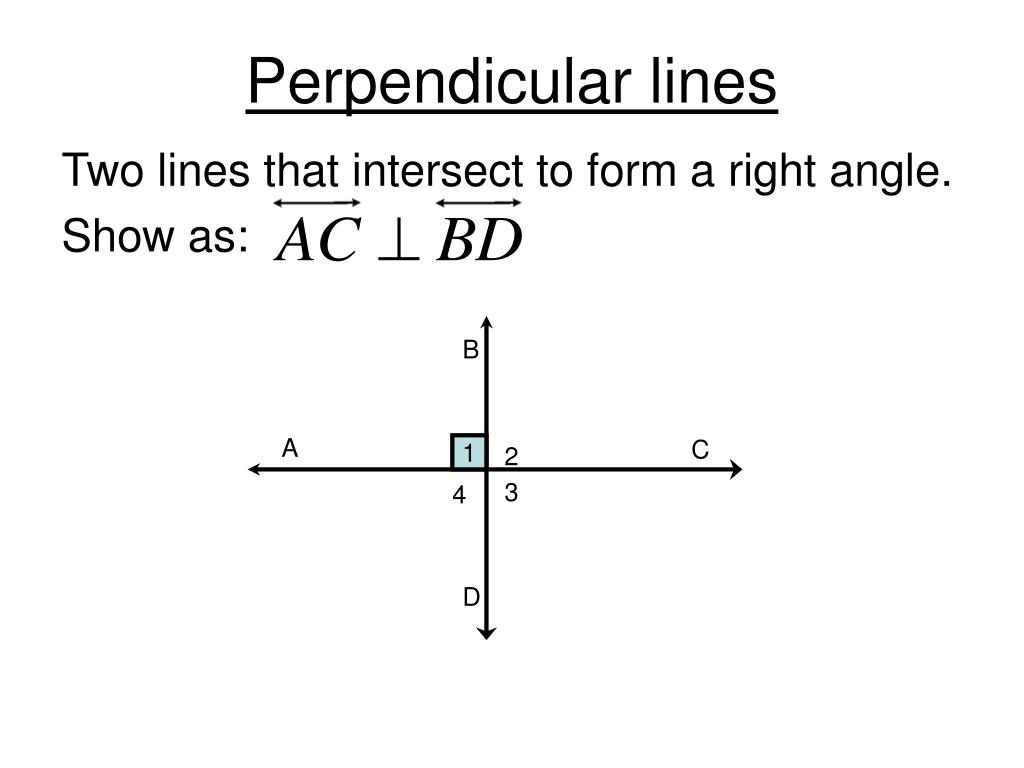
Two lines intersect and create four identical ninety-degree corners. That structural intersection forms what we call a perpendicular line. You'll find these exact angles everywhere, from the walls of your bedroom to the grid layout of city streets.
Understanding how perpendicular lines work goes beyond passing a middle school math test. It's the core principle behind building stable structures, designing user interfaces, and mapping land. When two lines meet at a right angle, they create a reliable baseline of stability and measurement. Let's break down how they function, how to construct them, and why they matter.
What Defines a Perpendicular Line
In geometry, perpendicular lines are two lines, segments, or rays that intersect at a right angle, measuring exactly ninety degrees. If you have line $AB$ and line $CD$ crossing each other, and the angle in any of the four resulting quadrants is ninety degrees, all four quadrants measure ninety degrees.
You can spot them easily using the standard perpendicular symbol, which looks like an upside-down capital T ($\perp$). If line $l$ is perpendicular to line $m$, we write it as $l \perp m$.
The Slope Relationship
In coordinate geometry, perpendicular lines have a very specific mathematical relationship regarding their slopes. If you graph two non-vertical perpendicular lines on a Cartesian plane, their slopes are negative reciprocals of each other.
- If line one has a slope of $2$, the perpendicular line has a slope of $-\frac{1}{2}$.
- If line one has a slope of $-\frac{3}{4}$, the perpendicular line has a slope of $\frac{4}{3}$.
When you multiply the slope of a line by the slope of its perpendicular line, the product is always $-1$. Vertical and horizontal lines are a special case. A vertical line has an undefined slope, while a horizontal line has a slope of zero. They intersect at right angles, forming the classic axis cross on a graph.
Real-World Applications of Right Angles
Right angles aren't just abstract math concepts. They keep our physical world from collapsing.
Architecture and Construction
Builders rely on perpendicular lines to ensure walls stand straight and floors remain level. If a foundation corner isn't set at a precise ninety-degree angle, the framing above it will skew. Carpenters use a framing square—a large metal tool shaped like an L—to check corners during construction.
Urban Planning
City grids depend heavily on perpendicular intersections. Planners design streets to cross at right angles to maximize land use, simplify navigation, and make utility installation straightforward. For more on how urban grids shape modern infrastructure, you can explore resources from the American Planning Association.
Graphic Design and Screens
Every digital interface you look at uses a grid of perpendicular lines. Computer screens display images using pixels arranged in a rectangular grid of horizontal and vertical rows. Without perpendicular alignment, text would skew, and user interfaces would break apart.
How to Construct Perpendicular Lines
You don't always have to rely on a digital tool or a plastic protractor. You can construct a perpendicular line using classic geometric tools: a straightedge and a compass.
Constructing a Perpendicular Through a Point on a Line
Imagine you have a straight line and a specific point sitting directly on that line, and you need to draw a line straight up from it at a right angle.
- Place your compass point on the given point and draw two arcs of equal radius that intersect the line on both the left and right sides.
- Open your compass slightly wider than the distance to one of those intersection points.
- Place the compass on one intersection point and draw an arc above or below the line.
- Without changing the compass width, move it to the other intersection point and draw a second arc that crosses the first one.
- Use your straightedge to connect the original point on the line to the place where your two new arcs intersect. That new line is strictly perpendicular.
Common Mistakes to Avoid
When working with geometric proofs or drafting designs, it's easy to make a few common errors.
- Assuming visual accuracy: Never assume lines are perpendicular just because they look like they form a corner. Always check the angle measure or the slope calculation.
- Confusing parallel and perpendicular: Parallel lines run side-by-side and never cross, while perpendicular lines intersect. Mixing up their slope rules is a quick way to fail a math exam.
- Incorrect reciprocal calculation: When finding a perpendicular slope, remember to flip the fraction and change the sign. If you only flip the fraction, you'll end up with a parallel or skewed line instead.
Frequently Asked Questions
Can curved lines be perpendicular?
Strictly speaking, standard perpendicularity applies to straight lines, segments, or rays. However, in calculus and advanced geometry, a curve and a line can be perpendicular at the exact point where the line intersects the tangent line of the curve.
What is the difference between perpendicular and orthogonal?
They are often used interchangeably, but there is a nuance. Perpendicular is a standard geometric term for lines or planes intersecting at right angles. Orthogonal is a broader term used frequently in linear algebra and engineering to describe vectors or functions that are at right angles or statistically independent.
How do you check if a corner is truly ninety degrees?
Carpenters use the 3-4-5 rule, which is a practical application of the Pythagorean theorem ($a^2 + b^2 = c^2$). If you measure three inches along one side, four inches along the other, and the diagonal distance between those two marks is exactly five inches, the corner is a true right angle.
Do perpendicular lines always intersect?
Yes. By definition, intersecting lines must share a single common point. If two lines run at right angles to each other in three-dimensional space without intersecting, they are called skew lines, not perpendicular lines.



