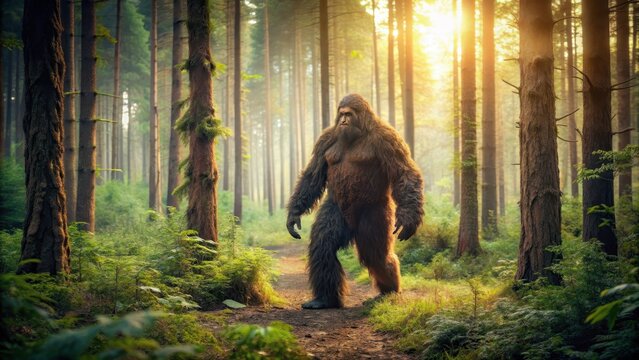
Captured in the dense timber of the Blue Mountains on the border of Washington and Oregon, the Paul Freeman Bigfoot footage from 1994 remains one of the most polarizing pieces of visual evidence in cryptozoology history. Second only to the 1967 Patterson-Gimlin film, Freeman's recording offers a brief, shaky glimpse of a massive, bipedal figure navigating steep woodland terrain. Decades after its release, researchers, skeptics, and digital analysts still argue over whether the tape documents an undiscovered primate or an elaborate hoax.
To understand why this footage defined a generation of Sasquatch research, we have to look past the low-resolution tape and examine the investigator behind the lens, the physical anomalies captured in the frames, and the legitimate controversies that cloud his legacy.
The Investigator and the Context
Paul Freeman wasn't a casual tourist or a weekend filmmaker looking for a thrill. Serving as a former U.S. Forest Service patrolman, Freeman spent years combing the Umatilla National Forest, particularly around Deduct Spring. By the early 1990s, he had built a controversial reputation within the Bigfoot community by discovering hundreds of footprints—many of which featured unusual anatomical details like dermal ridges.
On that summer morning in 1994, Freeman carried an early consumer camcorder into the woods because he anticipated an encounter. When he spotted a large, dark figure moving through the trees, he began filming. The resulting footage runs for several tense minutes, tracking a bulky, hair-covered subject as it walks calmly away from the camera, occasionally pausing to navigate the uneven forest floor.
Key Elements of the 1994 Recording
What keeps researchers returning to the Freeman film isn't just the silhouette of a walking figure; it's specific micro-details embedded within the video and audio tracks.
- The Fluid Gait: Analysts often point to the creature's stride length and knee articulation. The subject moves with a deliberate, heavy-footed motion that structural experts claim is difficult to mimic naturally in a standard theatrical costume.
- The Audio Mystery: Around the 3:31 mark of the unedited tape, two distinct vocalizations or "whoops" echo through the background. Crucially, Freeman doesn't react or turn toward the sound, leading some to argue the audio was an ambient environmental noise rather than a planted cue for a staged hoax.
- The Secondary Figure: Later in the recording, Freeman remarks that there appear to be two figures. Years after Freeman's death, media producers reviewing master copies noticed what looked like a juvenile creature being carried on the back of a larger adult—a subtle detail Freeman never capitalized on or hyped during his lifetime.
The Hoax Allegations and Credibility Issues
You can't discuss Paul Freeman without addressing his tarnished reputation among mainstream scientists. Critics frequently label him a fraud because of incidents where he was caught experimenting with plaster casts in his garden.
Skeptics argue that if a researcher admits to manufacturing fake tracks for testing purposes, their entire body of evidence becomes compromised. Defenders, however, maintain that Freeman's garden tests were misunderstood experiments designed to see how easily a hoaxer could fake a print, and that his televised statements were taken out of context by editing. Regardless of intent, these controversies provided ammunition for skeptics who argue the 1994 film was just another man in a custom-built suit.
Common Mistakes in Analyzing Old Cryptid Footage
When modern enthusiasts review archival clips like the Freeman film, they often fall into predictable analytical traps:
- Judging 1990s Tech by Modern Standards: Reviewers often complain about graininess and blur, forgetting that early consumer 8mm magnetic tape maxed out at very low pixel counts. Digital enhancement can create artifacts that weren't in the original analog signal.
- Ignoring Terrain Constraints: Critics sometimes claim the subject moves too slowly or cautiously, ignoring the reality of navigating dense, fallen timber and steep forest slopes without modern hiking gear.
- Treating the Creator as All-Knowing: Observers often assume that if a videographer is dishonest about one peripheral piece of evidence, every frame they capture must be fraudulent—ignoring the possibility of a mixed record.
Frequently Asked Questions
Where exactly was the 1994 footage captured?
The video was recorded in the Blue Mountains within the Umatilla National Forest in the Pacific Northwest, a region historically dense with reported Sasquatch sightings.
Did Paul Freeman profit significantly from the film?
Unlike modern internet creators or commercial documentary stars, Freeman lived a modest life and passed away with very little financial gain from his decades of field research, which supporters cite as evidence of his genuine belief in the subject.
What did physical anthropologist Grover Krantz say about Freeman's evidence?
Dr. Grover Krantz, a respected academic who risked his professional reputation to study Bigfoot, analyzed Freeman's footprint casts and concluded that the anatomical structure—particularly the mid-tarsal break and dermal ridges—would be exceptionally difficult, if not impossible, for a human hoaxer to forge consistently in raw field conditions.
Is the full unedited video available to view?
Yes, portions and extended cuts of the Freeman footage are archived across cryptozoology databases and video platforms, though complete master tape context is heavily debated by competing research factions.