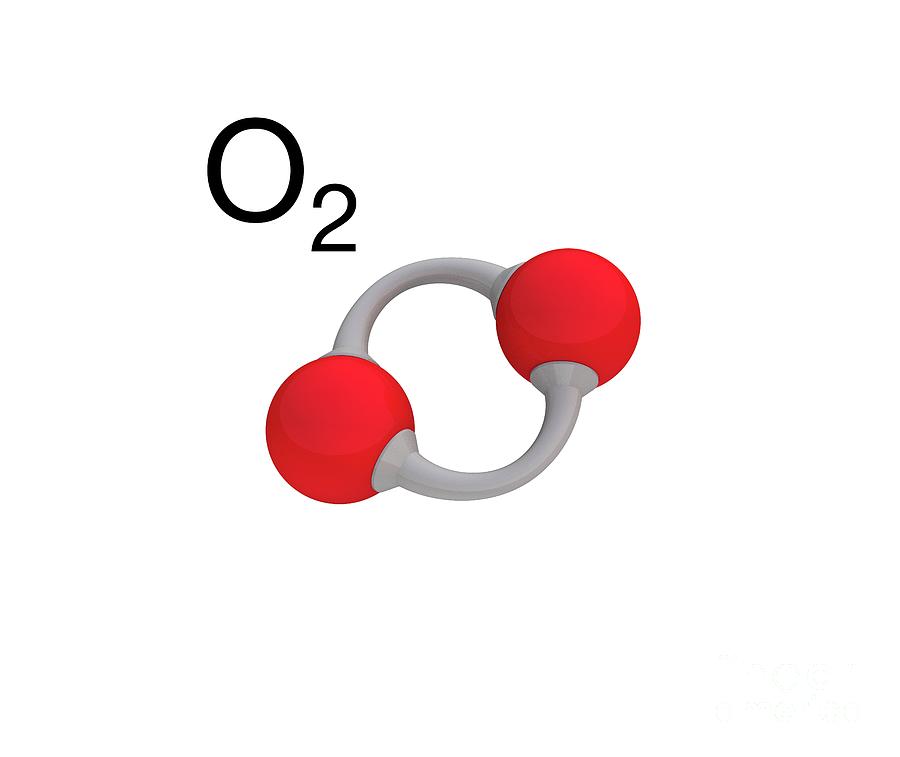
Oxygen gas drives aerobic life on Earth, forming the foundation of respiration, combustion, and countless industrial processes. Understanding its chemical makeup reveals why this diatomic molecule dominates our atmosphere and sustains complex ecosystems.
The Oxygen Gas Formula and Molecular Structure
The chemical formula for molecular oxygen is $O_2$. This notation indicates that two oxygen atoms bond covalently to form a stable diatomic molecule.
Each individual oxygen atom possesses eight protons and six valence electrons in its outer shell. To achieve a stable electron configuration, two oxygen atoms share two pairs of electrons, forming a strong double covalent bond. This double bond requires significant energy to break, which dictates how oxygen reacts with other elements during oxidation and combustion.
Unlike single oxygen atoms, which are highly reactive and unstable free radicals, diatomic oxygen ($O_2$) is stable enough to persist in the atmosphere at a concentration of approximately 21 percent by volume.
Why Diatomic Bonding Matters
At room temperature and standard pressure, oxygen exists as a colorless, odorless gas. The pairing of atoms into $O_2$ prevents the element from reacting too quickly with Earth's surface materials. If single oxygen atoms dominated the atmosphere, runaway oxidation would consume forests and organic matter instantly. The double bond moderates reactivity, allowing plants, animals, and microbes to utilize oxygen safely for energy production.
Historical Discovery and Naming
Chemists isolated and identified oxygen late in the eighteenth century through methodical experimentation.
English chemist Joseph Priestley isolated oxygen in 1774 by heating mercuric oxide with a focused sunlight lens, noting that the resulting gas supported combustion vigorously. Simultaneously, Swedish pharmacist Carl Wilhelm Scheele discovered oxygen independently around 1772 by heating various compounds like potassium nitrate and mercuric oxide, though his findings were published later in 1783.
French chemist Antoine Lavoisier recognized the significance of these experiments. Lavoisier named the element oxygen in 1789, deriving the name from Greek roots meaning "acid former," because he incorrectly believed oxygen was an essential component of all acids. Despite that chemical misconception, Lavoisier established mass conservation principles that modernized chemical nomenclature.
Biological Role in Respiration and Metabolism
Multicellular organisms rely on $O_2$ as the terminal electron acceptor in cellular respiration. Inside mitochondria, glucose and other nutrients break down to generate adenosine triphosphate (ATP), the primary energy currency of living cells.
During this process, hemoglobin in red blood cells binds to oxygen molecules within the lungs, transporting them through the circulatory system to peripheral tissues. Cells consume the oxygen to produce energy, releasing carbon dioxide ($CO_2$) as a metabolic byproduct.
Without a continuous supply of $O_2$, human brain cells begin to suffer irreversible damage within minutes due to energy failure.
Environmental Distribution and the Global Carbon Cycle
Oxygen cycles continuously through the Earth's biosphere, lithosphere, and atmosphere. Terrestrial plants, phytoplankton, and cyanobacteria drive the production side of this cycle via photosynthesis.
During photosynthesis, organisms use solar energy to convert carbon dioxide and water into glucose and molecular oxygen:
$$6CO_2 + 6H_2O \rightarrow C_6H_{12}O_6 + 6O_2$$
Marine phytoplankton account for roughly half of the global oxygen production, releasing $O_2$ directly into the upper ocean layers, where it supports aquatic animal life and regulates oceanic chemistry.
Common Mistakes and Misconceptions
People often confuse molecular oxygen ($O_2$) with ozone ($O_3$) or atomic oxygen ($O$).
- Molecular Oxygen ($O_2$): The stable, breathable gas found in the troposphere that fuels respiration.
- Ozone ($O_3$): A reactive allotrope containing three oxygen atoms, found primarily in the stratosphere where it shields Earth from ultraviolet radiation.
- Atomic Oxygen ($O$): A transient, highly reactive single atom that exists briefly in high-energy environments like the upper atmosphere or laboratory plasmas.
Another frequent error assumes that Earth's oxygen supply is running out due to fossil fuel combustion. While combustion consumes $O_2$ and releases $CO_2$, the sheer scale of the atmospheric oxygen reservoir means that even complete fossil fuel depletion would reduce atmospheric oxygen by a fraction of a percent. The primary environmental threat from combustion relates to carbon emissions and greenhouse warming rather than oxygen depletion.
Frequently Asked Questions
Why is oxygen gas written as $O_2$ instead of just $O$?
Oxygen atoms possess six valence electrons and need two more to complete their octet. By sharing four electrons in a double covalent bond, two oxygen atoms form a stable $O_2$ molecule. Single oxygen atoms are radicals that bond instantly with other elements or themselves.
How do fish breathe oxygen if the formula is $O_2$?
Fish don't split water molecules ($H_2O$) to get oxygen. Instead, they extract dissolved molecular oxygen ($O_2$) from water using their gills. Water holds a lower concentration of dissolved oxygen than air, which is why fish suffocate quickly when removed from aquatic environments.
Can humans breathe pure oxygen safely?
Breathing 100 percent oxygen at normal atmospheric pressure for short periods is safe, often used in medical settings. However, prolonged exposure to high partial pressures of oxygen leads to oxygen toxicity, causing lung irritation, central nervous system damage, and visual disturbances.
Where does most of Earth's oxygen come from?
Marine microorganisms, specifically photosynthetic phytoplankton and cyanobacteria in the oceans, generate approximately 50 to 80 percent of the oxygen in Earth's atmosphere. Terrestrial forests and plants produce the remainder.



