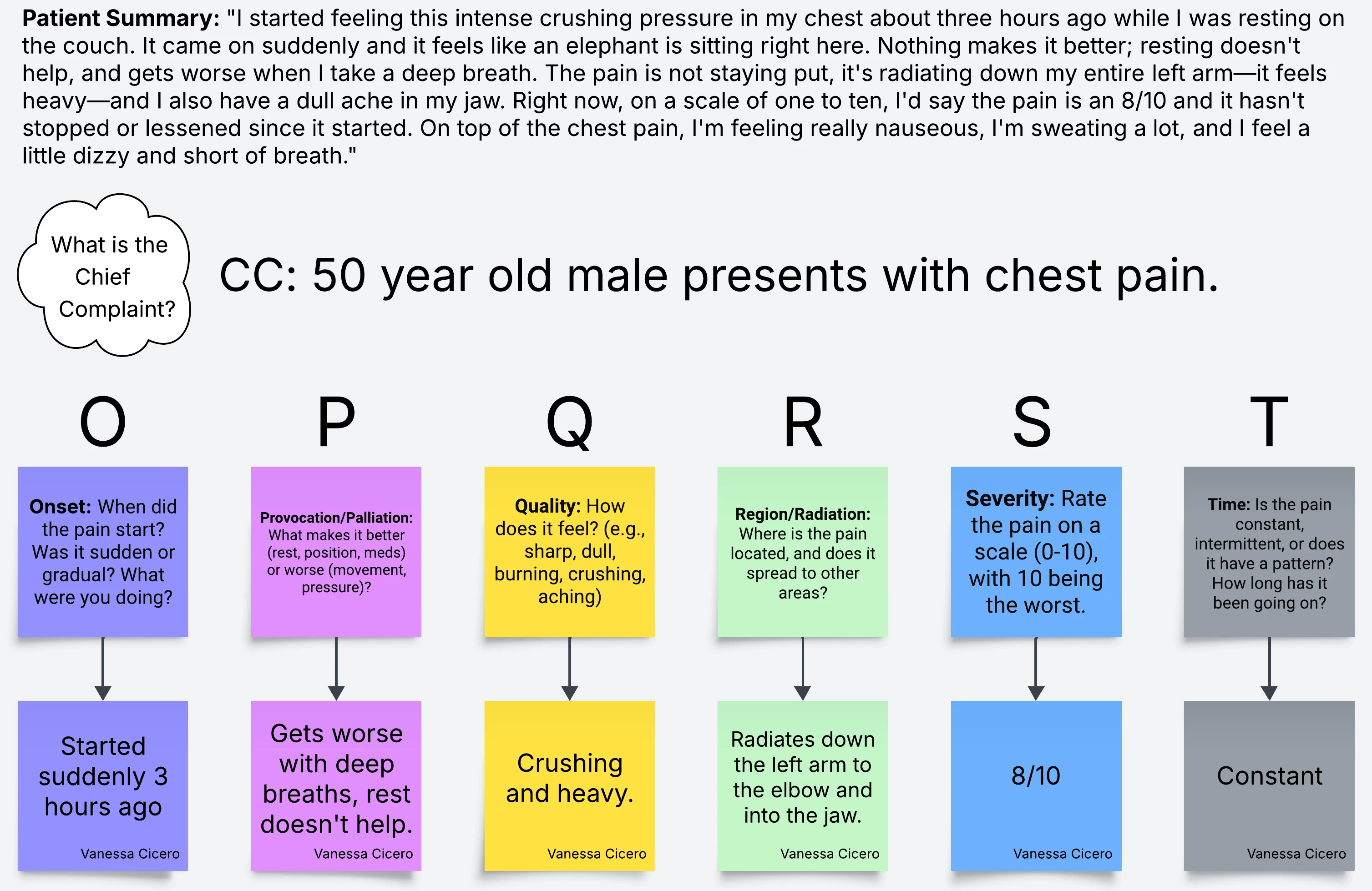
Accurate clinical assessment begins the moment a patient describes a symptom. In emergency medical services and clinical practice, vague complaints like chest pain or dizziness require a systematic approach to prevent diagnostic errors. The OPQRST mnemonic provides a structured framework for medical professionals to gather critical history efficiently and thoroughly.
Originally popularized in emergency medicine to evaluate pain and acute complaints, this six-step checklist guides practitioners from a broad starting point to a precise clinical picture. Mastering this tool improves documentation, enhances patient trust, and ensures critical details aren't missed during high-pressure evaluations.
Breaking Down the OPQRST Framework
Each letter in the acronym represents a distinct pillar of symptom investigation. Understanding how to apply these components changes a casual conversation into a targeted medical interview.
O is for Onset
Onset focuses on the exact moment the symptom began and how it started. You need to determine whether the event came on suddenly over a matter of seconds or developed gradually over hours or days.
- Ask what the patient was doing when the symptoms started. Were they resting, exercising, or experiencing emotional stress?
- Differentiate between acute triggers and chronic conditions that have slowly worsened.
- For example, a sudden tearing sensation in the back suggests a different urgency than a dull ache that built up over a week.
P is for Provocation and Palliation
This component explores what makes the symptom worse or better. Provoking factors trigger or intensify the discomfort, while palliating factors bring relief.
- Inquire about specific physical movements, breathing patterns, or external pressures that influence the pain.
- Ask if specific resting positions, changes in posture, or over-the-counter medications lessen the severity.
- Specificity matters: instead of asking if movement affects the pain, ask if it hurts more when climbing stairs or twisting the torso.
Q is for Quality
Quality captures the patient's own description of the symptom. Because clinicians cannot feel what the patient feels, eliciting precise descriptive language is vital.
- Let the patient use their own words. Common descriptors include sharp, dull, crushing, burning, throbbing, or cramping.
- Pay close attention to unique metaphors. A "heavy pressure like an elephant sitting on the chest" carries distinct clinical implications compared to a sharp, pinprick sensation.
- Avoid planting words in the patient's mouth; ask open-ended questions like, "How would you describe the feeling?"
R is for Region and Radiation
Region pinpoints the exact anatomical location of the symptom, while radiation tracks whether the sensation travels to other parts of the body.
- Ask the patient to point directly to the spot where it hurts most.
- Inquire if the sensation stays in one place or moves elsewhere.
- Radiation patterns often provide critical clues for differential diagnosis, such as cardiac pain radiating down the left arm or up into the jaw.
S is for Severity
Severity quantifies the intensity of the symptom, usually on a standardized numerical scale from 0 to 10, where 0 means no symptoms and 10 represents the worst imaginable discomfort.
- Establish a baseline by asking for the current rating.
- Determine what the rating was at its absolute worst since the onset.
- This numerical tracking allows healthcare teams to monitor whether a condition is improving, stabilizing, or deteriorating over time.
T is for Time
Time tracks the evolution of the symptom from its inception to the present moment.
- Establish whether the symptom has been constant or intermittent (coming and going).
- If intermittent, find out how long each episode lasts and how frequently they occur.
- Ask if the symptom has changed in character or intensity since it first started.
According to documentation standards outlined by the National Institutes of Health, consistent clinical record-keeping of symptom timelines helps specialists evaluate treatment efficacy accurately.
Practical Application in Clinical Settings
Using this framework effectively requires moving past rote memorization. Treat the mnemonic as a conversational guide rather than a rigid script. Weave the elements naturally into your dialogue so the patient feels heard rather than interrogated.
When interviewing a patient experiencing acute distress, pairing this tool with background gathering frameworks like the SAMPLE history (Symptoms, Allergies, Medications, Past medical history, Last oral intake, Events leading up to the incident) provides a complete clinical picture.
- Maintain active listening: Let the patient complete their thought before jumping to the next letter.
- Adapt to the chief complaint: While designed for pain, the structure works equally well for shortness of breath, nausea, or dizziness.
- Avoid premature closure: Don't lock onto an initial diagnosis before running through all six steps.
Common Mistakes to Avoid
Even experienced practitioners occasionally fall into operational traps when conducting symptom interviews. Recognizing these pitfalls keeps your assessments sharp and reliable.
- Rushing through the timeline: Failing to pin down whether a symptom is truly constant or fluctuating can lead to misjudging the acuity of a condition.
- Accepting vague quality descriptions: Settling for "it hurts bad" without pushing for descriptive words leaves diagnostic gaps.
- Ignoring radiation: Focusing solely on the primary site of discomfort can obscure referred pain patterns originating from internal organs.
- Treating the interview as an interrogation: Firing off rapid-fire questions damages patient rapport and often yields unreliable data.
For official guidelines on clinical communication and documentation practices, consult resources provided by the World Health Organization.
Frequently Asked Questions
Can this framework be used for non-pain symptoms?
Yes. While frequently applied to pain assessment, the structure adapts easily to complaints like shortness of breath, weakness, or vertigo. For instance, you can evaluate when dizziness started (Onset), what triggers it (Provocation), and how long dizzy spells last (Time).
How does severity scoring work for pediatric or non-verbal patients?
Numerical 0-10 scales don't work for young children or patients with cognitive impairments. In these cases, clinicians substitute visual analog scales, such as the Wong-Baker FACES scale, or rely on behavioral indicators like facial expressions and body tension to gauge severity.
Is this tool exclusively for emergency medical technicians?
No. While standard training for EMTs and paramedics emphasizes this mnemonic, nurses, medical students, physicians, and triage staff across various clinical environments use it to standardize patient handovers and documentation.
What should I do if a patient cannot remember when the symptoms started?
If exact timelines are unavailable due to confusion or trauma, document the best available estimate from family members or bystanders, and focus heavily on current severity, quality, and objective physical signs.



