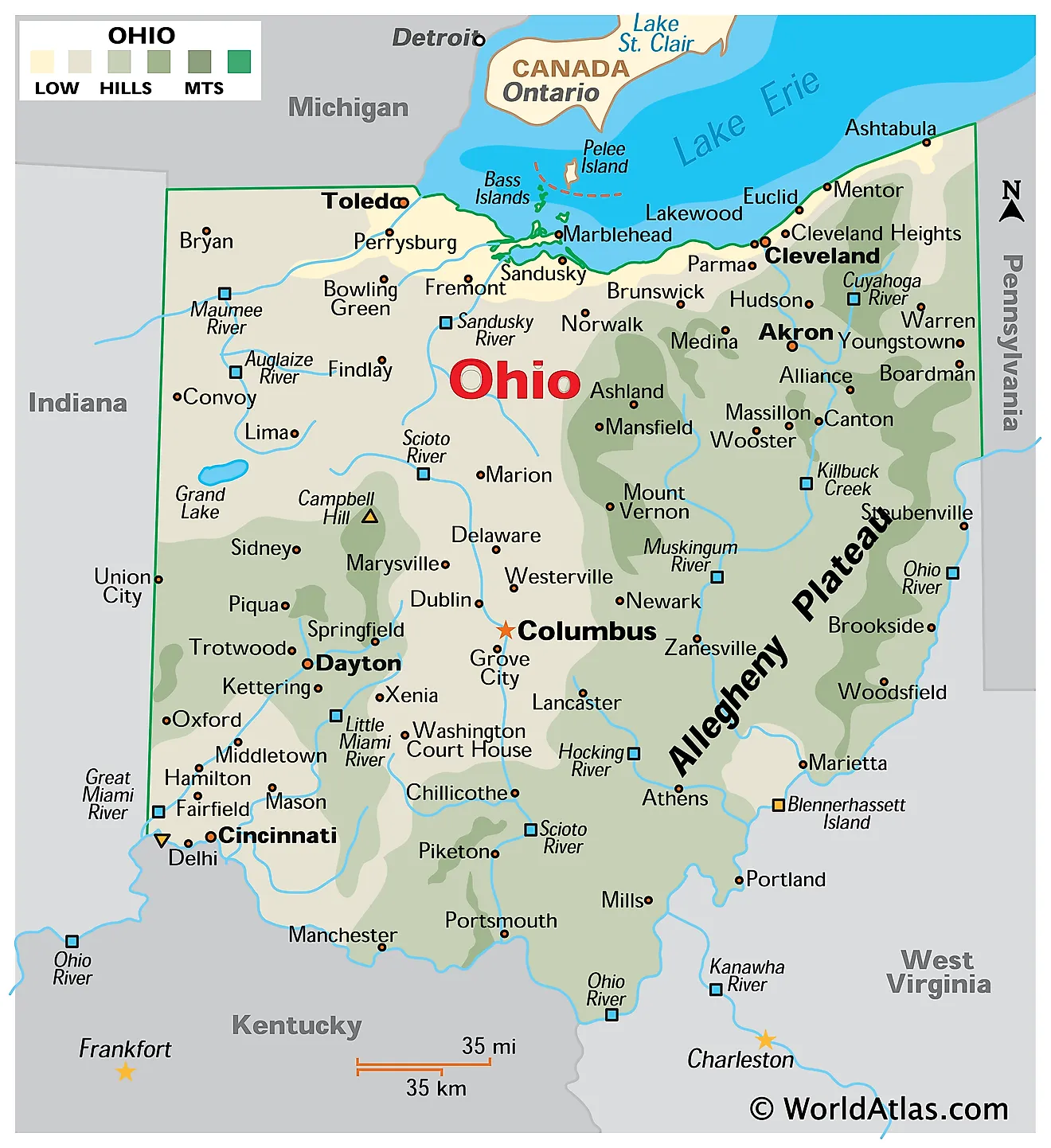
Almost the entire state of Ohio operates on the Eastern Time Zone, syncing its clocks with major eastern financial hubs. Yet, sitting right on the geological edge of the Midwest, the Buckeye State has a unique geographic relationship with time. Solar noon doesn't line up neatly with the clock here. This mismatch creates a subtle friction between natural solar rhythms and standard administrative timekeeping.
Understanding how time operates across Ohio requires looking past the simple label on a map. From historical railway standardization to modern legislative debates over permanent daylight saving time, the state's clock-keeping reflects a broader struggle to balance human convenience with planetary mechanics.
The Geography of Ohio Time
Ohio sits entirely within the Eastern Standard Time zone, designated as UTC-5 during standard months and UTC-4 during daylight saving time. Geographically, however, the state straddles a natural meridian that complicates this uniform assignment.
The 82.5° W longitude line cuts directly through the eastern third of the state. According to solar time theory, regions west of this line naturally belong in the Central Time Zone. Cities like Toledo, Columbus, Dayton, and Cincinnati sit well west of that theoretical divider.
- Solar Noon Discrepancy: Because Ohio pushes so far west within its assigned zone, the sun reaches its highest point in the sky significantly later than it does in eastern Maine or coastal Massachusetts.
- The Daylight Edge: During summer months, western Ohio experiences exceptionally late sunsets, with daylight lingering past 9:00 PM in late June.
- Uniformity Benefits: Despite the geographical stretch, the state maintains a single time zone to prevent commerce and travel complications between Cleveland and Cincinnati.
For official boundaries and federal oversight, the U.S. Department of Transportation regulates time zone limits nationwide, ensuring that state-wide consistency remains legally binding under federal code.
Historical Roots of Modern Timekeeping
Before the late 19th century, time in Ohio was strictly local. Every town set its clocks by the position of the sun, meaning noon in Cleveland happened a few minutes earlier than noon in Columbus. This local variation created chaos for the burgeoning railroad industry.
Railroad companies needed predictable schedules to prevent collisions on single tracks. In November 1883, American railroads unilaterally adopted standard railway time, dividing the country into four distinct vertical segments. Ohio found itself straddling the line between Eastern and Central time, leading to intense local debates.
- The Railroad Transition: Major industrial hubs quickly adopted Eastern Time to stay synchronized with New York and Pittsburgh markets.
- The 1918 Standard Time Act: The federal government formalized these railroad zones into law, placing Ohio firmly into the Eastern zone, though municipal pushback lingered in western counties for years.
- Industrial Influence: The dominance of manufacturing and shipping tied Ohio's economic engine to eastern financial centers, sealing its fate as an Eastern Time state.
To explore how these national boundaries were formalized into law, check out the National Institute of Standards and Technology historical archives on time standardization.
Daylight Saving Realities in the Buckeye State
Like most of the United States, Ohio observes Daylight Saving Time (DST), shifting clocks forward one hour on the second Sunday in March and back on the first Sunday in November. This semi-annual ritual impacts everything from morning school commutes to agricultural operations.
Because western Ohio is situated on the western edge of the Eastern Time Zone, standard winter mornings bring very late sunrises. In mid-winter, children in places like Toledo wait for school buses in pitch-black conditions well after 7:30 AM.
Winter: Sunrise delayed until ~7:45 AM (EST)
Summer: Sunset extended past ~9:00 PM (EDT)
These extremes fuel recurring legislative debates. State lawmakers periodically introduce bills or resolutions aimed at opting out of seasonal time changes or lobbying for permanent daylight saving time. However, federal law currently requires congressional approval for any state to adopt permanent daylight saving time unilaterally, keeping Ohio locked into the traditional twice-yearly shift.
Common Misconceptions About Ohio Time
Travelers and newcomers often hold a few persistent myths about how time functions in the region.
- Myth 1: Ohio is split into two time zones. While neighboring states like Michigan and Indiana feature internal time zone splits, Ohio is entirely unified under Eastern Time.
- Myth 2: Daylight saving time is optional locally. Every county, township, and municipality in Ohio must follow the uniform federal schedule managed by the Federal Communications Commission and Department of Transportation for broadcast and transit consistency.
- Myth 3: Solar time matches clock time. As noted, clock noon in western Ohio can drift significantly from actual solar noon due to the wide geographic span of the Eastern Time Zone.
Frequently Asked Questions
Does any part of Ohio observe Central Time?
No. The entire state of Ohio is legally mandated to observe the Eastern Time Zone, with no exceptions or split counties.
When do clocks change in Ohio?
Clocks move forward one hour on the second Sunday in March at 2:00 AM and move backward one hour on the first Sunday in November at 2:00 AM.
Why does the sun set so late in western Ohio during summer?
Because Ohio sits on the far western edge of the Eastern Time Zone, its locations are shifted visually westward relative to the center of the time zone, resulting in prolonged evening daylight during summer months.
Has Ohio ever tried to change its time zone?
While various state legislators have proposed moving to permanent daylight saving time or evaluating the Central Time Zone for western counties, no official state-wide shift has ever passed into law.



