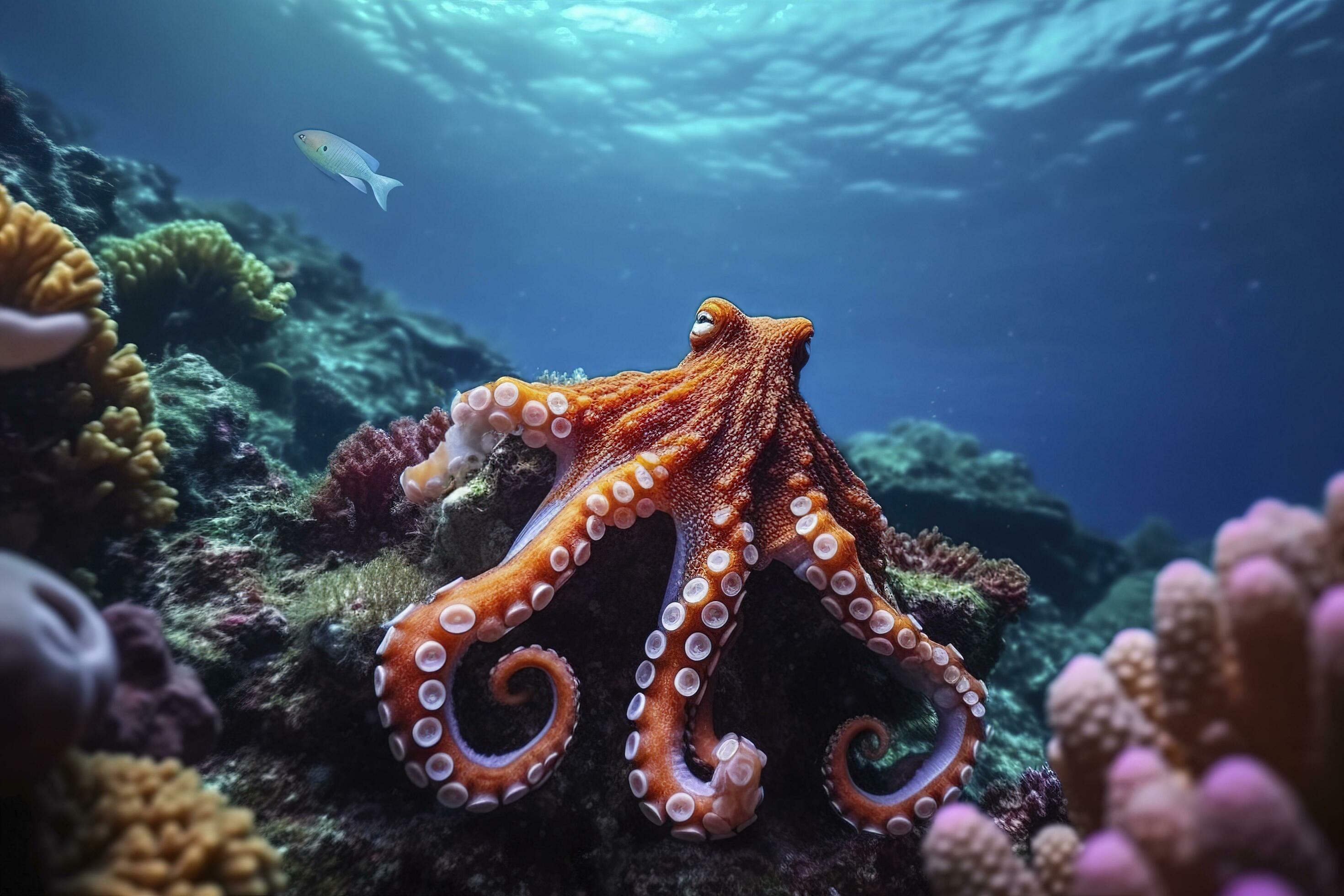
Octopus anatomy breaks every rule of vertebrate design. With three hearts, blue copper-based blood, and a central brain wrapped directly around its esophagus, an octopus operates more like an organic machine than a standard animal. These soft-bodied creatures lack an internal skeleton entirely, allowing them to squeeze through any opening larger than their hard, parrot-like beak.
Evolutionary biologists study these cephalopods because their genetic architecture developed along a radically different path than human ancestors. By examining their distributed nervous systems, skin-shaping chromatophores, and unique circulatory loops, we uncover how an invertebrate evolved sophisticated survival tactics in complex marine habitats.
The Boneless Blueprint and Distributed Nervous System
An octopus has no bones, shells, or rigid structural supports to anchor its muscles. Instead, its body relies on a hydrostatic skeleton made of densely packed muscle fibers that push against internal fluids. This lack of a skeleton gives the creature liquid flexibility, but it creates a massive coordination challenge.
Rather than sending every single motion command from a central command post, two-thirds of an octopus's neurons reside directly inside its eight arms. Each arm acts with a high degree of autonomy, processing touch and taste signals locally while coordinating movement without conscious oversight from the head.
- Axial nerve cords: Running down the center of each arm, these cords handle localized reflexes and sensory input.
- Temporary joints: Muscles can instantly stiffen to form temporary elbows and shoulders, turning soft tentacles into functional legs or rigid levers.
- Independent problem-solving: An amputated arm will still attempt to crawl away or grasp food items because the local neural ring functions independently.
Three Hearts and Blue Blood Dynamics
Managing oxygen underwater without large, static lungs requires an intense metabolic setup. An octopus handles this with a triple-heart circulatory system. Two smaller branchial hearts pump oxygen-depleted blood directly through the gills, while a larger systemic heart distributes the newly oxygenated blood to the rest of the body.
Unlike mammals that carry oxygen using iron-rich hemoglobin, octopuses rely on hemocyanin. This copper-based protein gives their blood a distinct blue tint. Hemocyanin works exceptionally well in cold, low-oxygen deep-sea environments, though it becomes less efficient in warm, highly oxygenated surface waters.
Vision and Sensory Processing
The cephalopod eye evolved independently from the vertebrate eye, yet it achieves comparable complexity. Octopuses possess a well-defined lens, iris, and a light-sensitive retina. Despite having sharp vision, scientific studies suggest most octopus species are color-blind, relying instead on high-contrast visual detection of polarized light patterns in the water column.
Touch and taste merge completely inside the hundreds of suckers lining each arm. As an octopus explores a rock crevice, its suckers analyze chemical signatures in the environment instantly. This dual-purpose sensory input lets the animal "taste" potential prey simply by brushing against it.
Dynamic Camouflage and Skin Texture
An octopus vanishes into its surroundings by combining skin pigmentation with muscular control over its physical contours.
- Chromatophores: Tiny, elastic sacs filled with yellow, red, brown, or black pigments expand and contract via tiny radial muscles under nervous control.
- Iridophores and Leucophores: Reflective cellular layers below the chromatophores scatter ambient light to create shimmering blues, greens, and silvers.
- Papillae: Specialized muscular hydrostats raise or lower the skin texture, transforming a smooth surface into jagged spikes that mimic coral or algae.
According to research published by the Ocean Biodiversity Information System, these rapid transformations occur in a fraction of a second, outperforming any other camouflage system in the natural world.
Frequently Asked Questions
Do octopuses have a brain in each arm?
Not a full brain, but they do have localized neural clusters called ganglia that act as mini-processors. These clusters control movement and touch reflexes independently from the central brain surrounding the esophagus.
Why is octopus blood blue?
Octopuses use hemocyanin, a copper-rich protein, to transport oxygen through their bloodstream instead of iron-based hemoglobin. When hemocyanin binds with oxygen, it turns bright blue.
Can an octopus regenerate a lost arm?
Yes. If an octopus loses an arm to a predator, it can regenerate the entire limb complete with working suckers, nerves, and muscle fibers over several months.
How do octopuses breathe?
Water enters the mantle cavity through large muscular openings, passes over two feathery gills to extract dissolved oxygen, and gets forcefully expelled through a funnel-shaped siphon.



