Nuclear physics is the foundation upon which modern atomic energy and weaponry are built. At its core, this scientific discipline examines the components, behaviors, and powerful forces operating inside the nucleus of an atom. Understanding how the strong nuclear force binds protons and neutrons together reveals why certain heavy elements can release staggering amounts of energy when split. That release of energy transformed global history in the mid-twentieth century and continues to shape geopolitics, energy production, and scientific research today.
When scientists talk about the physics behind an atomic weapon, they're talking about nuclear fission. While chemical explosives derive their power from rearranging electrons in molecular bonds, nuclear devices tap into the binding energy holding atomic nuclei together. This energy is millions of times more concentrated, which explains why a relatively small amount of active material can produce cataclysmic results. Let's look closer at the fundamental mechanics, historical context, and ongoing scientific principles that define this area of research.
The Atomic Structure and Nuclear Forces
To understand how a nuclear chain reaction works, you have to look at what's happening inside an atom. The nucleus sits at the center, packed with positively charged protons and neutral neutrons. These particles are held together by the strong nuclear force. This force operates across extremely short distances, but it's immensely powerful—strong enough to overcome the natural electrostatic repulsion pushing the positive protons apart.
In smaller atoms, like carbon or iron, the nucleus is stable. The ratio of protons to neutrons keeps the strong force comfortably in control. However, as atoms get larger, like uranium or plutonium, the nucleus stretches to its limits. The sheer number of protons creates massive repulsive forces that the strong nuclear force struggles to contain. Related insight regarding this has been shared by BBC.
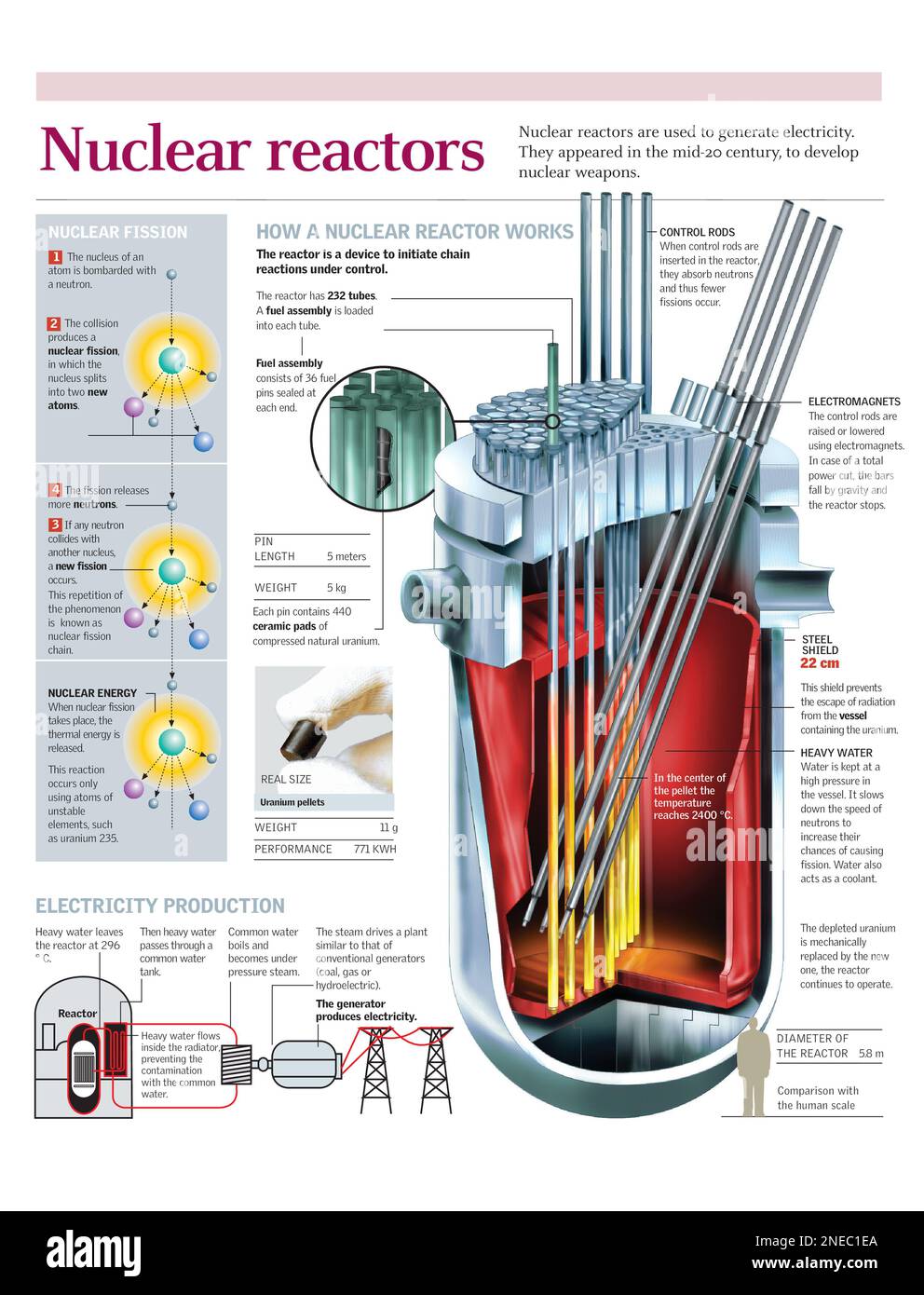
Heavy isotopes like uranium-235 are on the edge of instability. When an extra neutron strikes a uranium-235 nucleus, the nucleus deforms, wobbles, and splits into two smaller daughter nuclei. This process is known as nuclear fission.
The Physics of Nuclear Fission
Fission isn't just a clean split; it's a violent restructuring that releases a fraction of the atom's mass as pure energy, governed by Albert Einstein's famous equation $E = mc^2$. Because the combined mass of the resulting fission products is slightly less than the original uranium nucleus, that missing mass converts directly into kinetic energy and radiation.
Alongside the split products, the reaction frees two or three high-speed neutrons. If those liberated neutrons strike neighboring uranium-235 atoms, they trigger more fissions. This sets off a self-sustaining chain reaction.
To turn this physics principle into a working device, scientists had to solve two major engineering problems:
- Critical Mass: You need a minimum amount of fissile material so that escaping neutrons don't fizzle out before hitting another nucleus.
- Neutron Moderation: Fast neutrons don't split uranium-235 as efficiently as slow, thermal neutrons. Controlling their speed keeps the reaction running efficiently.
The Manhattan Project and Historical Context
The theoretical breakthroughs of the 1930s quickly merged with military urgency during World War II. Researchers across Europe and the United States realized that Nazi Germany might build a fission weapon first. This fear drove the creation of the Manhattan Project, a massive secret scientific undertaking led by physicist J. Robert Oppenheimer and general Leslie Groves.
The project relied on two distinct designs to achieve detonation:
- The Gun-Type Design: Code-named "Little Boy," this device used a conventional explosive to shoot one piece of uranium-235 down a barrel into another, creating a supercritical mass.
- The Implosion Design: Code-named "Fat Man," this weapon used a sphere of plutonium-235 surrounded by conventional high explosives. When triggered, the explosives compressed the plutonium inward symmetrically, forcing it into a dense, critical state.
These developments shifted the role of physicists forever. Science moved from academic laboratories into government-funded military complexes, permanently linking academic research with national security. You can read more about the historical archives and scientific milestones through the Atomic Heritage Foundation.
Radiation and Secondary Effects
An atomic blast isn't just a giant explosion with a shock wave and a fireball. The physics of the event unleashes multiple distinct waves of destruction:
- Thermal Radiation: The intense heat instantly vaporizes nearby structures and causes severe burns across vast distances.
- Blast Wave: The superheated air expands rapidly, creating a high-pressure shock wave that flattens buildings.
- Ionizing Radiation: A massive burst of gamma rays and neutrons floods the immediate area during the split itself.
- Fallout: The fission products and unfissioned material are sucked up into the mushroom cloud, drift downwind, and contaminate the environment with radioactive decay.
This persistent radioactivity separates nuclear weapons from conventional explosives. The long-term health and environmental consequences persist for decades because unstable isotopes continue to emit alpha, beta, and gamma radiation as they decay into stable lead.
Post-War Implications and Non-Proliferation
The reality of atomic weapons ushered in the Cold War and a tense global paradigm known as mutually assured destruction. Governments realized that mastering nuclear physics brought existential risks. International treaties, such as the International Atomic Energy Agency safeguards, were established to monitor nuclear materials and prevent the spread of weapon-grade technology.
At the same time, the peaceful applications of nuclear fission emerged. Nuclear power plants use controlled chain reactions to heat water, create steam, and turn turbines for electricity. While the engineering differs drastically from a weapon, the fundamental physics of splitting uranium remains identical.
Frequently Asked Questions
What is the difference between uranium-235 and uranium-238?
Uranium-235 is fissile, meaning it can sustain a nuclear chain reaction with slow neutrons. Uranium-238, which makes up over 99 percent of natural uranium, is fertile rather than fissile. It absorbs fast neutrons without splitting easily, making it useless for a direct chain reaction unless converted into plutonium in a reactor.
Why is plutonium used instead of uranium in some designs?
Plutonium-239 is an artificial element created by bombarding uranium-238 with neutrons in a nuclear reactor. It allows for a smaller, more efficient implosion design because it has a lower critical mass than uranium-235.
Can a nuclear weapon explode by accident?
No. Modern nuclear devices require complex, perfectly timed electrical triggers and mechanical sequences to achieve criticality. Accidental fires or impacts might scatter radioactive material, but they won't produce a nuclear detonation.
How does enriched uranium differ from natural uranium?
Natural uranium contains less than one percent uranium-235. Enrichment is an industrial process using centrifuges to increase the concentration of uranium-235 to the levels needed for weapons or power generation.



