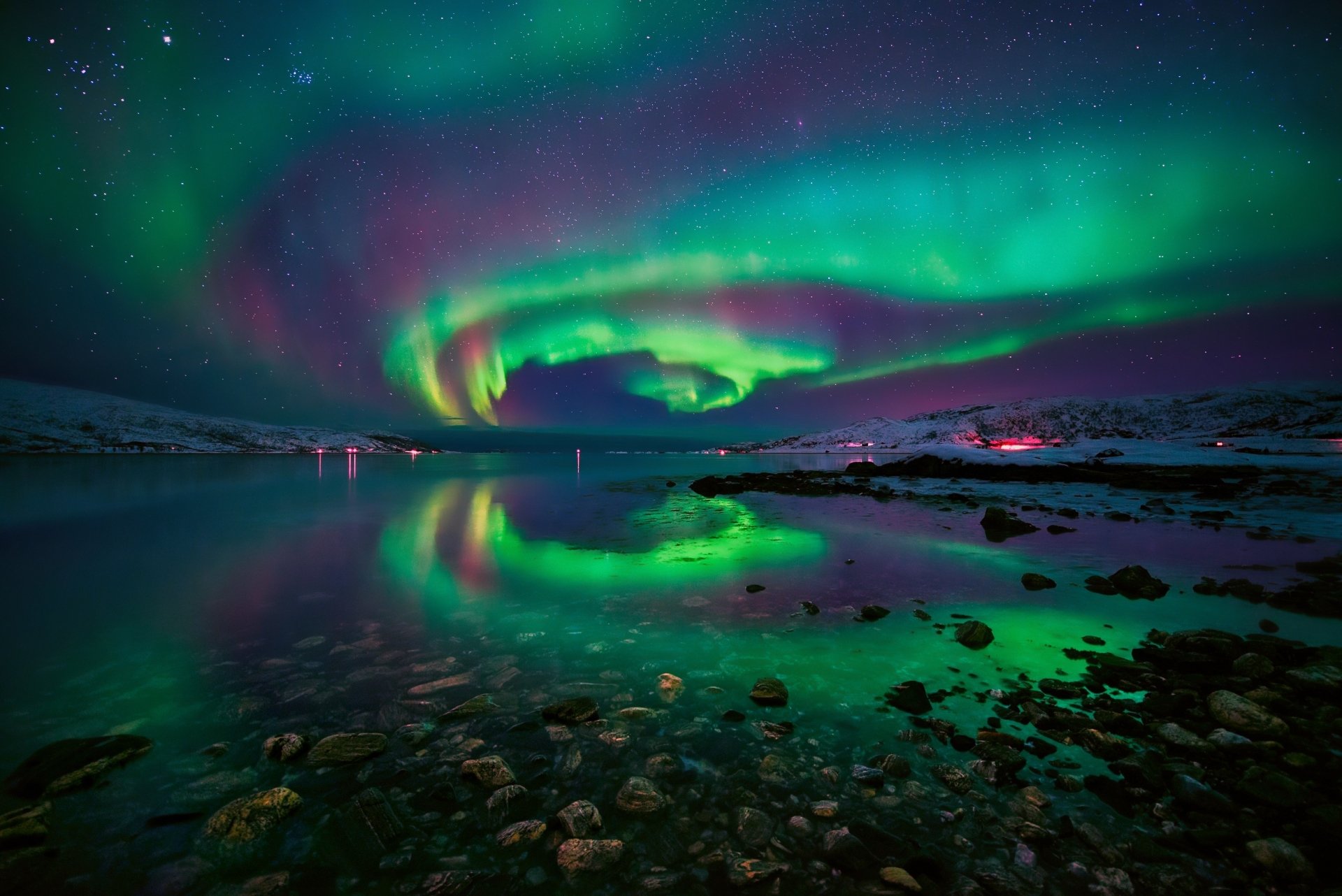
The Northern Lights are a magnificent natural light display that shimmers across night skies in high-latitude regions. If you've ever looked at photos of vivid green and violet curtains sweeping across the stars, you've witnessed the aurora borealis. This atmospheric phenomenon combines high-energy physics, solar activity, and the Earth's protective magnetic field into a single breathtaking visual.
Understanding how the aurora works goes far beyond simple myth and folklore. It requires looking at our sun, tracking solar wind, and measuring geomagnetic indices right from your phone. Whether you're planning a trip to the Arctic Circle or just want to understand the science behind the glow, here's what actually happens when the night sky lights up.
The Science Behind the Aurora Borealis
The science starts roughly 93 million miles away at the sun. Our star constantly ejects a stream of charged particles known as the solar wind. During periods of heightened solar activity, coronal mass ejections fling billions of tons of magnetized plasma directly into space at millions of miles per hour.
When these charged particles reach Earth, they encounter our planet's invisible magnetic shield, known as the magnetosphere. Most particles deflect away, but some get trapped in the magnetic field lines near the north and south magnetic poles.
As these high-energy electrons and protons funnel down toward the poles, they collide with gas molecules in Earth's upper atmosphere, mostly between 60 and 200 miles high. These collisions excite the gas atoms, temporarily boosting them to a higher energy state. When the atoms return to their normal state, they release photons of light. It's the exact same physics that makes a neon sign glow, just on a planetary scale.
What Causes the Different Colors?
The vibrant colors of the aurora depend entirely on which gas molecules get hit and at what altitude the collision takes place.
- Green: This is the most common color. It occurs when oxygen molecules are struck at altitudes of about 60 to 150 miles.
- Red: Higher-altitude oxygen collisions, starting above 150 miles, produce a deep red hue.
- Blue and Purple: When solar particles collide with nitrogen molecules at lower altitudes, below 60 miles, you get sharp blues and purples along the lower edges of the auroral arcs.
How to Forecast and Spot the Northern Lights
Catching a good display takes more than luck. You need to monitor space weather conditions just like you check local rain forecasts.
The primary metric to watch is the Kp index, a scale from 0 to 9 that measures geomagnetic activity. A Kp index of 0 means quiet conditions, while a Kp index of 5 or higher indicates a geomagnetic storm, which pushes the aurora visibility much further south than usual.
You also need to check cloud cover and light pollution. Even a strong aurora won't cut through heavy overcast skies or bright city streetlights. Head to dark-sky preserves or rural areas away from urban light pollution for the best viewing experience.
For reliable tracking, check official resources like the National Oceanic and Atmospheric Administration Space Weather Prediction Center for real-time forecasts, or consult the Canadian Space Agency for regional viewing tips.
Common Mistakes When Viewing the Northern Lights
Many first-time aurora chasers make avoidable mistakes that ruin their experience.
- Relying solely on your eyes right away: Human night vision takes at least 20 minutes to adjust to total darkness. Faint auroras often look like white or grey clouds to the naked eye before your eyes adjust or before a camera sensor picks up the hidden green hues.
- Ignoring moonlight: A bright full moon can wash out a weak or moderate aurora display entirely. Check lunar calendars before booking a trip.
- Dressing for the wrong weather: Clear nights in northern latitudes are often the coldest. Standing still for hours while waiting for activity means you need heavy winter gear, insulated boots, and chemical hand warmers.
Frequently Asked Questions
Can you hear the Northern Lights?
Some indigenous traditions and historical accounts describe a crackling or swishing sound during intense aurora displays. Modern scientists remain divided; while some low-frequency acoustic sounds have been recorded near ground level during geomagnetic storms, most researchers believe the lights are simply too high in the atmosphere for humans to hear directly.
Do the Northern Lights happen in the summer?
They happen year-round, but you can't see them during the summer months in the Arctic because the region experiences 24 hours of daylight, known as the midnight sun. Dark autumn, winter, and spring nights provide the necessary darkness for viewing.
Are auroras dangerous to humans?
No. The Earth's magnetic field and atmosphere absorb all the harmful radiation from solar storms long before it reaches the ground. Auroras are completely safe to watch.
Why is it called Aurora Borealis?
The name comes from Galileo Galilei in 1619. He combined Aurora, the Roman goddess of the dawn, with Boreas, the Greek name for the north wind. The southern counterpart is called the aurora australis.



