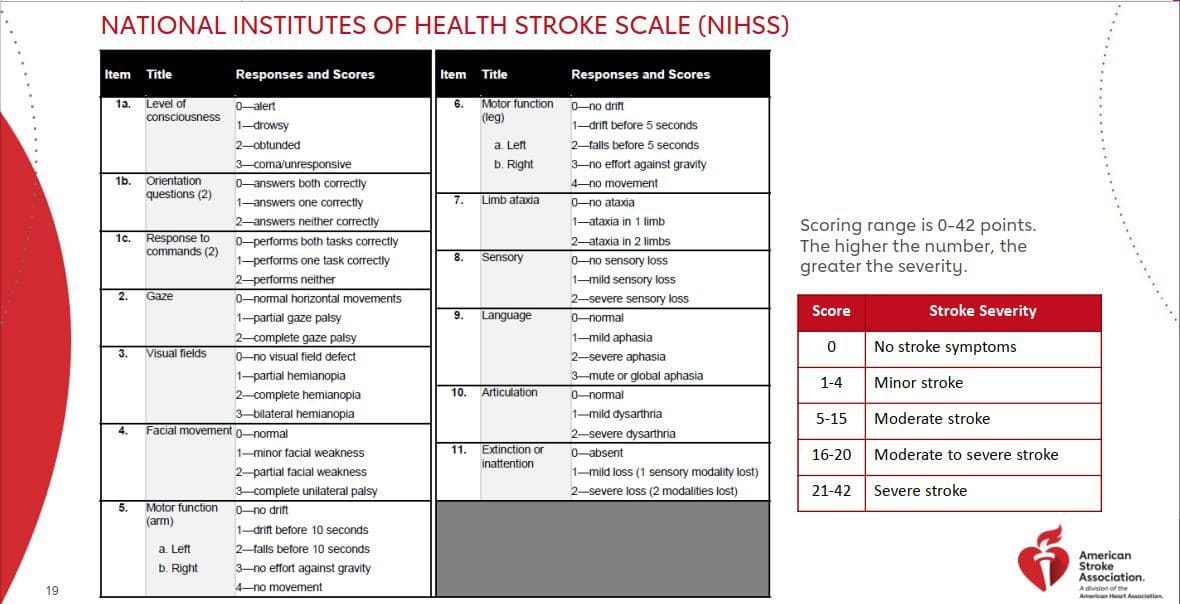
The National Institutes of Health Stroke Scale, or NIHSS, is a standardized 15-item tool that medical teams use to objectively quantify the neurological impairment caused by a stroke. When a patient arrives at the hospital with suspected stroke symptoms, doctors don't rely on guesswork. They administer this test to measure vital functions—ranging from level of consciousness and eye movements to motor strength, sensation, and language abilities.
Each category of the test is assigned a numeric point value, and these numbers add up to a cumulative score between 0 and 42. A higher total indicates more severe neurological damage, which directly dictates immediate treatment options, eligibility for interventions like clot-busting drugs or mechanical thrombectomy, and long-term rehabilitation planning.
How the NIHSS Exam is Structured
The assessment evaluates specific areas of the central nervous system through structured interactions. Certified examiners follow precise rules, testing patients in a fixed sequence without coaching or giving non-verbal hints.
- Level of Consciousness: Evaluates whether the patient is alert, arousable by minor stimulation, responsive only to repeated or painful stimuli, or entirely unresponsive (comatose).
- Gaze and Vision: Tests horizontal eye movements and visual field integrity across quadrants to check for gaze palsies or hemianopia.
- Facial Palsy and Motor Function: Assesses facial symmetry when smiling or closing eyes, alongside the drift and anti-gravity strength of both arms and legs.
- Sensory and Coordination: Checks response to pinprick sensations and tests for limb ataxia using finger-nose and heel-shin maneuvers.
- Language and Communication: Evaluates aphasia, articulation clarity (dysarthria), and the presence of sensory or spatial inattention.
Because a stroke affects different regions of the brain differently, this modular breakdown isolates specific functional deficits. For example, damage to the left hemisphere often presents with right-sided motor deficits and language impairment, while right-hemisphere damage typically impacts the left side of the body and spatial awareness. You can read more about standard evaluation protocols through the National Institute of Neurological Disorders and Stroke.
Decoding the Numbers: Severity Ranges
Total scores group patients into distinct tiers that help clinicians anticipate clinical trajectories and coordinate rapid care.
- 0 (Normal): No neurological deficits detected.
- 1 to 5 (Minor Stroke): Indicates mild impairment. Around 80% of patients falling into this range are ultimately discharged directly to home.
- 6 to 15 (Moderate Stroke): Reflects noticeable neurological deficits that usually require acute inpatient rehabilitation.
- 16 to 20 (Moderate to Severe Stroke): Signifies substantial impairment requiring intensive medical and specialized nursing care.
- 21 to 42 (Severe Stroke): Denotes massive neurological injury, often involving stupor or coma, necessitating critical care management.
Rapid scoring allows emergency teams to establish a reliable baseline. If a patient's score climbs over subsequent hours, it signals clinical deterioration, prompting immediate repeat brain imaging to check for swelling or secondary bleeding. Comprehensive clinical guidelines on management are maintained by the American Heart Association.
Common Scoring Pitfalls and Challenges
Administering the exam accurately requires rigorous training. Uncertified or rushed evaluations introduce errors that skew treatment decisions.
One frequent mistake involves confusing baseline chronic deficits with acute stroke symptoms. For instance, if a patient has pre-existing peripheral neuropathy, sensory testing in the hands and feet can yield false positives if not carefully differentiated from acute central sensory loss. Similarly, joint fusions or prior amputations must be marked as untestable ("UN") rather than scoring zero or maximum weakness.
Another hurdle arises when dealing with aphasic or intubated patients. Examiners must rely on pantomime, clear demonstration, or tactile cues without violating the strict rule against verbal prompting. Clinical oversight details can be explored via resources from the World Stroke Organization.
Frequently Asked Questions
Can a patient's NIHSS score improve after treatment?
Yes. When reperfusion therapies like thrombolytic medications or catheter-based clot retrieval restore blood flow quickly, neurological deficits can reverse. Serial exams capture these improvements over hours and days.
Does a low score mean a stroke can be ignored?
No. Even a score of 1 or 2 indicates a focal neurological deficit. Transient ischemic attacks or minor strokes still require urgent medical evaluation to prevent debilitating recurrent events.
How long does the entire assessment take?
A trained clinician typically completes the entire exam in less than 10 minutes. Its speed makes it ideal for high-pressure emergency department environments where every minute counts.
Who is authorized to perform the test?
While nurses, paramedics, and physicians can all administer the scale, clinical trials and hospital protocols generally require formal certification to ensure inter-rater reliability.



