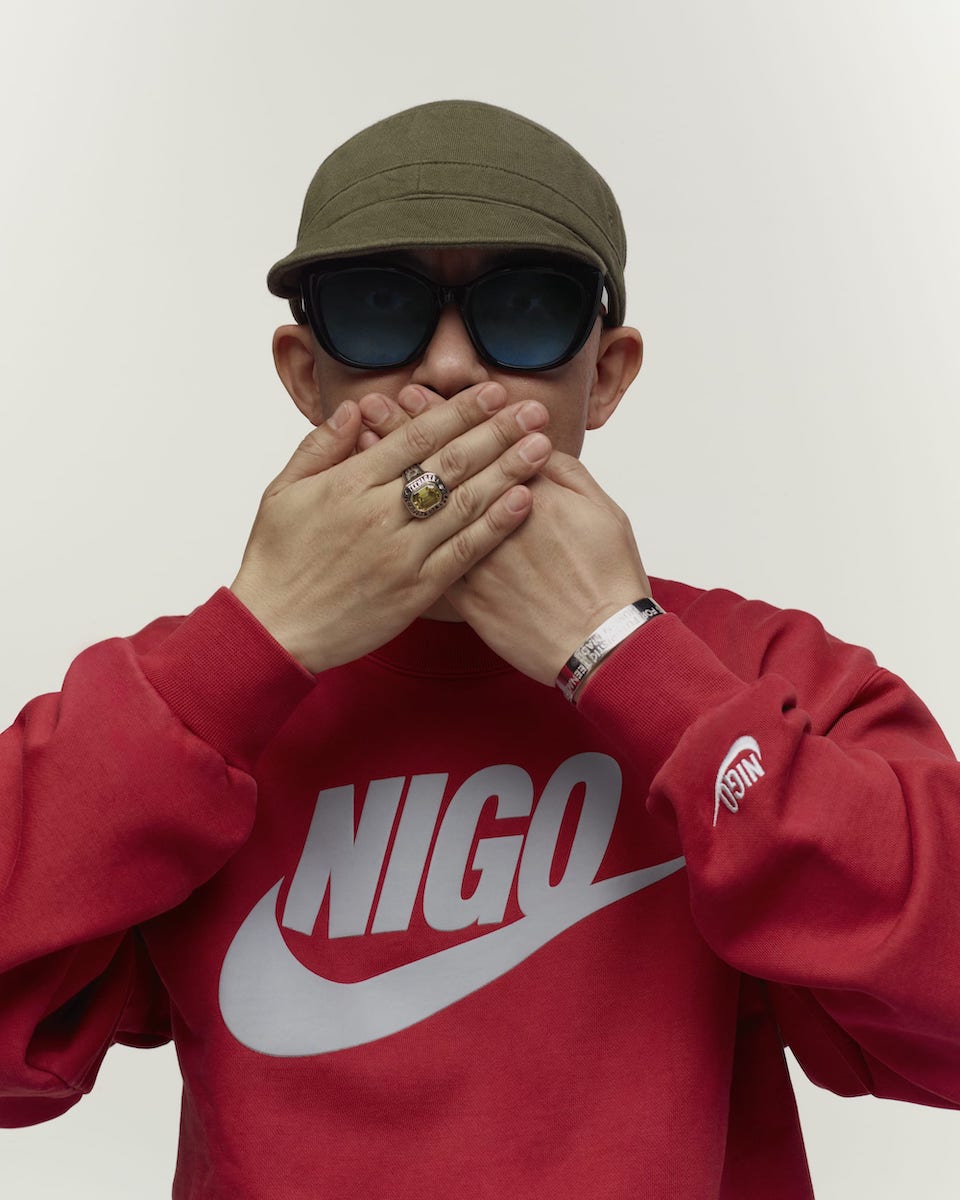
Tomoaki Nagao, universally known as Nigo, didn't just participate in the rise of modern streetwear—he engineered its blueprint. From a small-town record collector in Japan to the artistic director of a legacy French luxury house, his journey charts the exact evolution of street culture into high fashion. While many chroniclers frame his career as a simple transition from indie shopkeeper to corporate designer, the reality is a calculated masterclass in cultural architecture.
Understanding Nigo's trajectory requires looking past the glossy surface of limited-edition sneakers and graphic hoodies. His influence spans three distinct eras: the Harajuku underground explosion of the 1990s, the global hip-hop crossover of the 2000s, and his current standing as a multidisciplinary luxury director.
The Harajuku Genesis and the Birth of BAPE
Long before global luxury brands courted street culture, Nigo cut his teeth in Tokyo's dense fashion ecosystem. Working as an assistant and writer for Popeye magazine, he earned his moniker—meaning "number two" in Japanese—due to his striking resemblance to mentor and fragment design founder Hiroshi Fujiwara.
In 1993, alongside Jun Takahashi of Undercover, Nigo opened the legendary boutique Nowhere in the backstreets of Harajuku. It was here that A Bathing Ape (BAPE) was born, drawing its name loosely from the dystopian themes of Planet of the Apes and an ironic commentary on affluent Japanese youth culture. Similar coverage on this matter has been shared by BBC.
* 1993: Nowhere store opens in Harajuku; BAPE is founded.
* 1998: Introduction of the iconic 1st Camo pattern.
* 2002: Release of the culturally disruptive Bapesta sneaker.
The early operational model of BAPE defied conventional retail logic. Nigo deliberately produced tiny batches of t-shirts and hoodies, keeping supply far below demand. This scarcity model birthed modern streetwear hype. When hip-hop heavyweights like The Notorious B.I.G., Pharrell Williams, and later Kanye West adopted the brand, BAPE transformed from a cult Tokyo label into an international status symbol.
Crossing Over: Music, Billionaire Boys Club, and Leaving BAPE
Nigo's genius has always relied on cross-pollination between music and apparel. In the early 2000s, his partnership with Pharrell Williams resulted in the creation of Billionaire Boys Club and Ice Cream, bridging American hip-hop sensibilities with Japanese manufacturing precision. He also managed the hip-hop group Teriyaki Boyz, cementing his footprint in music production.
By 2011, following financial pressures and a changing corporate landscape, Nigo parted ways with BAPE (which was eventually acquired by Hong Kong's I.T Group). Rather than fading away, he immediately pivoted. He launched Human Made in 2010, a label dedicated to vintage Americana, archival workwear, and meticulous textile reproduction that stood in stark contrast to the loud graphics of his earlier career.
Redefining Luxury: Uniqlo, Louis Vuitton, and Kenzo
Nigo's entry into mainstream corporate retail began in 2014 when he took the helm as creative director for Uniqlo's UT line, democratizing graphic tees for millions globally. However, his transition into traditional high fashion surprised industry traditionalists.
His relationship with late designer Virgil Abloh opened doors at Louis Vuitton, where Nigo co-designed a high-profile capsule collection in 2020 that merged classic monogram canvas with his signature tailored streetwear cuts. This success led to a historic appointment in September 2021, when he was named artistic director of Kenzo, making him the first Japanese designer to lead the historic Paris fashion house founded by Kenzo Takada.
At Kenzo, Nigo successfully married Takada’s vibrant floral heritage with utility-driven workwear, proving that a streetwear pioneer could master traditional European tailoring without losing his distinct cultural edge.
Common Misconceptions About Nigo's Career
- Myth: Nigo studied formal fashion design at university.
- Fact: He studied editorial styling and fashion editing at Bunka Fashion College, building his career through hands-on retail, publishing, and cultural curation rather than flat-pattern sewing.
- Myth: He sold BAPE because the brand failed.
- Fact: He stepped down after structural shifts and a corporate buyout, immediately pivoting to launch Human Made and secure major global luxury appointments.
- Myth: Nigo only designs clothes.
- Fact: He is an avid contemporary art collector, interior designer, music producer, and creative partner for global lifestyle brands like Penfolds wine.
Frequently Asked Questions
What does the name Nigo mean?
The name translates to "number two" in Japanese. It was given to him by mentor Hiroshi Fujiwara, jokingly labeling Nigo as his lookalike and second-in-command during their early magazine days.
Why did Nigo leave A Bathing Ape?
Nigo stepped down from his executive and creative roles following changes in ownership and financial restructuring. He officially severed ties with the company in 2013 to focus entirely on independent ventures like Human Made.
How did Nigo influence modern streetwear culture?
He pioneered the artificial scarcity model—dropping small, limited quantities of graphic tees and hoodies—which directly inspired today's drop culture seen across brands like Supreme and Off-White.
What is Nigo's current role in fashion?
He serves as the artistic director of Kenzo, continues to run his independent vintage-inspired label Human Made, and consults on multidisciplinary global lifestyle collaborations.



