Every night, Earth sweeps through a river of interplanetary debris. Most of these rocks burn up in the upper atmosphere, creating the fleeting flashes we call shooting stars. A tiny fraction survives the brutal plunge, landing on the ground as physical samples of deep space. We study these rocks to decode the chemical history of our cosmic neighborhood.
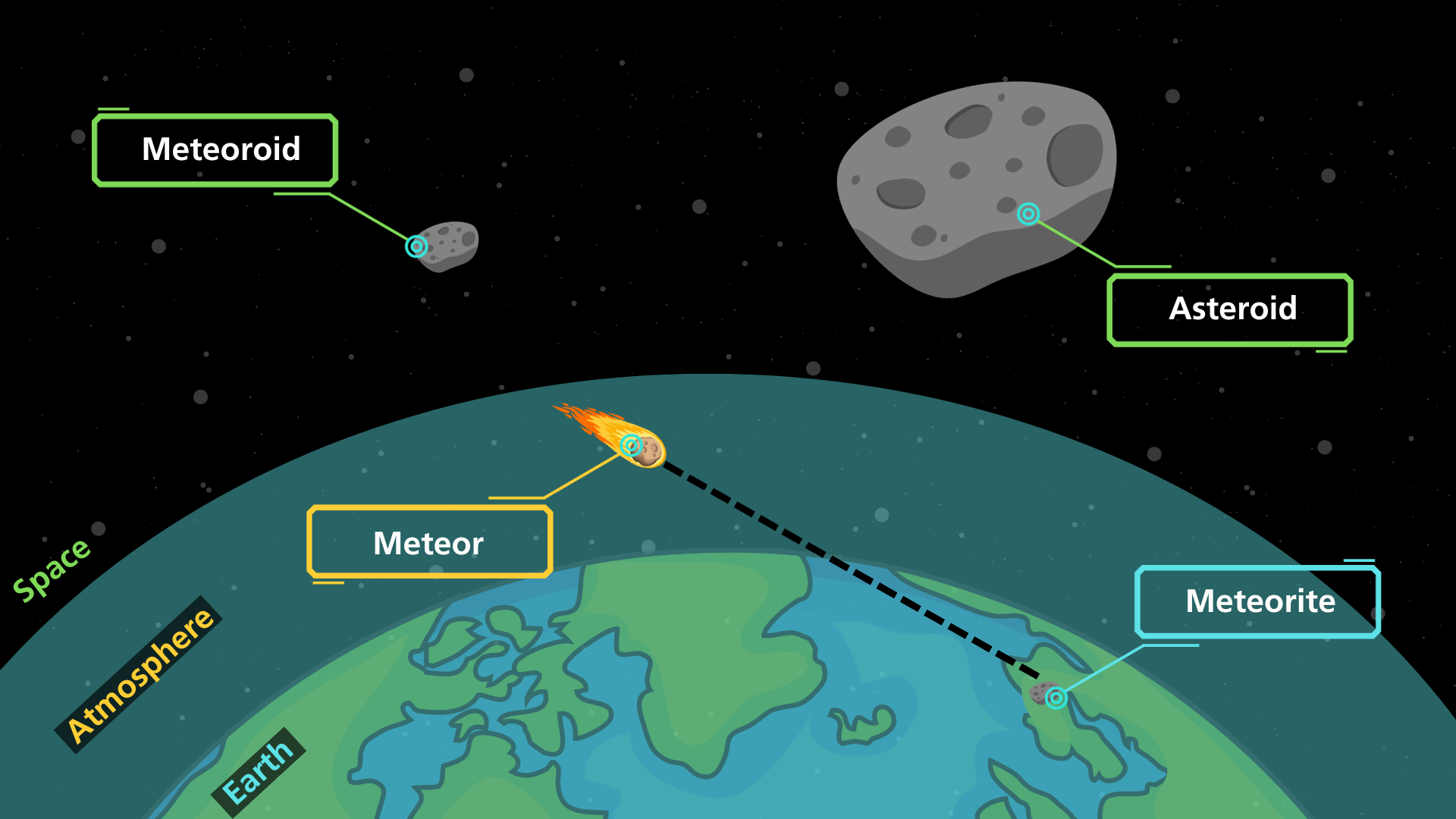
Understanding these objects requires tracking their transformations across three distinct phases. A meteoroid travels silently through the void, ranging from a speck of dust to a boulder one meter across. When it hits our atmosphere at speeds exceeding twenty kilometers per second, air resistance generates extreme heat. This vaporizes the surrounding gas into a glowing streak known as a meteor. If any solid core endures the thermal shock and reaches the surface, scientists classify it as a meteorite.
The Chemistry of Ancient Worlds
Meteorites aren't random space junk. They're pristine time capsules formed more than four and a half billion years ago. Because most asteroids haven't undergone major geological recycling, their fragments preserve the original building blocks of the inner planets.
Researchers categorize these space rocks into three primary groups based on their mineral makeup:
- Stony meteorites: Dominated by silicate minerals, these make up the vast majority of recovered falls. Chondrites within this group contain millimeter-sized glass spheres called chondrules that predate the planets.
- Iron meteorites: Composed primarily of iron and nickel alloys, these dense chunks represent the metallic cores of differentiated ancient planetesimals that were shattered by violent impacts long ago.
- Stony-iron meteorites: Rare hybrids containing roughly equal parts silicates and metal, originating from the boundary layer where a rocky mantle met a metallic core.
The NASA Asteroid Watch program tracks near-Earth objects to monitor potential hazards and understand how these parent bodies distribute material throughout the solar system.
How Scientists Recover and Identify Samples
Finding a space rock on Earth takes patience and specific geological knowledge. While eyewitness accounts of bright fireballs occasionally lead to fresh falls, researchers spend weeks scouring arid deserts and polar ice sheets where dark stones contrast sharply against sand or snow.
When a suspect rock enters a lab, researchers look for specific diagnostic markers:
- Fusion crust: A thin, dark, glassy exterior melted by atmospheric friction during the high-speed descent.
- Regmaglypts: Thumbprint-like indentations melted into the surface as swirling gases erode the stone.
- Internal structures: Iron samples reveal intricate crystalline patterns called Widmanstätten lines when etched with acid, while stony samples often display tiny chondrules under a microscope.
For deep dives into official classifications and verified recovery logs, the Meteoritical Society Database tracks nearly every documented space rock recovered on Earth.
Common Mistakes in Amateur Identification
People often mistake Earth-bound minerals for space rocks, leading to common misclassifications.
Many amateur rockhounds bring in terrestrial slag—a glassy byproduct of metal smelting—mistaking its bubbly texture for a fusion crust. Slag frequently contains trapped air bubbles, which never form in authentic meteorites.
Another frequent mix-up involves magnetite and hematite nodules. These heavy iron oxides look metallic and feel dense, but they lack the distinct nickel-iron crystal structures found in genuine iron meteorites. A simple nickel test kit easily rules out terrestrial lookalikes.
Frequently Asked Questions
How often do meteorites strike Earth?
Tons of extraterrestrial material enter our atmosphere daily, but most of it consists of microscopic dust. Larger rocks hit the surface regularly, though seventy percent land in oceans or unpopulated wilderness, leaving most falls unrecovered.
Are meteorites radioactive or dangerous to handle?
No. By the time a meteorite reaches Earth's surface, its short-lived radioactive isotopes have decayed. Handling a standard stone or iron meteorite poses no radiation hazard, though you should keep freshly recovered specimens dry to prevent rusting.
Can I keep a meteorite if I find one on public land?
Laws vary significantly depending on jurisdiction. In many countries, meteorites found on private property belong to the landowner, while finds on public or protected lands may be subject to strict government conservation laws.
Why do some meteorites look magnetic while others do not?
Iron and stony-iron meteorites contain high concentrations of metallic iron and nickel, making them strongly magnetic. Ordinary stony chondrites contain smaller amounts of free metal grains, meaning they exhibit only a weak magnetic pull.