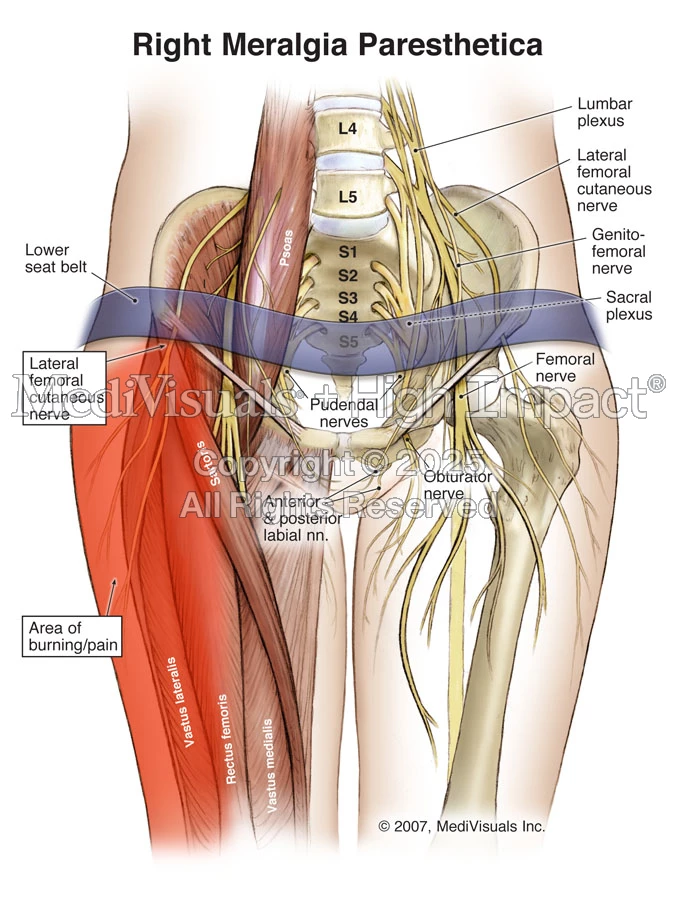
Meralgia paresthetica happens when the lateral femoral cutaneous nerve—the sensory nerve supplying the outer thigh—gets compressed or entrapped, usually as it passes under the inguinal ligament near the hip bone. This compression triggers burning pain, numbness, and tingling along the outer thigh. Targeted movement strategies help decompress this pathway by releasing tight hip flexors and stabilizing the pelvis.
Conservative care forms the foundation of recovery for most people. While severe cases require medical intervention, movement routines targeting the hip and lower trunk can relieve mechanical pressure on the nerve.
Understanding the Root Cause of Lateral Thigh Pain
The lateral femoral cutaneous nerve is purely sensory, meaning it doesn't control muscle movement, but it reacts intensely to mechanical irritation. When hip flexors tighten or pelvic alignment shifts, the space beneath the inguinal ligament narrows. Tight clothing, carrying excess weight, pregnancy, or prolonged sitting can all pinch this nerve.
Addressing the issue requires targeted mobility work rather than generic stretching. If you stretch the wrong structures or aggravate the pelvis, symptoms can flare up.
Key Stretches to Open the Hip Complex
Releasing tension around the pelvis requires length in the hip flexors, particularly the psoas and tensor fasciae latae, which often run tight in people experiencing lateral thigh discomfort.
Kneeling Hip Flexor Stretch
This movement targets the front of the hip and upper thigh, directly opening the space where the lateral femoral cutaneous nerve exits the pelvis.
- Kneel on your right knee on a comfortable mat, placing your left foot flat on the floor in front of you with your knee bent at a ninety-degree angle.
- Keep your torso upright and engage your core gently to avoid arching your lower back.
- Shift your weight forward into your left front leg until you feel a moderate stretch through the front of your right hip and thigh.
- Hold this position for twenty to thirty seconds while breathing deeply, then switch sides. Repeat three times per side.
Cobra Pose for Abdominal and Hip Extension
Gentle extension of the spine and abdomen can help relieve anterior pelvic tension that compresses upper leg nerves.
- Lie face down on an exercise mat with your palms flat on the floor directly beneath your shoulders.
- Keep your hips and lower body firmly anchored to the mat.
- Slowly press your upper body upward by straightening your arms, keeping your gaze forward and your shoulders relaxed.
- Hold for twenty seconds while maintaining smooth breaths, then lower yourself back down. Complete three to four repetitions.
Strengthening Exercises for Pelvic Stability
Stabilizing the pelvis prevents the hip joint from collapsing inward, which frequently aggravates the lateral femoral cutaneous nerve during daily activities like walking or standing.
Clamshells for Hip Stabilizers
Weak hip abductors often cause poor lower limb mechanics. Clamshells build strength in the outer hip without placing undue stress on the lumbar spine.
- Lie on your side with your hips and knees bent at a forty-five-degree angle, stacking your legs and feet precisely.
- Rest your head on your lower arm and place your top hand on the floor in front of your chest for stability.
- Keeping your heels pressed firmly together, slowly raise your top knee toward the ceiling.
- Pause for one to two seconds at the top, ensuring your pelvis doesn't roll backward. Lower your knee slowly. Perform fifteen repetitions on each side.
Glute Bridges
Bridges activate the posterior chain, counteracting the hip-flexion dominance that characterizes prolonged sitting.
- Lie flat on your back with your knees bent and your feet flat on the floor, spaced hip-width apart.
- Press your heels into the floor and lift your hips upward until your thighs and torso form a straight line.
- Squeeze your glutes at the top and hold for three to five seconds.
- Lower your hips back to the floor with control. Complete three sets of ten to fifteen repetitions.
Common Mistakes to Avoid
Managing nerve entrapment requires avoiding habits that worsen compression.
- Skipping warm-ups: Jumping straight into deep stretches cold can trigger protective muscle spasms that increase pressure on the nerve.
- Wearing restrictive clothing: Tight belts, skinny jeans, or heavy tool belts directly compress the nerve pathway over the hip bone. Opt for loose-fitting garments while recovering.
- Aggressive foam rolling: Rolling directly over the outer thigh or tensor fasciae latae with high pressure can aggravate a sensitive cutaneous nerve. Focus on gentle mobility instead.
- Pushing through sharp pain: Mild stretching discomfort is normal, but sharp or shooting pain means you should stop immediately.
For broader clinical context on peripheral nerve entrapments, you can review resources provided by the National Institute of Neurological Disorders and Stroke.
Frequently Asked Questions
How long does it take for meralgia paresthetica to resolve?
Mild cases often improve within a few weeks to months once mechanical irritants like tight clothing or poor posture are corrected. Persistent compression can take longer, and stubborn symptoms should be evaluated by a medical professional or physical therapist.
Can walking or running make the condition worse?
High-impact activities or long-distance running can aggravate symptoms if your hip flexors are excessively tight. If walking triggers burning pain, try shortening your stride or switching to low-impact alternatives like swimming or stationary cycling temporarily.
Is heat or ice better for outer thigh nerve pain?
Applying an ice pack wrapped in a cloth to the outer hip for fifteen minutes can help calm acute inflammation around the nerve site. Others find gentle heat helpful for relaxing chronically tight hip flexors prior to stretching.
When should I see a doctor for thigh numbness?
Consult a physician if numbness or pain worsens, if it spreads down past the knee, or if you experience muscle weakness in the leg. True nerve root compression from the spine can mimic meralgia paresthetica and requires professional medical diagnosis.
To learn more about related anatomy, visit the American Academy of Orthopaedic Surgeons.



