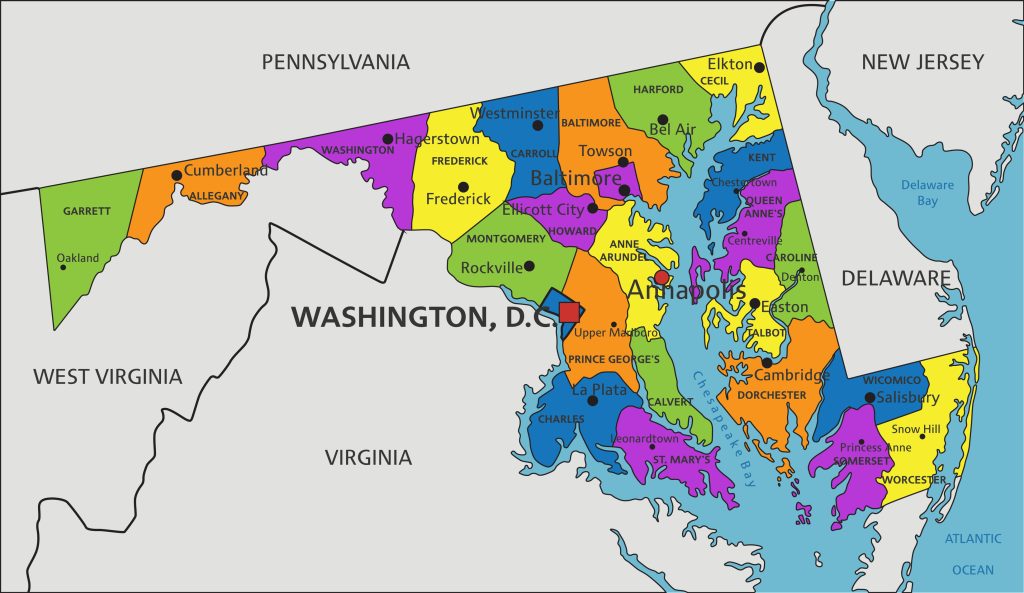
Maryland relies on six active area codes divided into two distinct geographic regions. If you're trying to figure out where a call is coming from, setting up a local business line, or understanding how local dialing works, knowing these boundaries saves you plenty of confusion. The state splits roughly down the middle, separating the Washington, D.C. suburbs from Baltimore and the Eastern Shore.
Instead of carving up existing territories into smaller pieces every time phone numbers run low, regulators rely on overlay zones. This means multiple area codes cover the exact same geographic footprint. Because of this setup, you must dial ten digits for every local call, even if you're calling someone in your own neighborhood.
The Western Region: 301, 240, and 227
The western numbering plan area covers the Maryland suburbs surrounding Washington, D.C., as well as parts of Southern Maryland and the western panhandle. This region includes heavily populated counties like Montgomery and Prince George's, alongside cities such as Frederick, Hagerstown, and Cumberland.
- 301: This is the historic code, dating back to 1947 when it originally covered the entire state of Maryland. Today, it's dedicated exclusively to the western region.
- 240: Introduced in 1997 as the first overlay for the 301 territory when demand for mobile phones, pagers, and fax lines exploded.
- 227: Rolled out in 2023 as the newest addition to the region, providing a fresh pool of numbers as older prefixes neared exhaustion.
Anyone living in Rockville, Bethesda, Silver Spring, or Waldorf might be assigned a 301, 240, or 227 number. They all sit on the exact same infrastructure, and local calls between them require the full area code. You can verify active number allocations and administrative rules through the North American Numbering Plan Administrator.
The Eastern Region: 410, 443, and 667
The eastern numbering plan area covers Baltimore, Annapolis, the surrounding counties, and the entire Eastern Shore. This zone handles major economic hubs, dense urban neighborhoods, and rural coastal communities alike.
- 410: Established in 1991 when the original 301 code was split, separating the Baltimore and Eastern Shore side of the state from the D.C. suburbs.
- 443: Added in 1997 as an overlay to absorb the rapid growth of new digital communication devices across the Baltimore and Annapolis areas.
- 667: Implemented in 2012 to further expand capacity across the same eastern footprint without disrupting existing subscriber numbers.
If you receive a call from Salisbury, Ocean City, Bel Air, or inner-city Baltimore, it will feature one of these three codes. Like the western zone, geographic boundaries don't separate them; a business next door might use 410 while the office upstairs uses 667.
Why Maryland Uses Overlay Codes
Decades ago, running out of phone numbers meant redrawing map lines and forcing half a population to change their seven-digit numbers. That approach created massive headaches for residents, local governments, and businesses that had to reprint stationery and update contact lists.
Overlays solved that problem. When 240 and 443 were introduced in the late nineties, existing customers kept their numbers, while new lines received the fresh code. To make this work smoothly, mandatory ten-digit dialing became standard across Maryland. If you drop the area code and dial just seven digits, your call won't go through, regardless of whether you're calling a landline or a mobile phone. For broader telecom consumer guidelines, check resources provided by the Federal Communications Commission.
Common Misconceptions About Maryland Phone Numbers
People often assume that a specific code ties a caller to a precise neighborhood or a particular type of device. In practice, that's rarely true today.
- Mobile versus landline: You can't look at an area code and tell if it belongs to a cell phone or a traditional landline. Number portability rules let users carry their phone numbers across carriers and technology types.
- Exact city tracking: While 301 or 410 can tell you which half of the state a call originates from, it won't pinpoint a specific town. A 240 number could belong to someone in Gaithersburg or someone living fifty miles south near the Potomac River.
- Long-distance charges: Because of overlay zones and local calling area definitions, calling from a 301 number to a 240 number within the same region isn't a toll call, even though you must dial ten digits.
Frequently Asked Questions
Why do I have to dial ten digits for local calls in Maryland?
Because Maryland uses overlay area codes. Multiple codes occupy the exact same geographic region, meaning the telephone network requires the area code to identify which specific number you're trying to reach.
Will Maryland add any new area codes soon?
State regulators and numbering administrators monitor phone number pools continuously. Following the addition of the 227 code in 2023, current forecasting suggests the existing inventory will sustain the state for several more years before another overlay becomes necessary.
Can I choose which area code I get when setting up a new phone?
It depends on your carrier. Many mobile providers assign numbers randomly based on your billing ZIP code, but some customer service teams or enterprise VoIP providers let you select from available local area codes during setup.
Does a Maryland area code mean the caller is physically located in the state?
Not necessarily. With digital phone services, VoIP applications, and number porting, a business or individual can maintain a Maryland phone number while operating from anywhere in the world.