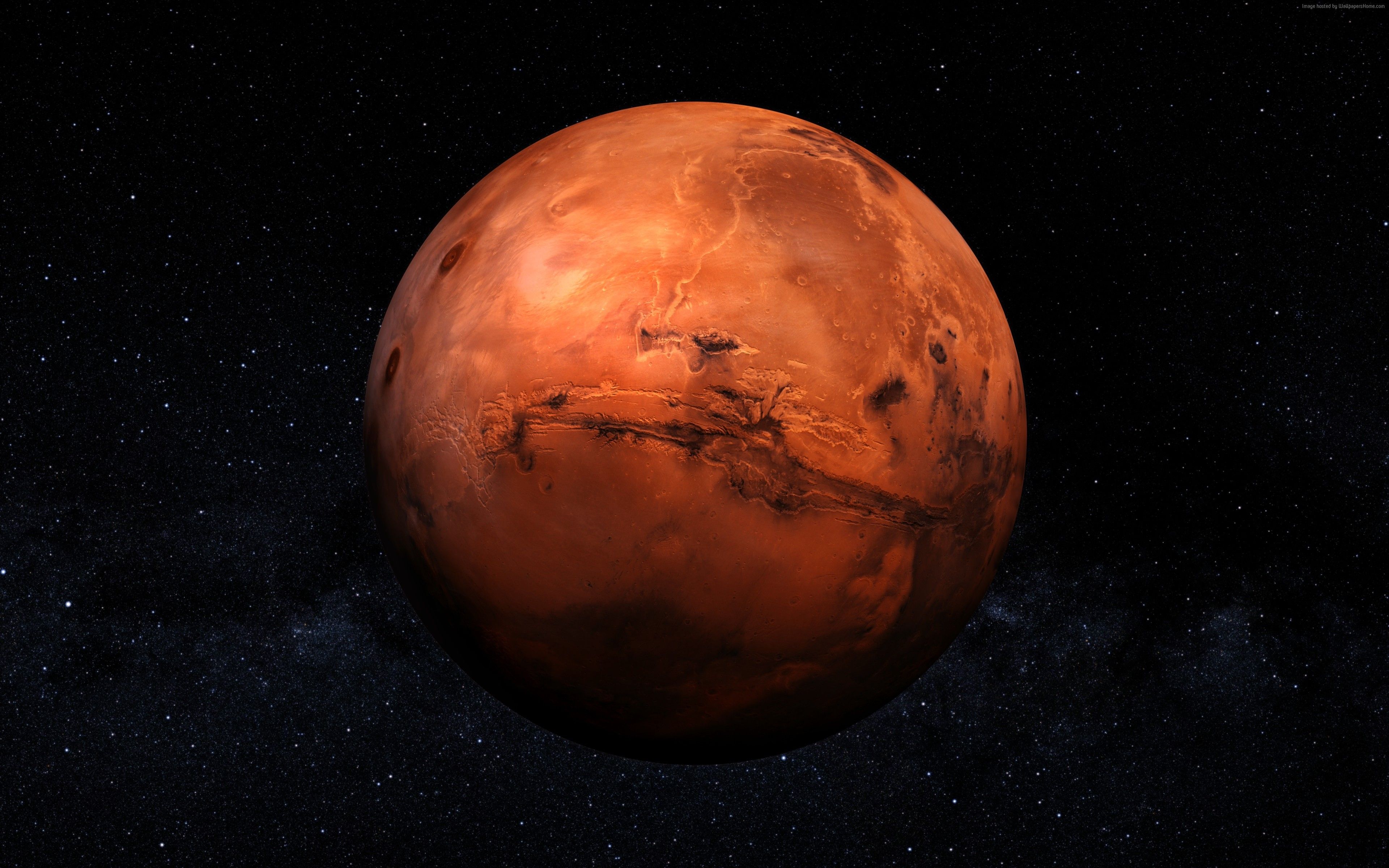
Mars orbits the Sun at an average distance of roughly 142 million miles, putting it about 1.5 times farther away than Earth. This extra distance drastically changes how much sunlight reaches the Red Planet, dropping solar energy levels to less than half of what we experience.
That single orbital reality creates a freezing world with a thin atmosphere, massive global dust storms, and a harsh environment for any machinery we send there. Let's break down the exact numbers behind the orbit, how the distance shifts throughout the year, and why those miles change everything for future human explorers.
The Orbital Numbers: Perihelion and Aphelion
Planets don't move in neat, perfect circles. Mars travels in an ellipse, meaning its distance from the Sun shifts dramatically over the course of a single Martian year.
- Average Distance: About 141.6 million miles (227.9 million kilometers)
- Perihelion (Closest Point): Roughly 128.3 million miles (206.6 million kilometers)
- Aphelion (Farthest Point): Approximately 154.9 million miles (249.3 million kilometers)
That swing of more than 26 million miles between its closest and farthest points means Mars experiences intense seasonal swings driven directly by its distance.
Comparing Mars and Earth
Earth sits at an average of 93 million miles from the Sun, setting our baseline for a habitable zone. Mars sits out much further, but the comparison goes beyond simple mileage.
Mars has an orbital eccentricity of about 0.09, which is much higher than Earth's gentle 0.016. Because of this elongated path, the southern hemisphere of Mars has much hotter summers and much colder winters than the northern hemisphere. When Mars is closest to the Sun during its southern summer, global dust storms routinely erupt, obscuring the entire planet from view for weeks.
According to data from NASA Solar System Exploration, this orbital eccentricity forces scientists to calculate spacecraft trajectories with extreme precision to account for fluctuating solar radiation pressure.
Why the Distance Matters for Temperature
Distance from the Sun dictates energy input. Mars receives roughly 43% of the solar flux that Earth gets at the top of its atmosphere.
Combine that low energy input with a thin carbon dioxide atmosphere that traps very little heat, and you get a brutally cold world. Average surface temperatures hover around minus 80 degrees Fahrenheit (minus 60 degrees Celsius), dropping to minus 195 degrees Fahrenheit at the poles during winter.
Even when Mars is at perihelion and getting a temporary boost in solar heating, the thin air can't hold onto the warmth. The temperature drops sharply the moment the sun goes down.
Engineering Challenges for Spacecraft
That 142-million-mile gap creates massive hurdles for space agencies building rovers and orbiters.
Power Generation
Solar-powered probes like Opportunity and Spirit relied entirely on sunlight hitting their panels. Because Mars sits so far out, those panels must be significantly larger than they would need to be on Earth or Venus. When global dust storms block the sunlight, power drops instantly, which is exactly what ultimately doomed the Opportunity rover in 2018. Modern explorers like the Perseverance rover sidestep this limitation by using a multi-mission radioisotope thermoelectric generator, converting heat from decaying plutonium into steady electricity instead of relying on the sun.
Communication Delays
Light and radio waves take time to cross interplanetary space. Depending on where Earth and Mars sit relative to each other in their respective orbits, a one-way radio signal takes anywhere from 3 to 22 minutes to travel between the two planets. Real-time remote control from mission control is impossible. Rovers must make autonomous driving and scientific decisions using onboard navigation algorithms.
Launch Windows
You can't just fly a rocket straight to Mars whenever you feel like it. Space agencies must wait for an optimal launch window that occurs roughly every 26 months. During this alignment, Earth and Mars are positioned so that a spacecraft can use the least amount of fuel to make the journey across the interplanetary void.
Frequently Asked Questions
How long does it take sunlight to reach Mars?
Sunlight takes roughly 13 minutes to travel the average distance from the Sun to Mars. When the two planets are at their closest approach, that travel time drops to about 11 minutes, and stretches to over 22 minutes when they are on opposite sides of the Sun.
Does Mars get closer to Earth than the Sun?
Yes. During opposition, when Earth passes directly between Mars and the Sun, Mars comes as close as 34 million miles to Earth. At that specific moment, Earth is actually closer to Mars than Mars is to the Sun.
Why is Mars' orbit more stretched out than Earth's?
Gravitational tugs from Jupiter, the largest planet in our solar system, slowly stretch and reshape the orbits of the inner rocky planets over millions of years, leading to the higher eccentricity we see in Mars' path today.
Can humans survive the temperatures caused by this distance?
Not without heavy life support. While summer days near the Martian equator can sometimes reach a relatively mild 70 degrees Fahrenheit, the thin air and rapid heat loss mean human habitats must feature advanced thermal insulation and pressurized suits to prevent freezing.



