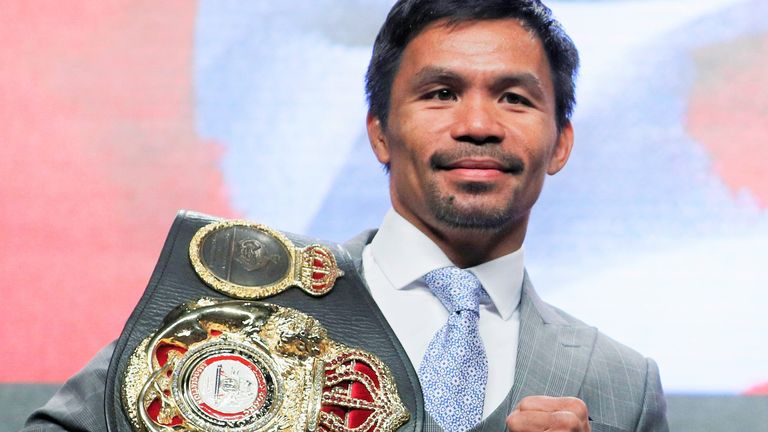
Manny Pacquiao didn't just win championships across eight different weight divisions; he fundamentally distorted how we understand human biomechanics in combat sports. Standing at just 5 feet 5 inches with a 67-inch reach, Pacquiao operated at a permanent physical deficit against the elite welterweights and junior middleweights of his era. Yet, his career remains an unmatched masterclass in turning perceived structural disadvantages into lethal offensive engines.
When examining the Filipino icon's legacy, casual fans often focus exclusively on his record-breaking title count. True analysts look deeper, examining how his extraordinary speed, unorthodox foot angles, and explosive power compensated for physical constraints. Let's examine the exact physical metrics, stylistic innovations, and historical context that define Manny Pacquiao's unparalleled legacy in the ring.
The Physical Blueprint: Height, Reach, and Bone Structure
Pacquiao's official measurements list him at 5 feet 5 inches (165 cm) with a reach of 67 inches (170 cm). In the modern era of boxing, where champions at lightweight and welterweight routinely tower above 5 feet 9 inches with 72-inch reaches, Pacquiao's dimensions were miniature.
More remarkable than his height was his skeletal frame expansion. Pacquiao began his professional career as a 106-pound junior flyweight in 1995. Over fifteen years, he scaled up to 154 pounds, capturing world titles in the flyweight, super bantamweight, featherweight, super featherweight, lightweight, junior welterweight, welterweight, and junior middleweight divisions.
Moving up eight weight classes requires more than muscle gain; it demands structural adaptation. Pacquiao maintained his blinding hand speed while carrying nearly fifty additional pounds of mass. His legs, famously dubbed tree trunks by trainers, generated ground force that baffled opponents who expected a depleted fighter as he climbed the scale.
Unorthodox Prowess: Speed over Size
In boxing physics, reach is supposed to dictate distance. Taller fighters use long jabs to keep shorter opponents on the outside. Pacquiao completely broke this convention by utilizing extreme lateral movement and lightning-fast entry angles.
The In-And-Out Blitz
Pacquiao's primary weapon was his ability to cover distance in milliseconds. While conventional fighters step sequentially, Pacquiao exploded off his lead foot, launching straight left hands from angles opponents couldn't track. By the time taller opponents registered the initiation, Pacquiao had already landed and pivoted off the centerline.
Southpaw Advantage
As a natural southpaw fighting out of an aggressive stance, Pacquiao created geometric nightmares for orthodox fighters. His lead right hook blinded opponents, while his straight left hand bypassed high guards by coming straight down the pipe or looping around static gloves.
Division-by-Division Breakdown: How He Conquered the Scales
Pacquiao's ascent wasn't a gradual, comfortable transition. He often jumped multiple weight classes at once, skipping divisions to challenge elite champions.
- Flyweight to Featherweight (1995–2003): Operating as a pure speed demon, Pacquiao relied on raw kinetic energy. His knockout of Ledwaba in 2001 on two weeks' notice announced his arrival on the global stage.
- Super Featherweight to Lightweight (2003–2008): This phase showcased his tactical evolution under trainer Freddie Roach. He stopped legends like Marco Antonio Barrera and Erik Morales by blending power with sharp combinations.
- Welterweight and Beyond (2009–2019): Facing giants like Oscar De La Hoya, Miguel Cotto, and Antonio Margarito, Pacquiao proved his power translated upward. Against Margarito, a man who rehydrated to well over 160 pounds, Pacquiao landed blistering combinations from angles that left the larger man severely battered.
For a deeper dive into athletic longevity and championship lineage, consult the World Boxing Hall of Fame.
Common Misconceptions About Pacquiao's Career
Boxing media often mischaracterizes Pacquiao's success as pure genetic endowment. Several myths persist among modern analysts.
First, critics suggest he fought bloated fighters who drained themselves. In reality, Pacquiao often entered the ring lighter than his opponents, absorbing heavy blows from natural welterweights and junior middleweights without losing his offensive rhythm.
Second, many assume his power diminished as he moved up. While his absolute knockout percentage dropped at welterweight, his accumulation of punches and sharp accuracy created stoppages through sheer velocity and volume rather than single-shot concussive force.
Frequently Asked Questions
What was Manny Pacquiao's peak walking weight?
During his prime years fighting at welterweight (147 pounds), Pacquiao typically walked around 150 to 152 pounds outside of training camp, requiring minimal water weight cutting compared to modern fighters who shed 15 to 20 pounds on fight week.
How many weight classes did Manny Pacquiao win titles in?
Pacquiao officially won world titles in eight different weight divisions, recognized by major sanctioning bodies from flyweight (112 pounds) up to junior middleweight (154 pounds).
Why was his southpaw stance so difficult to counter?
He combined an unusual wide stance with explosive lateral footwork, allowing him to leap forward from outside typical punching range while maintaining a dominant angle outside his opponent's lead foot.
Did Pacquiao ever hold belts concurrently?
Unlike modern multi-division champions who hold belts across two weights simultaneously, Pacquiao vacated titles as he moved up, challenging reigning champions at higher limits rather than defending across divisions at the same time.



