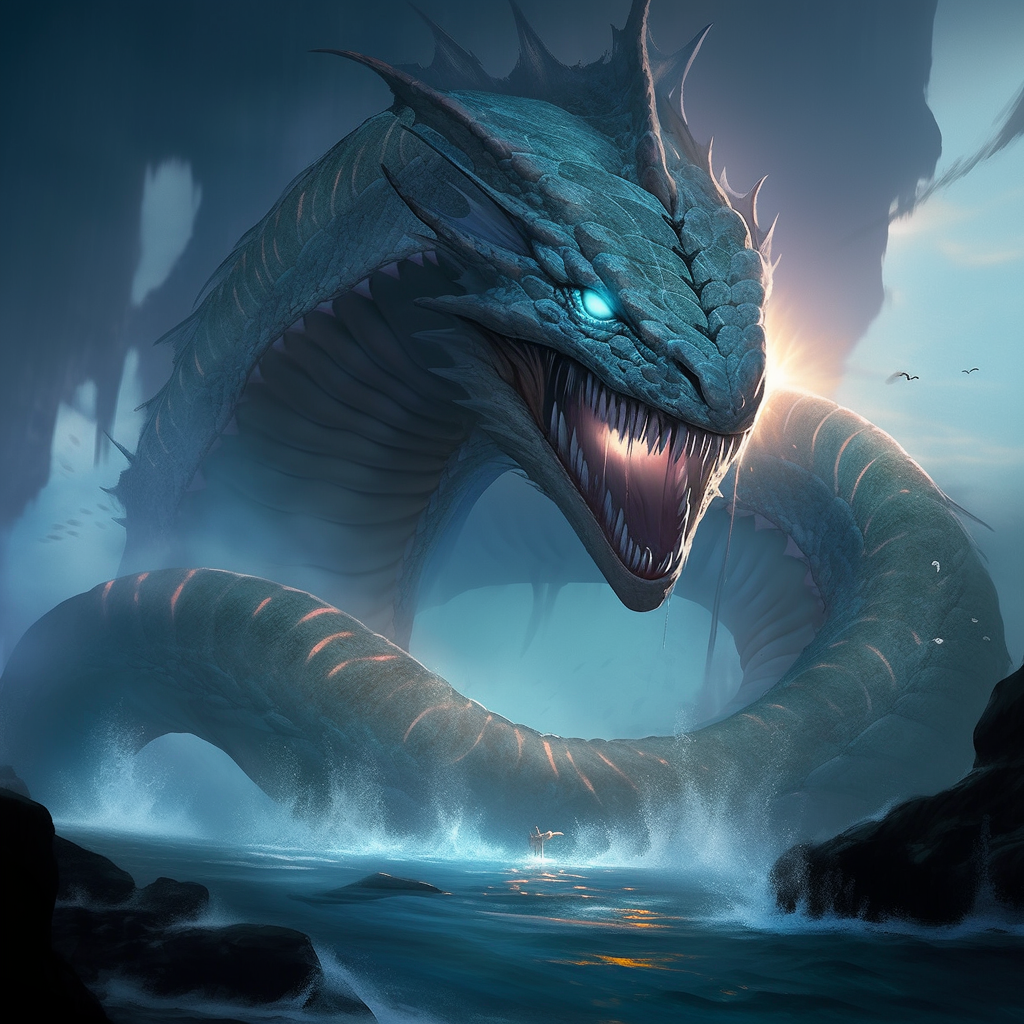
When people talk about leviathan vs kraken, they are usually comparing two completely different traditions of maritime terror. One is a biblical force of cosmic chaos, while the other is a monstrous Nordic cephalopod built to crush wooden galleons. Both creatures dominate stories of the deep ocean, but they represent entirely different kinds of fear.
Understanding these two legends means looking past modern cinematic exaggerations. By examining their actual historical origins, physical descriptions, and cultural impacts, you can see how sailors and ancient writers made sense of the unknown dangers lurking beneath the waves.
The Biblical Origins and Mythos of the Leviathan
The Leviathan first appears in Hebrew texts, most notably in the Old Testament books of Job, Psalms, and Isaiah. It is described as a primeval monster of the deep, often associated with the very chaos of creation. Unlike standard animals, the biblical Leviathan is an unyielding force that only its creator can master.
In Job 41, the creature receives a detailed description that emphasizes its impenetrable scales, fiery breath, and absolute dominance over the sea. No ordinary weapon can pierce its hide. Swords, spears, and javelins bounce off it like straw.
- Symbolic Scale: It represents cosmic power, pride, and the untamable aspects of the natural world.
- Aquatic Domain: It rules the chaotic waters that existed before order was established.
- Invulnerability: Its body is armored with interlocking scales that form an impenetrable shield.
Ancient Near Eastern mythologies heavily influenced these descriptions. Similar creatures appeared in Canaanite texts as Lotan, a twisting seven-headed serpent defeated by the storm god Baal. Over centuries, the monster evolved in folklore from a physical beast into a metaphor for earthly empires, political tyranny, or the ultimate terrors of the abyss.
The Nordic Roots and Maritime Terror of the Kraken
The Kraken comes from a much more localized and practical seafaring tradition, originating primarily in the coastal waters of Norway and Iceland. Norse sailors and fishermen lived in daily terror of real hazards like sudden whirlpools, rogue waves, and giant squids. The Kraken gave a face to those invisible dangers.
Written records of the beast date back centuries, with notable accounts by the Danish bishop Erik Pontoppidan in his 1753 Natural History of Norway. Pontoppidan described the creature as an island-sized beast that could create massive whirlpools simply by submerging, posing an immediate threat to any passing ship.
- Cephalopod Anatomy: Modern pop culture pictures it as a colossal octopus or squid, though older legends described it as a crab-like or hybrid monstrosity.
- Tactical Ambush: It attacks by wrapping its immense tentacles around a vessel's masts and dragging the entire ship down to the ocean floor.
- The Fisherman's Trap: Ironically, Norwegian fishermen also viewed the beast with cautious optimism, believing that schools of fish always gathered densely above feeding Krakens.
Unlike the cosmic scale of biblical monsters, the Kraken was rooted in the tangible risks of North Atlantic navigation. Sailors genuinely believed that misjudging a calm patch of water meant stumbling right over the beast's resting shell.
Comparing Size, Power, and Combat Capabilities
Pitting these two legends against each other requires looking at how their respective mythologies scale their physical and metaphysical traits.
The Leviathan possesses a scale that stretches into the realm of the theological. It is often viewed as a companion or symbol of primordial chaos, possessing a body so massive that the sea boils in its wake. Its power is absolute and tied to the creation of the universe itself.
The Kraken, on the other hand, operates within the laws of physical scale, even if exaggerated to monstrous proportions. It sinks ships, shatters timbers, and creates deadly vortexes. While a real-world giant squid can reach lengths of forty feet, the mythical Kraken scaled that up to the size of a floating island.
The Leviathan wins on sheer cosmic endurance and divine framing, since biblical text notes that only its maker can approach it with a sword. The Kraken relies entirely on physical constriction, brute force, and the element of surprise against material objects like ships.
Real Marine Biology Behind the Legends
Neither the Leviathan nor the Kraken exists as described in ancient texts, but both legends are deeply rooted in real encounters with ocean wildlife.
Ancient sailors frequently encountered large marine mammals and deep-sea creatures that fueled their imaginations. The sperm whale, for instance, regularly dives thousands of feet into the dark ocean and engages in violent battles with giant squids. When early mariners saw massive tentacles breaking the surface or witnessed whales breaching with barnacle-covered skin, they translated those rare sightings into folklore.
- Whale Anatomy: The massive ribbed structure and blowholes of baleen whales heavily influenced early artistic renderings of sea serpents.
- Deep Sea Giants: Colossal squids living in the ocean twilight zone provide the physical baseline for every tentacled monster story.
- Underwater Seismic Activity: Underwater volcanic vents and sudden oceanic bubbling off the coast of Iceland likely inspired tales of the Kraken rising from the sea floor.
Marine science continues to explore the deep ocean, discovering that our planet still holds massive, elusive creatures. You can learn more about ongoing marine discoveries through the National Oceanic and Atmospheric Administration, which maps uncharted underwater ecosystems.
Frequently Asked Questions
Which monster is older in mythology?
The Leviathan appears in texts that date back thousands of years across ancient Near Eastern and biblical traditions. The Kraken is a relatively later development, emerging primarily from medieval Norse folklore and Icelandic sagas.
Did sailors actually believe the Kraken was real?
Yes. For centuries, Scandinavian fishermen and cartographers treated the Kraken as a real, documented animal. It appeared on official maps and navigation warnings until marine science gradually explained deep-sea currents and cephalopod biology.
Is the Leviathan always depicted as a snake?
Not always. While the biblical text often implies a twisting serpent or dragon-like creature, later theological and artistic interpretations have portrayed it as a whale, a crocodile, or a composite sea dragon.
How does the Kraken catch its prey?
In folklore, the creature uses two main methods: wrapping its massive tentacles around ships to capsize them, or expelling a thick, foul-smelling cloud of black fluid that darkens the water and poisons surrounding fish.



