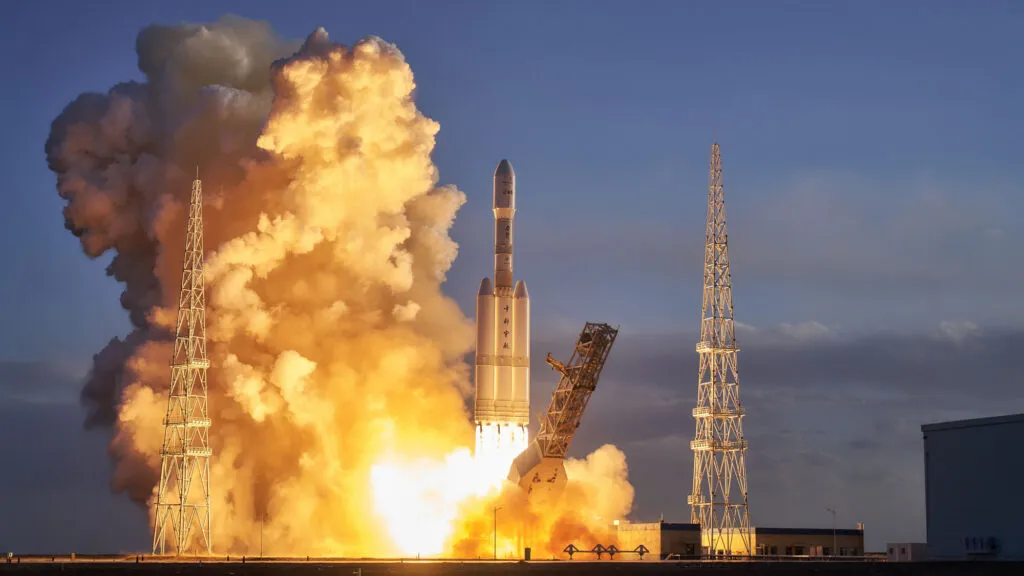
While pop culture loves to pitch warp drives and weekend trips to neighboring solar systems, actual astrophysics draws a hard boundary. The laws of physics dictate that humanity's future in space isn't limited by our imagination, but by hard equations governing speed, energy, and mass. If we want to build a lasting presence beyond Earth, we have to look past the fiction and deal with the physical reality.
The core constraint boils down to the tyranny of distance and the cosmic speed limit. Einstein's theory of relativity establishes that light speed is an absolute ceiling for objects with mass. As you push a spacecraft faster, its relativistic mass increases, demanding exponential energy for every extra meter per second. You can't just slap a bigger engine on a rocket and expect to visit the stars. Physics pushes back hard, and ignoring these rules guarantees failure.
The Brutal Math of Rocket Propulsion
The Tsiolkovsky Equation
Every rocket launch starts with a severe penalty known as the Tsiolkovsky rocket equation. It proves that a rocket's final speed depends directly on its exhaust velocity and the ratio of its initial mass to its final dry mass.
To carry more fuel, you need a larger tank. But a larger tank adds structural weight, which burns more fuel during liftoff. This vicious cycle creates exponential scaling problems.
- Chemical rockets max out around 4.5 kilometers per second in exhaust velocity.
- Escaping Earth's gravity well demands an orbital speed of about 7.9 kilometers per second, and leaving Earth entirely requires roughly 11.2 kilometers per second.
- Traveling to Mars with chemical thrusters requires months of coasting in free-fall, while reaching Alpha Centauri with the same tech would take tens of thousands of years.
Energy Density Limits
You can't cheat the First and Second Laws of Thermodynamics. Energy must be carried along, and every conversion leaks heat and wastes potential. Chemical propellants simply lack the energy density required for deep space missions.
Nuclear thermal propulsion offers a major upgrade by using a fission reactor to superheat liquid hydrogen, doubling the efficiency of chemical systems. Yet, building reliable, flight-ready reactors introduces extreme engineering and political hurdles. Fusion power remains the holy grail, promising massive energy yields, but sustained net-energy fusion in a compact spaceflight format remains out of reach.
Navigating Cosmic Distances and Time
The Light-Year Barrier
When we talk about deep space, distances are measured in years of travel at maximum possible speeds. Alpha Centauri sits 4.37 light-years away. Even if we built a spacecraft capable of cruising at 10% the speed of light—a monumental engineering feat—the journey would still take over four decades.
Human biology doesn't mix well with decades of cosmic isolation. Crews face severe psychological strain, closed-loop life support failures, and continuous degradation from space radiation.
Radiation and Material Stress
Deep space isn't empty; it's a harsh storm of galactic cosmic rays and solar particle events. Earth's magnetic field shields us, but interplanetary craft are exposed nakedly to ionizing radiation that damages DNA and central nervous systems.
- Adding thick lead or water shielding protects the crew, but it increases the craft's mass.
- Increased mass ruins fuel efficiency, dragging us right back into the traps of the rocket equation.
- Materials science must evolve to create ultra-lightweight, radiation-absorbent composites before crewed long-haul missions become practical.
Gravity Wells and Celestial Mechanics
Moving through our solar system requires playing a precise game of orbital chess. Planets sit at the bottom of deep gravitational wells. Climbing out of them takes immense energy, which is why mission planners rely on gravity assists.
By swinging a probe past Jupiter or Venus, engineers steal a fraction of a planet's orbital momentum to accelerate the spacecraft. This approach allows probes like Voyager to reach outer space without carrying impossible amounts of fuel.
However, gravity assists lock missions into rigid timelines. You can't just punch the gas and course-correct on a whim. A single miscalculation means decades of lost time or a missed rendezvous.
Speculative Physics: Fact vs. Fiction
Writers often invoke theoretical loopholes to bypass these constraints, but real physics keeps slamming the door.
Warp Drives and Exotic Matter
The Alcubierre drive concept suggests warping spacetime—contracting space in front of a ship and expanding it behind—to ride a bubble faster than light. While it fits within General Relativity math, it requires "exotic matter" with negative energy density. We've never observed this substance, and it likely violates quantum energy conditions.
Wormholes
Hypothetical tunnels through spacetime could theoretically connect distant quadrants of the universe instantly. Much like warp bubbles, stabilizing a wormhole long enough for a human ship to pass through demands forms of matter and energy that exist only on paper. They make great plot points, but they aren't transport options for our near future.
Frequently Asked Questions
Can we ever travel faster than light?
Current physics says no. Unless we discover entirely new dimensions of fundamental physics that overturn relativity, light speed remains the absolute speed limit for mass in our universe.
Why can't we use solar sails for interstellar travel?
Solar sails rely on photons from the sun pushing against a massive, ultra-thin reflective sheet. While practical for inner solar system probes, sunlight drops off rapidly with distance, making solar sails ineffective for pushing a ship past our outer planets without powerful external lasers driving them.
How long does it actually take to reach Mars?
Depending on planetary alignments and propulsion tech, a one-way trip to Mars currently takes between six and nine months.
Are nuclear rockets safe for space travel?
Nuclear thermal propulsion systems are designed to activate only once the spacecraft reaches a safe, high orbit, minimizing contamination risks during launch. They offer double the efficiency of chemical rockets, making them the most viable near-term step for deep space expansion.