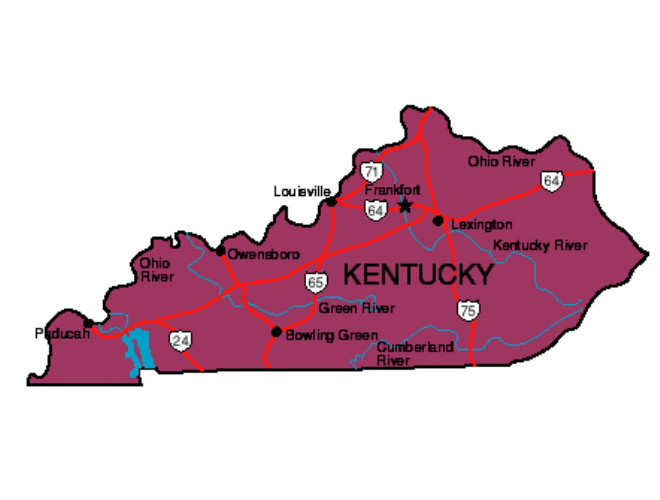
Navigating time changes across state lines can trip up even seasoned travelers, but few states split time zones quite as dramatically as the Commonwealth of Kentucky. If you're planning a road trip through Louisville, catching a flight out of Lexington, or scheduling a call with clients in Bowling Green, you need to know that Kentucky doesn't run on a single schedule.
Roughly sixty percent of the state sits in the Eastern Time Zone, while the remaining forty percent observes Central Time. This split divides major economic hubs, cuts across regional highways, and splits counties in ways that require a careful look at a map. Understanding how this division works prevents missed appointments, confused arrivals, and scheduling errors.
The Two Zones of Kentucky
Kentucky splits cleanly into two distinct time zones governed by federal regulations. Each region shifts between standard time and daylight saving time simultaneously, but the base offset from Coordinated Universal Time remains different year-round.
Eastern Time Zone
The eastern portion of the state operates on Eastern Standard Time (EST, UTC-5) during the winter months and Eastern Daylight Time (EDT, UTC-4) from March through November. This zone covers about sixty percent of the state's geographic area and includes major population centers like Louisville, Lexington, Frankfort, Covington, and Ashland. If you're visiting the horse farms around central Kentucky or touring the state capital, your clocks match New York and Atlanta.
Central Time Zone
The western forty percent of Kentucky runs on Central Standard Time (CST, UTC-6) in the winter and Central Daylight Time (CDT, UTC-5) in the summer. Key cities in this zone include Bowling Green, Owensboro, Hopkinsville, Paducah, and Murray. Travelers crossing from Nashville, Tennessee into southern Kentucky won't experience any time shift at the border, as both regions share the Central zone.
The Geographic Boundary Line
The demarcation line separating Kentucky's two time zones runs diagonally from the southeastern corner toward the north-central region, slicing the state roughly in half before curving westward toward the Ohio River.
Unlike straight latitudinal or longitudinal borders found out west, Kentucky's boundary follows a jagged path defined by county lines. The Kentucky Department of Geographic Information maintains detailed mapping data showing how the boundary cuts through the state's interior. Counties located to the north and east of this boundary observe Eastern time, while those to the south and west operate on Central time.
Historically, this line has shifted. For instance, Louisville switched from Central to Eastern time in 1961, and Wayne County moved to Eastern time in 2000. These adjustments happened because local commercial ties shifted toward eastern hubs like Cincinnati and Lexington, prompting county leaders to petition the federal government for changes.
Counties Split by the Boundary
A common source of confusion involves counties where the time zone boundary passes right through local communities. While most of Kentucky's 120 counties fall entirely into one zone or the other, a few unique areas experience boundary quirks.
When traveling near the diagonal seam, cellular phones can sometimes jump back and forth between cell towers operating on different network time zones. If you live or work near the dividing line, keeping an eye on your car's dashboard clock or setting manual alarms for appointments across county lines is a smart precaution.
According to official federal oversight managed by the U.S. Department of Transportation, changing a county's designated time zone requires a formal petition process proving that the local economy aligns more closely with the neighboring zone.
Practical Impact for Travel and Logistics
Driving across Kentucky on Interstate 64 or Interstate 24 forces you to cross the time zone boundary. If you drive west from Louisville toward Owensboro on local highways, you drop an hour once you cross the county threshold. Going the opposite direction from Bowling Green toward Lexington requires you to spring forward an hour.
- Business Scheduling: Always clarify whether a meeting time is referenced in Eastern or Central time, especially when dealing with statewide organizations or state government offices in Frankfort.
- Transit and Flights: Commercial airlines operating out of Louisville Muhammad Ali International Airport or Cincinnati/Northern Kentucky International Airport use Eastern time, while smaller regional fields in the west operate on Central time.
- Mobile Devices: Modern smartphones generally update automatically based on network tower pings, but remote rural pockets near the boundary can occasionally trigger incorrect time zone shifts.
For official details on legal time definitions and federal oversight guidelines, consult the National Institute of Standards and Technology, which maintains authoritative time standards across the United States.
Frequently Asked Questions
What major cities are in Kentucky's Eastern Time Zone?
Louisville, Lexington, Frankfort, Covington, Richmond, and Florence all observe Eastern time.
What major cities are in Kentucky's Central Time Zone?
Bowling Green, Owensboro, Hopkinsville, Paducah, and Madisonville operate on Central time.
Does Kentucky observe Daylight Saving Time?
Yes, the entire state of Kentucky observes daylight saving time, moving clocks forward in March and back in November in sync with federal schedules.
Why does Kentucky have two time zones?
The split reflects historical economic ties. Eastern Kentucky aligned naturally with eastern industrial centers and trade routes, while western Kentucky historically connected closer to commerce centered around Memphis and Nashville.



