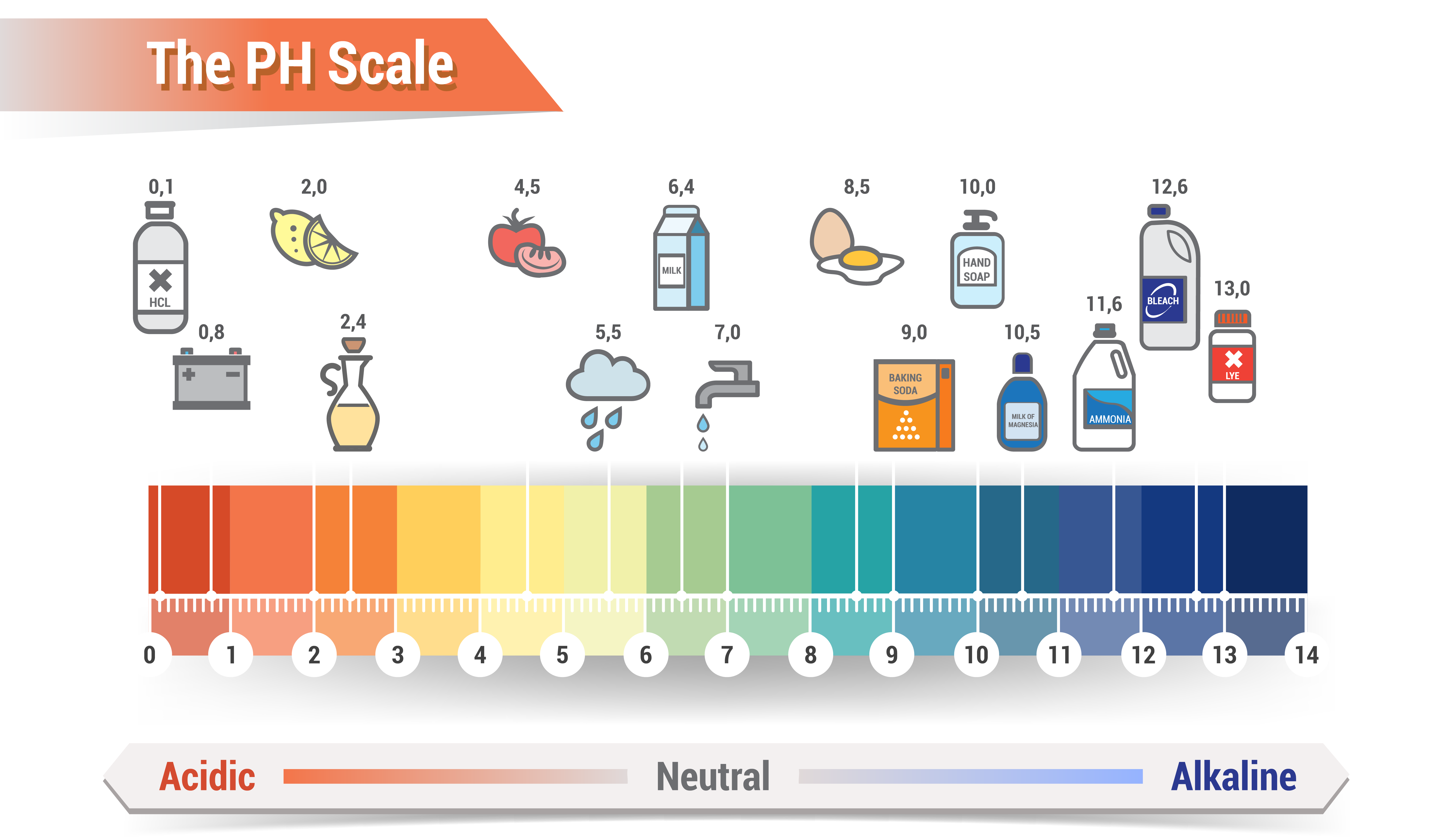
Acetic acid ($CH_3COOH$) sits at the center of many acid-base chemistry problems because it's a weak acid that doesn't dissociate completely in water. Its acid dissociation constant, or $K_a$ value, equals $1.8 \times 10^{-5}$ at room temperature. This specific number dictates how the molecule behaves in solution, how it establishes chemical equilibrium, and how chemists calculate the resulting pH of buffers and household mixtures like vinegar.
If you're trying to figure out why weak acids don't drop pH as aggressively as strong hydrochloric acid, or if you need to calculate the exact hydrogen ion concentration of a dilute solution, you have to look beyond simple concentration numbers and examine the equilibrium expression.
What Is the Ka Value of Acetic Acid?
When you mix acetic acid into water, molecules don't break apart all at once. Instead, a dynamic chemical equilibrium forms where intact molecules constantly trade places with dissociated ions. The reaction looks like this:
$$CH_3COOH_{(aq)} + H_2O_{(l)} \rightleftharpoons CH_3COO^-{(aq)} + H_3O^+{(aq)}$$
Because this reaction reaches a stable balance rather than running to completion, chemists use an equilibrium constant tailored for acids, known as $K_a$. The formula relies on the concentrations of the products divided by the concentration of the unreacted reactant at equilibrium:
$$K_a = \frac{[CH_3COO^-][H^+]}{[CH_3COOH]}$$
For acetic acid, that constant is $1.8 \times 10^{-5}$ (or $\text{p}K_a = 4.76$). Because this number is much smaller than 1, it tells us immediately that the equilibrium position favors the left side. Most molecules stay intact as neutral $CH_3COOH$ rather than splitting into acetate ($CH_3COO^-$) and hydrogen ions ($H^+$).
Step-by-Step pH Calculation Using Ka
Knowing the $K_a$ value allows you to calculate the exact pH of an acetic acid solution of any given molarity. Let's walk through a standard calculation for a $0.10\text{ M}$ solution of acetic acid.
Step 1: Set up an ICE table. Set up Initial, Change, and Equilibrium rows for your components.
- Initial: $[CH_3COOH] = 0.10\text{ M}$, $[CH_3COO^-] = 0\text{ M}$, $[H^+] = 0\text{ M}$ (ignoring autoionization of water).
- Change: $[CH_3COOH]$ changes by $-x$, while $[CH_3COO^-]$ and $[H^+]$ change by $+x$.
- Equilibrium: $[CH_3COOH] = 0.10 - x$, $[CH_3COO^-] = x$, $[H^+] = x$.
Step 2: Substitute into the $K_a$ expression. $$1.8 \times 10^{-5} = \frac{(x)(x)}{0.10 - x}$$
👉 See also: Acids as Proton Donors:Step 3: Simplify the math. Because $K_a$ is very small, $x$ will be tiny compared to $0.10$. We can safely assume that $0.10 - x \approx 0.10$. $$1.8 \times 10^{-5} = \frac{x^2}{0.10}$$ $$x^2 = 1.8 \times 10^{-6}$$ $$x = \sqrt{1.8 \times 10^{-6}} = 1.34 \times 10^{-3}\text{ M}$$
Step 4: Convert to pH. Since $x$ equals our hydrogen ion concentration $[H^+]$, take the negative logarithm: $$\text{pH} = -\log(1.34 \times 10^{-3}) = 2.87$$
A $0.1\text{ M}$ solution of acetic acid sits at roughly pH 2.87, which is notably less acidic than a strong acid like $0.1\text{ M}$ HCl, which sits near pH 1.0 because of complete dissociation.
Factors That Influence Acid Dissociation
Students often assume a $K_a$ value changes whenever concentration changes. It doesn't. The acid dissociation constant is temperature-dependent, meaning it remains constant unless thermal energy in the system changes.
- Temperature shifts: Endothermic or exothermic dissociation means heating a solution can alter the position of equilibrium slightly, changing the measured $K_a$.
- Common-ion effect: Adding a salt containing acetate, such as sodium acetate ($CH_3COONa$), floods the solution with $C_2H_3O_2^-$ ions. Le Chatelier's principle forces the equilibrium backward, consuming free hydrogen ions and raising the pH. This principle forms the foundation of acetate buffer solutions described by the IUPAC Gold Book on acidity constants.
- Ionic strength: In very concentrated solutions, electrostatic interactions between ions reduce their effective concentrations, altering the apparent dissociation behavior.
Common Mistakes in Weak Acid Problems
When solving problems involving acetic acid, a few recurring errors trip up students and laboratory technicians alike.
- Forgetting the approximation check: Always verify your assumption after solving for $x$. If $x$ is more than 5% of your initial concentration, you cannot drop the $-x$ term and must use the quadratic formula.
- Confusing $K_a$ with percent ionization: Remember that $K_a$ is an equilibrium constant, whereas percent ionization tells you what fraction of the acid molecules actually dissociated. Percent ionization changes depending on how dilute the starting solution is.
- Neglecting units in buffer calculations: When dealing with mixtures of acetic acid and acetate, always convert volumes to moles before plugging values into the Henderson-Hasselbalch equation.
Frequently Asked Questions
Why is acetic acid considered a weak acid if it can sting or burn skin?
Concentrated acetic acid (glacial acetic acid) causes severe chemical burns because it is corrosive and dehydrating, not because it completely ionizes. Acid strength refers strictly to proton-donation capability in water, whereas corrosiveness depends on concentration and chemical reactivity with tissue.
How does the pKa relate to the Ka value?
The $\text{p}K_a$ is simply the negative logarithm of the $K_a$ value ($\text{p}K_a = -\log K_a$). Chemists use $\text{p}K_a$ because it transforms unwieldy exponents like $1.8 \times 10^{-5}$ into manageable numbers like 4.76, making comparisons across different chemical species much easier.
Can acetic acid act as a buffer on its own?
Acetic acid cannot buffer a solution by itself. To create an effective buffer system, you need a mixture of the weak acid and its conjugate base—such as combining acetic acid with sodium acetate in comparable molar amounts—which neutralizes both added strong acids and added strong bases.
What happens to the pH of an acetic acid solution when it's diluted?
When you dilute an acetic acid solution with pure water, the pH increases (the solution becomes less acidic), but the percent ionization increases. More molecules break apart to compensate for the added volume, even though the total concentration of hydrogen ions per unit volume goes down.


